
You have about four hours a week. Possibly three.
Nobody chooses between cardio vs strength training in the abstract. The real question is how to divide a fixed, fairly small amount of time between two things that both work — and most articles answer a question you aren’t asking.
This one is built around the hours you actually have.
Quick Fact: A study following more than 416,000 adults found that people who combined cardio and strength training had a lower mortality risk than those doing cardio alone.
Last reviewed: October 2026
What Each One Actually Does
Cardio
| Primary adaptation | Heart, lungs, oxygen delivery |
| Burns during session | High |
| Builds muscle | Minimal |
| Bone density | Limited effect |
| Key health marker it moves | Cardiorespiratory fitness (VO2 max) |
| Time to notice change | 2–4 weeks |
| Equipment needed | None |
Strength Training
| Primary adaptation | Muscle, tendon, bone, neural control |
| Burns during session | Moderate |
| Builds muscle | Yes — this is the only thing that does |
| Bone density | Strong effect |
| Key health marker it moves | Muscle mass and strength |
| Time to notice change | 4–6 weeks for strength, 8–12 for size |
| Equipment needed | Minimal to none |
Both of those “key health markers” independently predict mortality. VO2 max and grip strength are two of the most robust predictors in the literature — which is the real reason the honest answer involves both.
Muscle burns roughly 6 calories per pound per day at rest. The
commonly quoted figure is 30 to 50.
The Two Claims That Get Overstated
This section exists because almost every article on this topic repeats two things that are true in direction and badly wrong in magnitude.
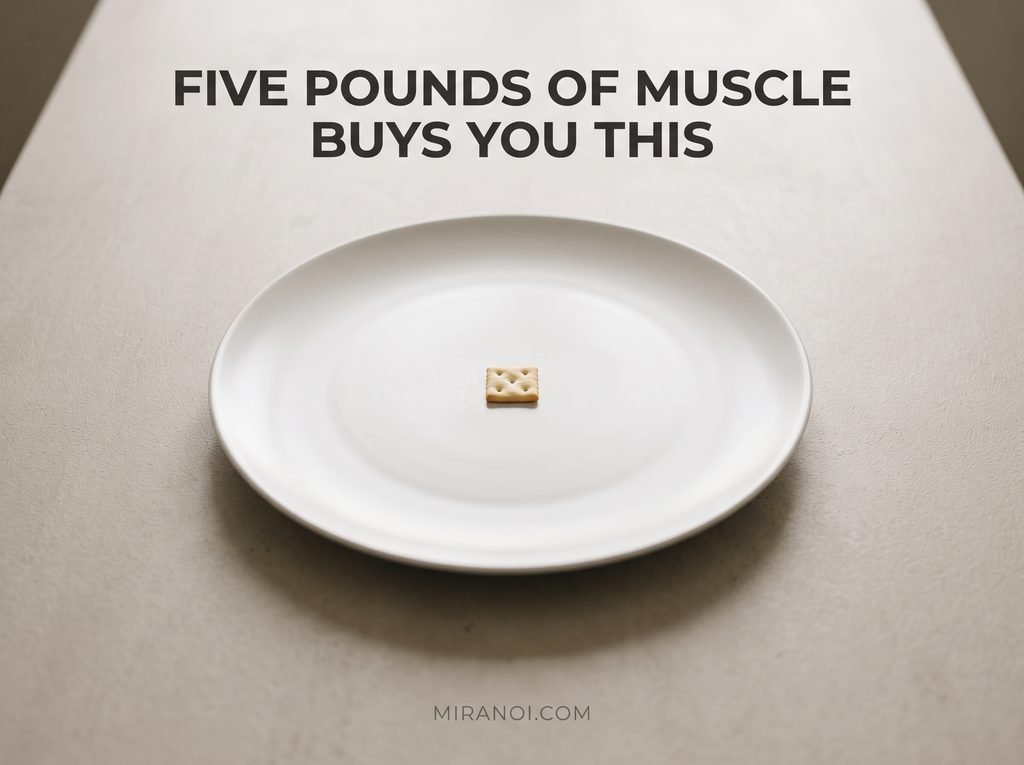
“Muscle burns a lot of calories at rest.” The commonly quoted figure is 30 to 50 calories per pound per day. The research figure is roughly 6 calories per pound — about 13 per kilogram — at rest. Adding five pounds of muscle, which is a good year’s work for a beginner, raises resting burn by around 30 calories a day. Counting the extra energy of moving a heavier body, the realistic total lands near 9 to 10 calories per pound.
That is not nothing, and it is not a weight-loss strategy. It’s a cracker.
“Strength training’s afterburn keeps you burning for 24 to 48 hours.” EPOC — the elevated metabolism after exercise — is real, and typically amounts to 6 to 15% of the session’s energy cost. A session burning 600 calories might add roughly 45 afterwards. The studies reporting large, long-lasting afterburn generally used training volumes far beyond what anyone does in practice, and the single most-cited large result has never been replicated.
What the Numbers Actually Are
| Claim you’ll see | What research supports |
|---|---|
| Muscle burns 30–50 cal/lb/day at rest | About 6 cal/lb/day at rest |
| 5 lb of new muscle transforms your metabolism | About 30 extra calories a day |
| Afterburn lasts 24–48 hours and burns hundreds | Typically 6–15% of the session’s calories |
| Strength training beats cardio for fat loss via metabolism | Session calories dominate; metabolism effects are small |
Why this matters for your decision. If you were choosing strength training over cardio because of the metabolic argument, that argument is much weaker than advertised. The real case for strength training is muscle, bone, strength and function — all of which are excellent reasons. It just isn’t a calorie-burning shortcut.
Goal by Goal
| Your goal | Lean toward | Why |
|---|---|---|
| Fat loss, scale moving | Cardio, with 2 strength sessions | Cardio creates the deficit; lifting protects muscle inside it |
| Fat loss, keeping shape | Strength, with 2–3 cardio sessions | Preserving muscle changes what the loss looks like |
| Building muscle | Strength, 3–4 sessions | Nothing else builds it |
| Endurance or event training | Cardio, with 2 strength sessions | Lifting reduces injury and supports economy |
| Blood sugar and insulin sensitivity | Both, roughly equally | Combined training outperforms either alone |
| Bone density | Strength, loaded and progressive | Impact and loading drive bone adaptation |
| Blood pressure and heart health | Cardio primary, strength supporting | Most direct cardiovascular stimulus |
| Longevity, no specific goal | Genuine mix | Both markers predict mortality independently |
Does Doing Both Blunt Either One?
This is the question people with limited time actually need answered, and it rarely gets addressed.
Doing a lot of hard endurance work can modestly interfere with strength and muscle gains — the effect is well documented in athletes training at high volumes, and appears larger with running than with cycling, and larger when the two sessions are close together.
For almost everyone reading this, it is not a practical concern. Interference becomes meaningful at endurance volumes far above 150 minutes a week. At ordinary amounts, the two support each other more than they compete.
Two simple precautions make it a non-issue: separate the two by several hours when you can, and if strength is your priority, don’t do long hard cardio on your lifting days’ legs.

If You Only Have a Few Hours
Weekly Allocation by Time Available
| Hours per week | Suggested split | Notes |
|---|---|---|
| 2 hours | 2 × 45 min full-body strength + 30 min brisk walking | Strength has the higher floor when time is scarce |
| 3 hours | 2 × 45 min strength + 90 min cardio | The most common realistic budget |
| 4 hours | 3 × 45 min strength + 105 min cardio | Enough for genuine progress in both |
| 5+ hours | 3–4 strength + 150 min cardio | Meets general activity guidelines comfortably |
Why strength gets priority at two hours: cardiovascular fitness responds to incidental activity — walking, stairs, carrying things — in a way that muscle does not. If your week collapses, walking still happens by accident. Lifting never does.
The general public health targets — roughly 150 minutes of moderate cardio plus two strength sessions weekly — are covered in our guide to how much exercise you actually need.
Order Within a Session
If you’re doing both on the same day, order has a modest but consistent effect.
Strength first if strength or muscle is the priority. Lifting under fatigue reduces the quality of the work that matters most.
Cardio first only if you’re training for an endurance event where the cardio session is the point.
Either order if you’re doing moderate amounts of both for general health — the difference at that level is small enough not to organize your life around.
For the cardio portion itself, most of it should be comfortable enough to hold a conversation — our guide to zone 2 training covers why.

What People Actually Run Into
The most common pattern is doing only the one you’re already good at. People who find running tolerable run; people who like lifting lift. The thing you avoid is usually the thing with the most headroom left, and the gap tends to widen over years rather than close.
The second is abandoning strength training during a fat-loss phase, on the reasoning that cardio burns more. This is the choice most likely to be regretted — losing weight without resistance training means a meaningful share of what’s lost is muscle, and the shape people were hoping for depends on what stays.
Third, and the quietest: people treat the two as a permanent identity rather than a current allocation. Your split should change when your goal changes, and most people’s goals change every year or two while their training doesn’t.
Common Mistakes
Choosing strength training for the metabolism argument. It’s a weak argument. Choose it for muscle, bone, and strength — those are real.
Dropping lifting while dieting. This is when it matters most.
Doing both badly rather than one well. Two serious strength sessions beat four half-sessions plus three rushed jogs.
Treating a hard lifting session as cardio. Heart rate rising isn’t the same stimulus as sustained aerobic work.
Worrying about interference at ordinary volumes. It’s a real effect at athlete volumes and largely irrelevant below them.
Never changing the split. The right allocation follows your current goal, not your training history.
Judging cardio only by calories burned. Its best-supported benefit is cardiorespiratory fitness, which predicts mortality more strongly than almost any other modifiable marker.
Practical Tips
Decide your split by the hours you genuinely have, not the hours you intend to have. Three realistic hours beats six aspirational ones.
Protect the strength sessions first when a week falls apart — incidental walking partly covers cardio, nothing covers lifting.
Separate hard cardio and hard lifting by several hours where you can.
Put strength first in a combined session unless you’re training for an endurance event.
Re-examine your split every few months against your current goal.
If fat loss is the goal, keep lifting and let the deficit come mostly from food and cardio — our guide to how much protein you need covers the other half of protecting muscle.
If you’re new to the lifting side, our guide to strength training for beginners gives you the first session.
When Should You See a Doctor?
Check with a doctor before starting if you have a heart condition, uncontrolled high blood pressure, a history of chest pain or dizziness on exertion, or have been inactive for an extended period.
Stop and seek evaluation for chest pain or pressure, unusual breathlessness, or dizziness during either type of exercise.
See a doctor for joint pain that persists beyond a few days, or pain that is sharp, localised, or one-sided.
Discuss your plan with a provider if you have diabetes, since exercise affects blood sugar in ways that differ by type and intensity.
Frequently Asked Questions
Is cardio or strength training better for weight loss? Cardio burns more calories per session, so it creates a deficit more directly. But strength training protects muscle while you lose, which determines what the result looks like. Combined consistently outperforms either alone.
Does muscle really boost your metabolism? Far less than commonly claimed. Muscle burns roughly 6 calories per pound per day at rest, so five pounds of new muscle adds around 30 calories daily. Real, but not a weight-loss mechanism.
Is the afterburn effect significant? It’s real but modest — typically 6 to 15% of the session’s energy cost. A 600-calorie session might add about 45 calories afterwards.
Should I do cardio and strength training on the same day? It’s fine. Do strength first if strength is the priority, since lifting under fatigue reduces the quality of the work. Separating them by several hours is better still when possible.
How much of each should I do per week? A common target is roughly 150 minutes of moderate cardio plus two to three strength sessions. With less time available, prioritise strength — incidental daily activity partly covers cardio, and nothing covers lifting.
The Bottom Line
If you want an actual answer rather than “it depends,” here it is.
Two strength sessions a week, 45 minutes each, non-negotiable. Then as much easy cardio as your schedule allows, up to about 150 minutes, most of it comfortable enough to talk through.
That’s roughly three and a half hours. If you only have two, keep both strength sessions and walk more. If you have six, add a third strength session before adding more cardio.
Adjust from there when your goal changes — but start from that, not from the debate.
This article is for general informational purposes and is not a substitute for personalized medical or fitness advice. Consult a healthcare provider before starting a new exercise program, especially with an existing health condition.