
Zone 2 became fitness’s favorite idea somewhere around 2022. Podcasts described it as the intensity that builds mitochondria, burns fat, and underpins longevity. The advice was often absolute: do most of your cardio here.
Then in July 2025, a narrative review in Sports Medicine — led by researchers at Queen’s University and McMaster, including Martin Gibala — did something unusual. It challenged the entire premise.
Their conclusion was direct: current evidence does not support Zone 2 as the optimal intensity for improving mitochondrial capacity, and prioritizing intensities above Zone 2 appears critical for maximizing cardiometabolic benefit.
That’s a substantial disagreement with what most people have been told. Here’s the honest version.
Quick Fact: A meta-analysis of 56 studies found that exercise performed below 60% of maximum work rate is not expected to increase mitochondrial density — which sits at or below the lower boundary of what most people train as Zone 2.
Last reviewed: September 2026
What Zone 2 Actually Is
Zone 2 is low-intensity aerobic exercise performed below the first lactate threshold — the point where lactate begins accumulating faster than your body clears it.
Practically, it’s roughly 60-70% of maximum heart rate. The defining feature is conversational: your breathing is elevated, but you can speak in full sentences without gasping.
At this intensity, energy comes predominantly from fat oxidation rather than glycogen, which is why sessions can be sustained for long periods without depleting fuel stores.
Where the idea came from. German physician Ernst van Aaken developed the original low-intensity, high-volume concept in the mid-20th century, calling it “Long Steady Distance.” Physiologist Dr. Iñigo San Millán expanded on it in the 1990s, identifying Zone 2 as the intensity he considered most effective for mitochondrial function. That framing is what eventually reached mainstream audiences.
The Case For It
The supporting arguments are real and worth stating fairly.
Low fatigue cost. This is Zone 2’s genuine advantage. It’s intense enough to activate AMPK and PGC-1α signaling — the pathways driving mitochondrial adaptation — while remaining low enough to avoid significant glycogen depletion, nervous system fatigue, or extended recovery.
Sustainable volume. Because it costs little to recover from, you can accumulate far more of it. HIIT sessions must be limited in frequency; Zone 2 can be repeated almost daily.
Autonomic adaptations. Consistent low-intensity work is associated with lower resting heart rate, improved heart rate variability, and better sleep — adaptations that support long-term training capacity.
Fat oxidation in untrained people. The 2025 review theorized Zone 2 likely improves fat oxidative capacity in sedentary and untrained populations specifically, while the effect in already-trained individuals appears limited.
Quick Reference: What Zone 2 Does and Doesn’t Do
| Claim | Evidence Status |
|---|---|
| Builds mitochondria efficiently per unit of fatigue | Supported |
| Is the optimal intensity for mitochondria | Not supported (2025 review) |
| Improves fat oxidation in untrained people | Likely supported |
| Improves fat oxidation in trained athletes | Limited effect |
| Increases capillary density | One study found it does not |
| Maximizes VO2 max improvement | Higher intensities appear superior |
| Low recovery cost, high repeatability | Strongly supported |
The Case Against the Hype
The 2025 review’s central objection is about the origin of the recommendation.
Zone 2 advice for the general public derived largely from observational data on elite endurance athletes — people who perform enormous volumes of low-intensity work and also possess high mitochondrial capacity. The inference was that the training caused the capacity.
But elite athletes also train at high intensities, have years of accumulated adaptation, and are genetically unrepresentative. Extracting “do Zone 2” from that population and applying it to a recreational exerciser training four hours a week is a substantial leap.
Two specific findings complicate the picture further:
- A meta-analysis of 56 studies found exercise below 60% of maximum work rate isn’t expected to increase mitochondrial density
- A study by Liu and colleagues found low-intensity endurance training does not increase capillary density
Multiple analyses conclude that higher intensities elicit greater mitochondrial capacity and aerobic conditioning than low-intensity work.
The Reasonable Synthesis
Neither extreme survives contact with the evidence.
Zone 2 isn’t useless. It’s efficient — it produces meaningful adaptation per unit of fatigue, and it’s the only intensity you can accumulate large volumes of without breaking down.
Zone 2 also isn’t optimal in isolation. Structural and molecular adaptations that higher intensities trigger aren’t fully activated by low-intensity work alone.
As one analysis of the 2025 review framed it: Zone 2 is efficient, not necessarily maximal. It’s one component of a varied program, not the only intensity worth training.
The practical version: build a base of Zone 2 for volume and recovery, and include one to two higher-intensity sessions weekly for the adaptations Zone 2 can’t fully drive. This is close to what most endurance coaches have recommended for decades — the polarized model — and the recent research reinforces rather than overturns it.
Finding Your Zone 2
The formula method. Subtract your age from 220 for estimated maximum heart rate, then take 60-70%. A 35-year-old lands around 111-130 bpm.
Why formulas are unreliable. A 2025 study in Translational Sports Medicine tested 50 experienced cyclists and found standardized heart rate percentages produced wide individual differences in actual metabolic response. Two people at the same percentage of estimated max can be at genuinely different physiological intensities.
The talk test. More practical and often more accurate: you should be able to hold a conversation in full sentences. If you’re breaking sentences to breathe, you’ve drifted above Zone 2. If you can sing comfortably, you’re below it.
Nasal breathing. Some people use the ability to breathe through the nose comfortably as a rough ceiling marker.
Quick Reference: Intensity Zones Simplified
| Zone | Feel | Talk Test | Primary Use |
|---|---|---|---|
| Zone 1 | Very easy | Can sing | Recovery |
| Zone 2 | Easy-moderate | Full sentences | Aerobic base, volume |
| Zone 3 | Moderate-hard | Short sentences | “Grey zone” — often overused |
| Zone 4-5 | Hard to maximal | Few words | VO2 max, mitochondrial adaptation |
What People Actually Run Into
The most common problem is drifting out of Zone 2 without noticing.
The intensity feels almost too easy at first, and there’s a strong pull to push harder — particularly on hills, or when training with others. The result is Zone 3: too hard to accumulate volume, too easy to drive high-intensity adaptations. It’s the least productive place to spend most of your training time, and it’s where a lot of recreational cardio actually lands.
The second frustration is how slow it feels. People accustomed to moderate-intensity workouts often find their Zone 2 pace embarrassingly slow, especially early on. Walking uphill instead of jogging is a common adjustment, and it’s correct rather than a concession.
Third: many people do only Zone 2 after hearing the podcast version, then plateau. This is precisely the gap the 2025 review addresses — the adaptations driving VO2 max improvement require intensities Zone 2 doesn’t reach. Adding one hard session weekly usually resolves the stall.
Common Mistakes
Training in Zone 3 while believing it’s Zone 2. The most common error. If you can’t speak in full sentences, you’ve drifted up.
Relying solely on the 220-minus-age formula. Research found wide individual variation in metabolic response at standardized heart rate percentages.
Doing only Zone 2. Higher intensities drive adaptations low-intensity work doesn’t fully trigger. A base without a ceiling stalls.
Assuming elite athlete protocols transfer. The recommendation originated in observational data from athletes training 20+ hours weekly. That context doesn’t map onto four hours a week.
Expecting fast results. Zone 2 adaptations accumulate over months. It’s the slowest-feeling and slowest-showing form of productive training.
Treating it as optional if you do HIIT. Zone 2 provides the volume and recovery base that makes hard sessions sustainable. Neither replaces the other.
Practical Tips
- Use the talk test as your primary gauge and heart rate as a secondary check — the formula is a starting estimate, not a target.
- Accept a slower pace than feels natural; walking uphill instead of running is normal and correct.
- Aim for sessions of at least 30-45 minutes, since Zone 2’s benefit comes from accumulated volume rather than intensity.
- Add one to two higher-intensity sessions weekly rather than training exclusively in Zone 2.
- If you consistently finish Zone 2 sessions feeling tired, you were probably in Zone 3.
- Track pace at a fixed heart rate over months — going faster at the same heart rate is the clearest sign the base is building.
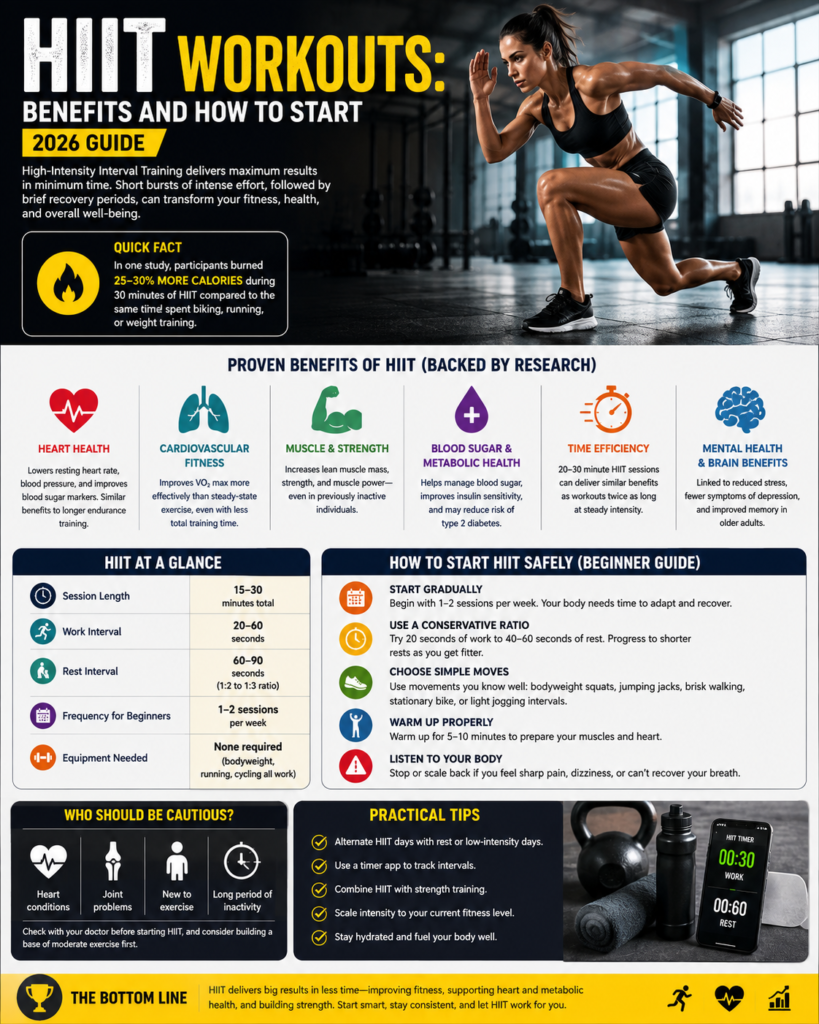
If you’re building a complete routine, it’s worth pairing this with our guides on VO2 max and HIIT workouts, since the higher-intensity work Zone 2 doesn’t cover is exactly what those address.
When Should You See a Doctor?
Check with a doctor before starting structured cardiovascular training if you have known heart disease, uncontrolled high blood pressure, or have been sedentary for an extended period — particularly before adding the higher-intensity sessions discussed here.
Also seek evaluation for chest discomfort, unusual breathlessness at easy intensities, dizziness during exercise, or a resting heart rate that has changed noticeably without explanation.
Frequently Asked Questions
What heart rate is Zone 2? Roughly 60-70% of maximum heart rate, though research found standardized percentages produce wide individual variation in actual metabolic response. The talk test — speaking in full sentences — is often more reliable.
Is Zone 2 the best intensity for building mitochondria? Current evidence suggests not. A 2025 narrative review in Sports Medicine concluded that Zone 2 is not the optimal intensity for mitochondrial capacity, and that higher intensities appear more effective.
How long should Zone 2 sessions be? Generally 30-45 minutes minimum, since the benefit derives from accumulated volume. Longer sessions are common for endurance athletes.
Can I only do Zone 2 training? You can, but you’ll likely plateau. Adaptations driving VO2 max improvement require intensities above Zone 2 that low-intensity work doesn’t fully trigger.
Why does Zone 2 feel too easy? Because it’s supposed to. The difficulty is maintaining the discipline to stay there rather than drifting into Zone 3, which feels more productive but delivers less of either benefit.
The Bottom Line
Zone 2 is genuinely useful and genuinely oversold. The 2025 Sports Medicine review makes a fair case that the “optimal intensity” framing came from elite-athlete observation rather than evidence in general populations — and that higher intensities matter more for mitochondrial and cardiorespiratory adaptation than the podcast version suggested. Treat Zone 2 as the efficient base it is: the volume you can sustain, paired with the intensity that drives the ceiling. Not one or the other.
This article is for general informational purposes and is not a substitute for personalized medical or fitness advice. Consult a healthcare provider before beginning structured exercise training, especially with existing cardiovascular conditions.
References
- Sports Medicine — Much Ado About Zone 2: A Narrative Review Assessing the Efficacy of Zone 2 Training for Improving Mitochondrial Capacity and Cardiorespiratory Fitness in the General Population (2025)
- Translational Sports Medicine — Individual Variation in Metabolic Response to Standardized Heart Rate Percentages (2025)
- NIH (PubMed Central) — Exercise Intensity and Mitochondrial Adaptations Meta-Analysis