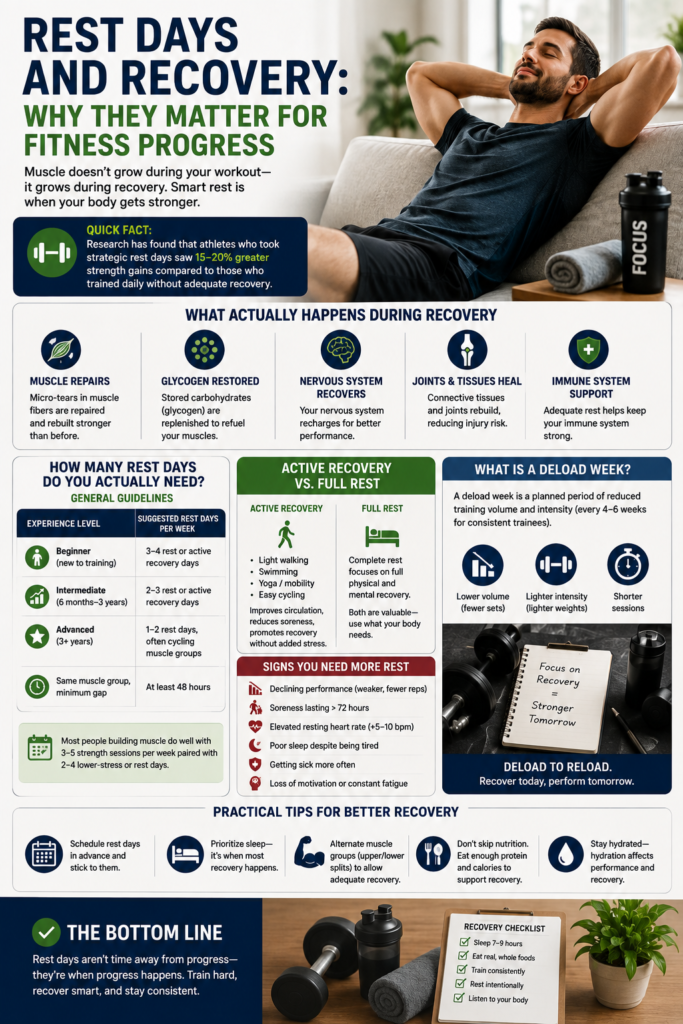
Rest days and recovery often feel like the opposite of progress — like time you’re not spending working toward your goals.. In reality, the research points the other way: muscle doesn’t grow during your workout, it grows during recovery, and skipping rest days often stalls progress rather than accelerating it.
Quick Fact: Research has found that athletes who took strategic rest days saw 15-20% greater strength gains compared to those who trained daily without adequate recovery periods.
What Actually Happens During Recovery
When you lift weights or do intense exercise, you create microscopic tears in your muscle fibers. This isn’t damage in a bad sense — it’s the trigger for growth. During rest, your body repairs these tears through a process called muscle protein synthesis, rebuilding the fibers back stronger and slightly larger. This repair process stays elevated for roughly 24-48 hours after a resistance training session before returning to baseline, which is part of why training the same muscle group again too soon can interrupt the process rather than accelerate it.
Rest days also let your body restore glycogen — the stored form of carbohydrate your muscles use for fuel — and give your nervous system, joints, and connective tissues time to recover from the cumulative stress of training.
How Many Rest Days Do You Actually Need?
The right amount varies by training experience, intensity, and individual recovery capacity, but general research-backed guidance converges on a few patterns:
Quick Reference: General Rest Day Guidelines
| Experience Level | Suggested Rest Days per Week |
|---|---|
| Beginner (new to training) | 3–4 rest or active recovery days |
| Intermediate (6 months–3 years) | 2–3 rest or active recovery days |
| Advanced (3+ years) | 1–2 rest days, often cycling muscle groups |
| Same muscle group, minimum gap | At least 48 hours |
Most people building muscle do well with 3-5 strength sessions per week paired with 2-4 lower-stress or rest days — the specific split depends on training volume, intensity, sleep, and how well you’re recovering overall.
Active Recovery vs. Full Rest
A rest day doesn’t have to mean total inactivity. Active recovery — light walking, swimming, gentle yoga, or mobility work — can improve circulation and reduce soreness without adding meaningful training stress. This can be a useful middle ground for people who find complete rest days difficult to stick to, while still giving muscles the recovery window they need.
Signs You Need More Rest
Overtraining doesn’t always announce itself clearly, but a few patterns are worth watching for:
- Declining performance — weights feel heavier, reps drop, or exercises that felt manageable recently now feel much harder
- Persistent soreness lasting more than 72 hours after a session
- Elevated resting heart rate — 5-10 beats above your normal baseline first thing in the morning
- Sleep disruption despite feeling physically exhausted
- Getting sick more often, since overtraining can suppress immune function
- Loss of motivation that feels different from normal day-to-day variation
If several of these show up together, it’s a signal to scale back — not push through — for a period of days to weeks depending on severity.
What Is a Deload Week?
A deload week is a planned period of reduced training volume and intensity, typically recommended every 4-6 weeks for people training hard and consistently. Rather than stopping training entirely, a deload might mean lighter weights, fewer sets, or shorter sessions — enough to let accumulated fatigue dissipate while staying in the habit of training.
Practical Tips
- Schedule rest days into your week in advance rather than deciding day-to-day, which makes them easier to actually stick to.
- Prioritize sleep on training-heavy weeks — one night of poor sleep can measurably reduce strength output in your next session.
- Alternate muscle groups (upper/lower splits) if you want to train frequently while still giving specific muscles adequate recovery time.
- Don’t confuse a rest day with a “free pass” to abandon good nutrition — recovery still depends on adequate protein and calories.
If you’re building a complete training routine, it’s worth pairing this with our guides on strength training for beginners and sleeping better naturally, since sleep quality is one of the most significant, and most overlooked, recovery factors.
Frequently Asked Questions
Will taking rest days make me lose progress? No — the opposite is generally true. Adequate rest supports the muscle repair process that training actually depends on, and research links appropriate rest to greater strength gains than training without sufficient recovery.
Is it okay to do cardio on a rest day from strength training? Yes, light to moderate cardio is a common form of active recovery and doesn’t interfere with muscle repair the way another intense strength session on the same muscles would.
How do I know if I’m overtraining versus just having a hard week? A single tough workout or busy week isn’t overtraining. Watch for a pattern — persistent decreased performance, ongoing sleep issues, and elevated resting heart rate together over more than a week or two are stronger signals.
Do rest days matter as much for cardio-focused training as strength training? Recovery matters for both, though the mechanisms differ slightly. Cardio-heavy training still stresses joints, the nervous system, and overall energy systems, and benefits from planned lower-intensity or rest days.
Don’t forget your warm-up and cool-down routine — our guide on static vs dynamic stretching covers when to use each type.
The Bottom Line
Rest days aren’t time away from progress — they’re the part of the process where progress actually happens. Matching your rest to your training intensity and experience level, paying attention to recovery signals, and treating sleep as seriously as your workouts will do more for long-term results than pushing through fatigue ever will.
This article is for general informational purposes and is not a substitute for personalized medical or fitness advice. Consult a healthcare provider or qualified trainer if you’re unsure how to structure recovery for your specific training program.
References
- Journal of Strength and Conditioning Research — Recovery and Strength Adaptation
- Sports Medicine — Muscle Protein Synthesis Research
- National Institutes of Health (NIH) — Exercise Recovery Research