Carbohydrate counting is the standard method for matching insulin to food. It works, it’s well-researched, and a 2025 meta-analysis found it reduced HbA1c by an average of 0.94% — a clinically meaningful change.
It’s also built on an assumption that isn’t entirely true: that only carbohydrates matter.
Understanding both halves — why the method works and where its logic breaks down — is what separates people who count accurately from people who count precisely and still get unexpected readings.
Quick Fact: A 2025 systematic review of seven studies covering 599 children and adolescents with type 1 diabetes found every carbohydrate counting method reduced HbA1c compared to controls, with reductions ranging from 0.73% to 1.35%.
Last reviewed: September 2026
The Core Logic
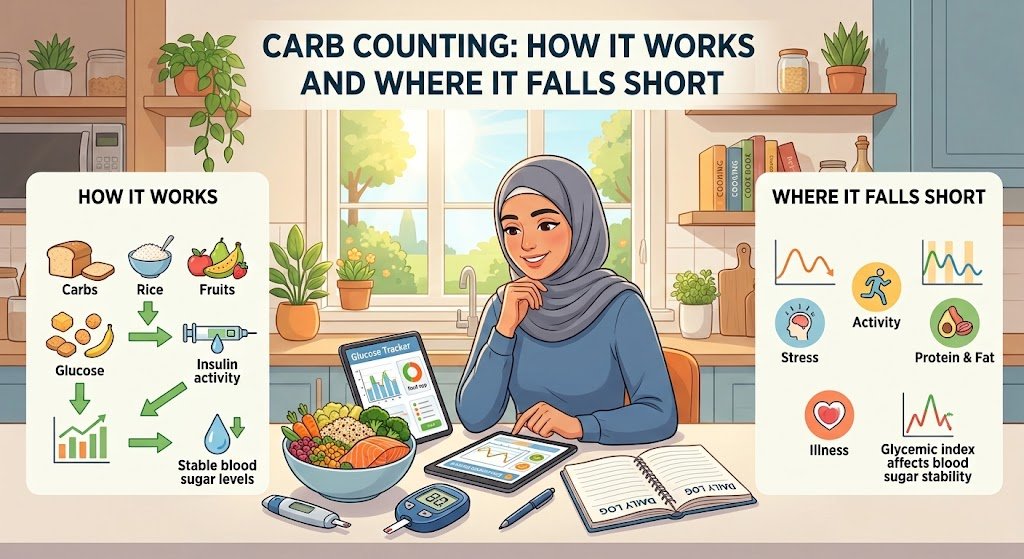
Carbohydrates raise blood glucose more, and faster, than protein or fat. Carb counting takes that fact and builds a system on it: measure the carbohydrate in a meal, apply your insulin-to-carbohydrate ratio, and dose accordingly.
The foundational rule is simple: 15 grams of carbohydrate equals one “carb serving.” Once you know how much of a food equals 15 grams, portions become quick to estimate rather than calculated each time.
Two things you need before starting, and both come from your provider:
- Insulin-to-carb ratio — how many grams of carbohydrate one unit of insulin covers
- Correction factor — how much one unit lowers your blood glucose
Neither is universal. Both are individual, and both can change over time.
Quick Reference: Common Carb Serving Sizes (~15g each)
| Food | One Serving |
|---|---|
| Bread | 1 slice |
| Cooked rice or pasta | ⅓ cup |
| Potato | ½ medium |
| Apple or orange | 1 small |
| Milk | 1 cup |
| Cooked beans | ½ cup |
| Cereal (unsweetened) | ¾ cup |
Basic vs. Advanced Counting
Basic carb counting works in servings — roughly 15g units — and pairs with a consistent meal pattern. It’s simpler and often sufficient for people on fixed insulin doses or managing type 2 diabetes with oral medication.
Advanced carb counting uses exact gram totals and a personal insulin-to-carb ratio to calculate each dose individually. It offers more flexibility in what and when you eat.
Worth knowing honestly: the DIET-CARB randomized trial compared basic counting, advanced counting, and standard care in adults with type 1 diabetes over six months. All three groups improved, and the differences between them were not statistically significant.
The takeaway isn’t that advanced counting is useless — it’s that consistency likely matters more than precision for many people, and that a simpler method you actually maintain may outperform a complex one you abandon.
Where the Method Falls Short
This is the part most guides skip, and it explains a lot of unexplained readings.
Carb counting assumes a linear relationship between carbohydrate grams and insulin need. Research is explicit that the method is user-dependent and fails to account for several factors that genuinely affect glucose response:
Fat. High-fat meals delay gastric emptying. The glucose rise arrives later — sometimes hours later — and can persist longer. Pizza is the classic example: the count looks right, the immediate reading looks fine, and the number climbs three hours later.
Protein. In larger amounts, protein contributes to glucose rise through gluconeogenesis. Standard carb counting ignores this entirely. Some people with type 1 diabetes use protein and fat counting alongside carbohydrates for this reason.
Glycemic index and load. Fifty grams of carbohydrate from lentils and fifty from white bread produce meaningfully different curves. Carb counting treats them identically.
Meal composition. A carbohydrate eaten alone behaves differently than the same carbohydrate eaten with fat, fiber, and protein.
None of this makes carb counting wrong. It makes it a strong approximation rather than a complete model — which is useful to know when the math was right and the reading still wasn’t.
Quick Reference: What Carb Counting Doesn’t Capture
| Factor | Effect on Glucose |
|---|---|
| Dietary fat | Delays and prolongs the rise |
| Large protein portions | Contributes to later rise via gluconeogenesis |
| Glycemic index | Same grams, different curve shape |
| Fiber content | Slows absorption |
| Meal order | Carbs last produces a lower peak |
| Physical activity | Can lower insulin needs for hours afterward |
The Net Carbs Question
Net carbs — subtracting fiber and sugar alcohols from total carbohydrate — appears on many product labels.
Two things worth knowing:
The FDA does not recognize net carbs, and there is limited scientific evidence supporting the calculation as a dosing method.
Traditional carb counting using total carbohydrate remains the preferred approach in clinical guidance.
Net carbs may have some utility for high-fiber or low-glycemic foods, since insoluble fiber isn’t digested and many sugar alcohols aren’t either. But as a dosing basis, total carbohydrate is what the evidence and guidelines support.
Where Technology Is Moving
Research published in Diabetes Care in 2025 examined AI-powered carbohydrate counting — photograph a meal, get an estimate.
The context matters: the paper noted that conventional carb counting is user-dependent, influenced by cognitive ability and education level, and doesn’t account for glycemic load or mixed-meal composition. AI approaches aim at exactly those gaps.
A separate narrative review found that in all four studies using mobile applications, app-assisted counting produced better glucose control than manual counting.
This is a genuinely promising direction, though it doesn’t replace the fundamentals — and estimation errors in either direction still translate into dosing errors.
What People Actually Run Into
The most common frustration is doing everything right and still getting a bad reading.
This is usually one of the gaps above — most often a high-fat meal producing a delayed spike, or a large protein portion contributing hours later. Knowing the mechanism turns an inexplicable failure into a recognizable pattern, which is the difference between adjusting and giving up.
The second pattern is portion estimation drift. People weigh food carefully at first, then transition to eyeballing, and accuracy erodes gradually without anyone noticing. Research consistently identifies estimation error as a primary source of counting inaccuracy. Re-weighing your common foods every few months recalibrates the eye.
Third: many people find the cognitive load is the real obstacle, not the arithmetic. Counting every meal, every day, indefinitely is genuinely demanding — and research on adherence found it correlates with education level and income, which suggests the burden isn’t distributed evenly. If it’s becoming unsustainable, that’s a reason to discuss simplification with your care team, not a personal failing.
Common Mistakes
Counting net carbs instead of total. The FDA doesn’t recognize net carbs, and clinical guidance prefers total carbohydrate for dosing.
Ignoring fat in mixed meals. High-fat meals shift the glucose rise later. The immediate reading isn’t the whole story.
Not accounting for large protein portions. Protein contributes to glucose rise through gluconeogenesis, which standard counting doesn’t capture.
Letting portion estimates drift. Accuracy decays over months. Periodic re-weighing keeps the estimates honest.
Assuming your ratio is permanent. Insulin-to-carb ratios change with weight, activity, illness, and time. They need periodic review.
Counting cooked vs. uncooked inconsistently. Rice and pasta absorb water; a cup cooked and a cup dry are entirely different carbohydrate amounts.
Practical Tips
- Weigh your ten most frequently eaten foods once, then estimate from that reference — this fixes most accuracy problems at the source.
- Note the meal’s fat and protein content alongside the carb count when a reading surprises you; the pattern usually appears within a few entries.
- Use a food scale for anything cooked-vs-dry, especially rice, pasta, and oats.
- Re-check your insulin-to-carb ratio with your provider periodically, particularly after weight or activity changes.
- If a mobile app helps, use it — research found app-assisted counting outperformed manual counting in every study reviewed.
- Track patterns rather than individual meals; a single unexpected reading is noise, a repeated one is information.
If you’re managing blood sugar more broadly, it’s worth pairing this with our guides on normal blood sugar levels and 6 diabetes-friendly dinner recipes, since target ranges and meal structure both shape how counting works in practice.
When Should You See a Doctor?
Work with a doctor or certified diabetes care and education specialist to establish your insulin-to-carb ratio and correction factor — these are individual and cannot be estimated from general guidance.
Contact your provider if you’re consistently seeing post-meal readings outside your target range despite accurate counting, if your ratio seems to have stopped working, or if you experience frequent hypoglycemia after meals. Any of these may indicate a ratio that needs adjustment.
Never change your insulin-to-carb ratio independently.
Frequently Asked Questions
How many carbs should I eat per meal? There’s no universal number. Targets depend on your weight, activity level, medication, and diabetes type, and should be set with your provider or a diabetes educator.
Should I count net carbs or total carbs? Total carbohydrate. The FDA doesn’t recognize net carbs, and evidence supporting the calculation as a dosing method is limited — traditional counting remains preferred.
Why is my blood sugar high after a meal I counted correctly? Most commonly because of fat or protein content. High-fat meals delay the glucose rise, and large protein portions contribute to it through gluconeogenesis — neither is captured by carb counting alone.
Is advanced carb counting better than basic? Not necessarily. A randomized trial comparing basic counting, advanced counting, and standard care found no statistically significant differences in HbA1c after six months.
Do carb counting apps actually help? Research suggests yes — a narrative review found that in all four studies examining mobile applications, app-assisted counting produced better glucose control than manual methods.
The Bottom Line
Carb counting works — a 2025 meta-analysis put the average HbA1c reduction near 1%, which few interventions match. But it models carbohydrate alone, and glucose responds to fat, protein, fiber, and meal order too. The most useful thing to understand isn’t a better formula; it’s that when your count was right and the reading wasn’t, the method didn’t fail you — it just wasn’t measuring everything that mattered.
This article is for general informational purposes and is not a substitute for personalized medical advice. Insulin-to-carb ratios must be established and adjusted by a healthcare provider.
References
- International Journal of Pediatrics — Carbohydrate Counting as a Precision Method for Glycemic Control in Youth With Type 1 Diabetes: A Systematic Review and Meta-Analysis (2025)
- Diabetes Care (ADA) — AI-Powered Carbohydrate Counting for Type 1 Diabetes: Accuracy and Real-World Performance (2025)
- NIH (PubMed Central) — Manual and Application-Based Carbohydrate Counting and Glycemic Control in Type 1 Diabetes: A Narrative Review