Two people can have identical BMIs and completely different health risks.
One carries their weight as muscle with relatively little abdominal fat. The other has a normal-range BMI and a substantial amount of fat packed around their internal organs. On paper, they look the same. Metabolically, they aren’t close.
The measurement that separates them costs nothing and takes thirty seconds: a tape measure around your waist.
Quick Fact: A 2023 analysis in JAMA Network Open following 387,672 participants until death found waist-to-hip ratio was a better predictor of future health problems than BMI — likely because it better reflected how much visceral fat people carried.
Last reviewed: September 2026
Two Kinds of Fat, Very Different Consequences
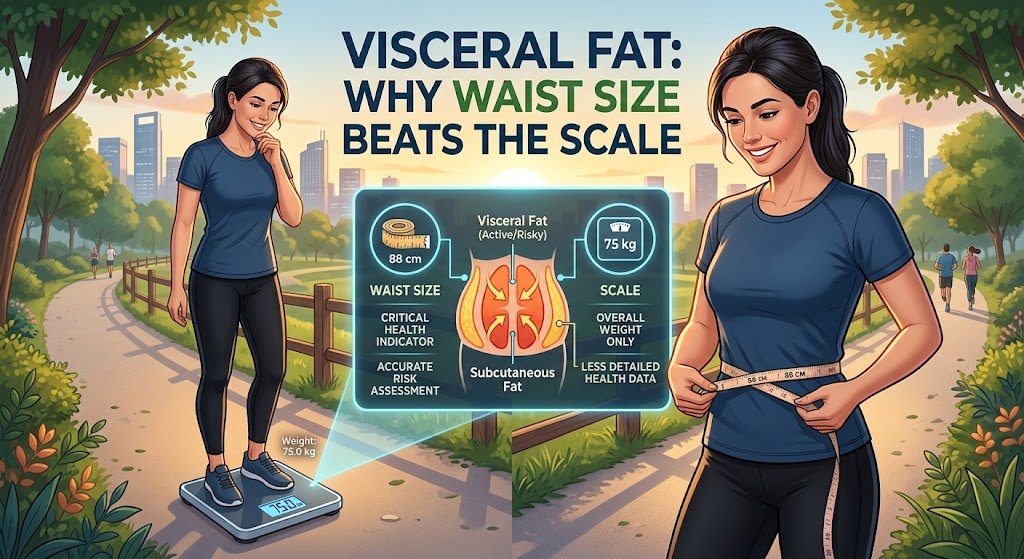
Subcutaneous fat sits just under the skin, distributed across the body. It’s the fat you can pinch. Metabolically, it’s relatively inert.
Visceral fat sits deep in the abdomen, wrapped around the liver, pancreas, and intestines. You can’t pinch it, and it behaves entirely differently.
Visceral fat is metabolically active tissue. It releases hormones and inflammatory signals that drive a chronic stress response and alter how the body stores and uses fat. It’s the depot linked most directly to type 2 diabetes, liver disease, and cardiovascular disease.
This is the core reason the scale misleads. Total body weight doesn’t distinguish between the fat that’s largely inert and the fat that’s actively driving metabolic disease.
Why BMI Falls Short
BMI has been the primary obesity metric for over fifty years, and its limitation is structural: it only knows height and weight.
It can’t distinguish muscle from fat. It can’t tell you where fat is stored. This produces two well-documented failure modes:
Normal BMI, high visceral fat. Sometimes called “normal weight obesity” — a person whose weight looks fine but who carries substantial abdominal fat and meaningful metabolic risk.
High BMI, good muscle mass, low visceral fat. Someone classified as overweight or obese who may be metabolically healthier than the first person.
An International Atherosclerosis Society consensus statement put it directly: BMI alone is not sufficient to assess cardiometabolic risk, and waist circumference should be measured routinely in clinical practice. Decades of evidence support it, and it still isn’t standard.
Quick Reference: The Measurement Options
| Measure | How | Strength |
|---|---|---|
| BMI | Weight ÷ height² | Population screening; poor individual precision |
| Waist circumference | Tape at navel level | Strong link to visceral fat; simple |
| Waist-to-height ratio | Waist ÷ height | Often the best simple predictor |
| Waist-to-hip ratio | Waist ÷ hips | Outperformed BMI in large mortality study |
| CT/MRI | Imaging | Gold standard; expensive, rarely necessary |
The Simplest Useful Rule
Divide your waist measurement by your height. The result should be under 0.5.
Put more plainly: your waist should measure less than half your height.
This is the waist-to-height ratio, and it has held up well. A 2025 report in The Lancet Regional Health found it outperformed BMI for predicting heart disease risk. It also has a practical advantage — it needs no age or sex-specific charts, because it scales automatically to body size.
A separate 2025 study in Aging found that people with higher waist-to-height and waist-to-hip ratios showed poorer physical performance, suggesting the measure captures something functional, not just metabolic.
Quick Reference: Interpreting Your Numbers
| Waist-to-Height Ratio | General Interpretation |
|---|---|
| Under 0.4 | May indicate underweight; worth discussing |
| 0.4 – 0.49 | Healthy range |
| 0.5 – 0.59 | Increased risk |
| 0.6 and above | Substantially increased risk |
General guidance. Thresholds vary somewhat by population and source — discuss your specific numbers with a provider.
How to Measure Correctly
Small technique errors change the number meaningfully, so this part matters:
- Measure against bare skin, not over clothing
- Stand upright, feet shoulder-width apart
- Position the tape at the level of your navel — or midway between the lowest rib and the top of the hip bone
- Keep the tape horizontal all the way around
- Exhale normally and measure at the end of a normal breath out — don’t suck in or hold your breath
- The tape should be snug but not compressing the skin
Measure at the same time of day, ideally in the morning before eating, and repeat every few weeks rather than daily.
An Honest Note on the Evidence
Visceral fat is the more direct cause of metabolic disease, which suggests measuring it directly should be better than a tape measure.
The research is more interesting than that.
A 2025 study in the American Journal of Clinical Nutrition analyzed NHANES data from over 8,000 adults, comparing visceral adipose tissue measurement against BMI, body fat percentage, and waist circumference for predicting metabolic syndrome, type 2 diabetes, and insulin resistance.
The finding: the authors did not find a clear advantage of direct visceral fat measurement over simple waist circumference or waist-to-height ratio in association with metabolic disease.
Which is genuinely good news. It means the free tape measure captures most of the practical signal, and expensive imaging isn’t necessary for the vast majority of people.
What Actually Reduces Visceral Fat
Visceral fat responds well to intervention — better, in some research, than subcutaneous fat does.
Consistent aerobic activity. The most reliably supported approach. Moderate-intensity aerobic exercise specifically targets visceral fat stores, and effects appear even without large changes in total body weight.
Resistance training. Preserves muscle during fat loss and improves insulin sensitivity, which influences where fat is stored.
Reduced refined carbohydrate and added sugar intake. High sugar intake drives hepatic fat conversion, feeding the visceral depot specifically.
Adequate sleep. Short sleep is independently associated with visceral fat accumulation.
Stress management. Cortisol influences abdominal fat distribution, which is part of why chronic stress shows up as central weight gain.
Limiting alcohol. Alcohol contributes to visceral accumulation through liver-mediated pathways.
Notably absent: abdominal exercises. Crunches strengthen abdominal muscles but don’t preferentially burn the fat sitting beneath and behind them.
What People Actually Notice
The most common experience is the disconnect between scale and tape.
People frequently report their waist shrinking meaningfully while the scale barely moves — particularly when they’ve added resistance training. This is a normal and favorable pattern: losing visceral fat while gaining or preserving muscle produces a substantially better metabolic profile with almost no change in body weight.
Tracking only the scale in that situation reads real progress as failure.
The second pattern: people are often surprised by their own measurement. Someone with a completely normal BMI measures a waist-to-height ratio above 0.5 and realizes the metric they’d been trusting was hiding something.
Third, and worth naming: measurement inconsistency causes unnecessary alarm. Measuring at a different height on the torso, over clothing, or after a large meal can shift the number by an inch or more. People sometimes interpret that as rapid change when it’s just technique variance. Same time, same spot, same conditions.
Common Mistakes
Tracking only the scale. Weight can’t distinguish visceral fat loss with muscle gain from no progress at all.
Sucking in during measurement. It produces a lower number and a useless trend. Measure on a normal exhale, relaxed.
Measuring over clothing. Even light fabric adds to the reading and introduces inconsistency between measurements.
Assuming a normal BMI means low visceral fat. Normal weight obesity is well documented — the two measures capture different things.
Doing abdominal exercises to reduce belly fat. Spot reduction doesn’t work. Crunches build muscle under the fat, not fat loss above it.
Measuring daily. Waist circumference changes slowly. Every two to four weeks is enough to see a trend without reacting to noise.
Practical Tips
- Measure your waist and height once, divide, and aim to keep the ratio under 0.5.
- Measure in the morning before eating, at the same spot, on a normal exhale.
- Track waist alongside weight rather than instead of it — the two together tell you what the scale alone can’t.
- Prioritize aerobic activity if visceral fat is the target; it’s the most consistently supported intervention.
- Address sleep and alcohol before adding more training volume — both influence visceral fat independently.
- Re-measure every two to four weeks, not daily.
If you’re working on body composition more broadly, it’s worth pairing this with our guides on body recomposition and how much added sugar is too much, since muscle gain and sugar intake both influence where fat is stored.
When Should You See a Doctor?
Talk to a doctor if your waist-to-height ratio is 0.5 or above, particularly alongside high blood pressure, elevated blood sugar, or abnormal cholesterol — that combination points toward metabolic syndrome, which benefits from clinical evaluation rather than self-management.
Also raise it if your waist has increased noticeably without a corresponding change in weight or habits, since unexplained central weight gain can reflect hormonal or metabolic factors worth investigating.
Frequently Asked Questions
What is a healthy waist-to-height ratio? Under 0.5 is the commonly cited target — meaning your waist should measure less than half your height. This measure doesn’t require age or sex-specific charts because it scales to body size.
Is visceral fat worse than subcutaneous fat? Yes, metabolically. Visceral fat surrounds internal organs and actively releases inflammatory signals and hormones, and it’s more directly linked to type 2 diabetes, liver disease, and cardiovascular disease.
Do I need a scan to measure visceral fat? Generally no. A 2025 NHANES analysis found no clear advantage of direct visceral fat measurement over simple waist circumference or waist-to-height ratio for predicting metabolic disease.
Can I lose visceral fat without losing weight? Yes. Visceral fat responds well to aerobic exercise, and it’s common to reduce waist circumference while the scale stays relatively stable, especially when gaining muscle simultaneously.
Do ab exercises reduce belly fat? No. Spot reduction isn’t supported — abdominal exercises strengthen the muscles beneath the fat but don’t preferentially burn it.
The Bottom Line
BMI has served as the default obesity measure for fifty years while missing the thing that matters most: where the fat actually is. A tape measure and one division — waist divided by height, aiming under 0.5 — captures most of the practical signal, and research suggests expensive imaging adds little for most people. Track it alongside the scale, and you’ll see progress the scale alone would hide.
This article is for general informational purposes and is not a substitute for personalized medical advice. Discuss your measurements and individual risk with a healthcare provider.
References
- Nature Reviews Endocrinology — Waist Circumference as a Vital Sign in Clinical Practice: IAS/ICCR Consensus Statement
- American Journal of Clinical Nutrition — Cross-Sectional Analysis of Visceral Adipose Tissue Associations with Obesity-Related Disease (2025)
- Cleveland Clinic — Visceral Fat: What It Is and How It Affects You