For years, the standard advice was firm: you can’t gain muscle and lose fat at the same time, so pick one — bulk, then cut, in separate phases. Recent research has quietly closed that debate. A 2024 editorial in Frontiers in Physiology confirmed that body recomposition “occurs in untrained, trained, and highly trained populations of different ages.” The real question isn’t whether it’s possible anymore — it’s who it works best for, and what it actually takes.
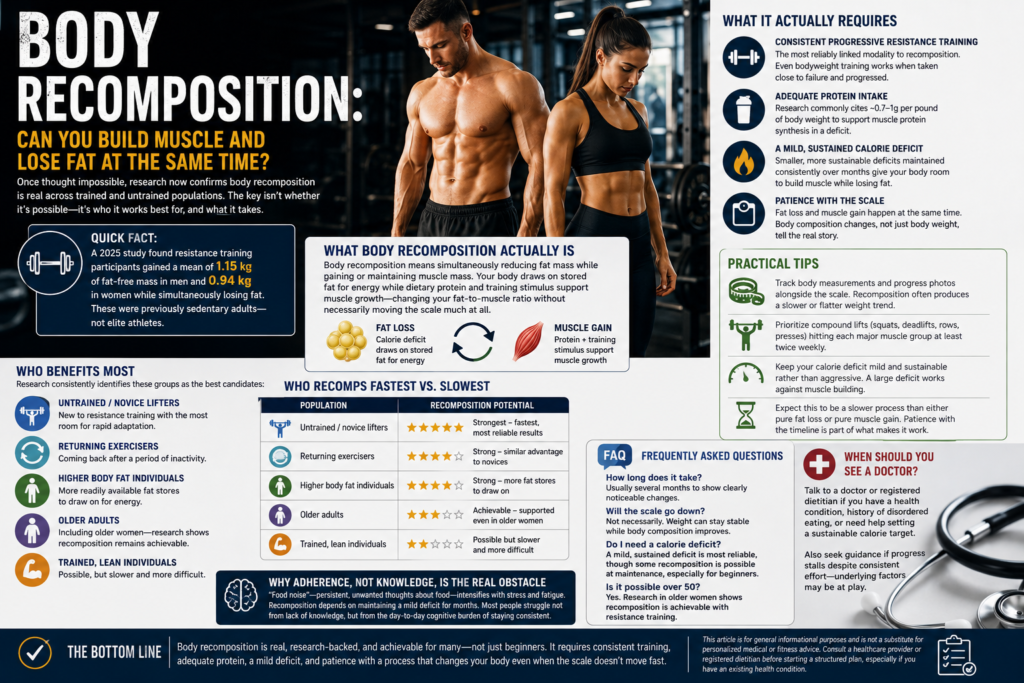
Quick Fact: A 2025 study found resistance training participants gained a mean of 1.15 kg of fat-free mass in men and 0.94 kg in women while simultaneously losing fat — and these weren’t elite athletes, but previously sedentary adults starting a structured program.
What Body Recomposition Actually Is
Body recomposition means simultaneously reducing fat mass while gaining or maintaining muscle mass — two processes (catabolism and anabolism) that were long considered metabolically incompatible, since fat loss traditionally requires a calorie deficit and muscle building traditionally requires a surplus. Recomposition works by running both processes in parallel: your body draws on stored fat for energy while dietary protein and training stimulus support muscle growth, changing your fat-to-muscle ratio without necessarily moving the scale much at all.
Who Benefits Most
This is the part most marketing skips. Research consistently identifies specific groups as the best candidates for recomposition:
- Untrained or novice lifters — new to resistance training, with the most room for rapid neuromuscular and muscular adaptation
- People returning to exercise after a period of inactivity
- People with higher body fat percentages, who have more readily available fat stores to draw on for energy while building muscle
- Older adults, including older women specifically, where research shows recomposition remains achievable despite assumptions that this window closes with age
More advanced, already-lean trained individuals can still achieve recomposition, but the research shows it becomes progressively harder and slower as training experience and leanness increase — there’s simply less “easy” adaptation left to access.
Quick Reference: Who Recomps Fastest vs. Slowest
| Population | Recomposition Potential |
|---|---|
| Untrained/novice lifters | Strongest — fastest, most reliable results |
| Returning exercisers | Strong — similar advantage to novices |
| Higher body fat individuals | Strong — more fat stores to draw on |
| Older adults | Achievable — supported even in older women specifically |
| Trained, lean individuals | Possible but slower and more difficult |
What It Actually Requires
Consistent progressive resistance training. This is the modality most reliably linked to recomposition across the research, regardless of specific equipment — even bodyweight training can produce sufficient stimulus when taken close to failure and progressed consistently.
Adequate protein intake. Higher protein intake (commonly cited research uses roughly 0.7-1g per pound of body weight) supports muscle protein synthesis even while in a calorie deficit, helping the body prioritize burning fat rather than muscle for energy.
A mild, sustained calorie deficit — not an aggressive one. Unlike traditional fat-loss phases that sometimes use large deficits, recomposition research points toward smaller, more sustainable deficits maintained consistently over months, giving the body room to build muscle while still net losing fat.
Patience with the scale. Because you’re losing fat and gaining muscle simultaneously, the number on the scale often moves much more slowly than with fat loss alone — body composition changes (measurements, how clothes fit, strength gains) are more informative than weight during this process.
Why Adherence, Not Knowledge, Is Usually the Real Obstacle
Research on eating behavior has increasingly focused on something called “food noise” — persistent, unwanted thoughts about food that don’t require actual hunger to occur, intensifying with stress and fatigue. This matters for recomposition specifically because the process depends on maintaining calorie precision consistently over a long timeline; most people who struggle with recomposition aren’t failing from lack of information about training or protein targets, but from the day-to-day cognitive burden of sustaining a mild deficit for months.
Practical Tips
- Track body measurements and progress photos alongside (not instead of) the scale, since recomposition often produces a slower or flatter weight trend than fat loss alone.
- Prioritize compound resistance exercises (squats, deadlifts, rows, presses) hitting each major muscle group at least twice weekly.
- Keep your calorie deficit mild and sustainable rather than aggressive — a large deficit tends to work against the muscle-building side of recomposition.
- Expect this to be a slower process than either pure fat loss or pure muscle gain — patience with the timeline is part of what makes it work.
If you’re building out this approach, it’s worth pairing this with our guides on calorie deficit explained and strength training for beginners, since both cover the two core components recomposition depends on.
When Should You See a Doctor?
Talk to a doctor or registered dietitian before starting a structured recomposition plan if you have an existing health condition, a history of disordered eating, or are unsure how to set a sustainable calorie target for your situation. It’s also worth professional guidance if progress stalls significantly despite consistent training and adequate protein, since underlying factors (sleep, hormones, medical conditions) can affect results.
Frequently Asked Questions
How long does body recomposition typically take? It’s generally slower than dedicated fat-loss or muscle-building phases alone, often taking several months to show clearly noticeable changes, since both processes are happening at a moderated pace simultaneously.
Will the scale go down during body recomposition? Not necessarily much, or not at a steady rate — since you’re losing fat while gaining muscle, total body weight can stay relatively stable even as body composition meaningfully improves.
Do I need to be in a calorie deficit for recomposition to work? Most research points toward a mild, sustained deficit as the most reliable approach, though some recomposition has been observed even at maintenance calories, particularly in less-trained individuals.
Is body recomposition possible for people over 50? Yes — research specifically in older women shows resistance training can produce genuine recomposition, challenging the assumption that this becomes impossible with age.
The Bottom Line
The old bulk-or-cut binary isn’t the only path anymore — body recomposition, once dismissed as unrealistic outside of beginners, is now confirmed across trained and untrained populations alike in the research. It requires consistent resistance training, adequate protein, and a mild rather than aggressive calorie deficit, plus real patience with a scale that may not move as fast as you’d expect, even while your actual body composition improves.
This article is for general informational purposes and is not a substitute for personalized medical or fitness advice. Consult a healthcare provider or registered dietitian before starting a structured recomposition plan, especially if you have an existing health condition.
References
- Frontiers in Physiology — Body Recomposition Editorial (2024)
- Strength and Conditioning Journal (NSCA) — Body Recomposition: Can Trained Individuals Build Muscle and Lose Fat at the Same Time?
- Journal of Education, Health and Sport — Strategies for Simultaneous Muscle Gain and Fat Reduction (2025)