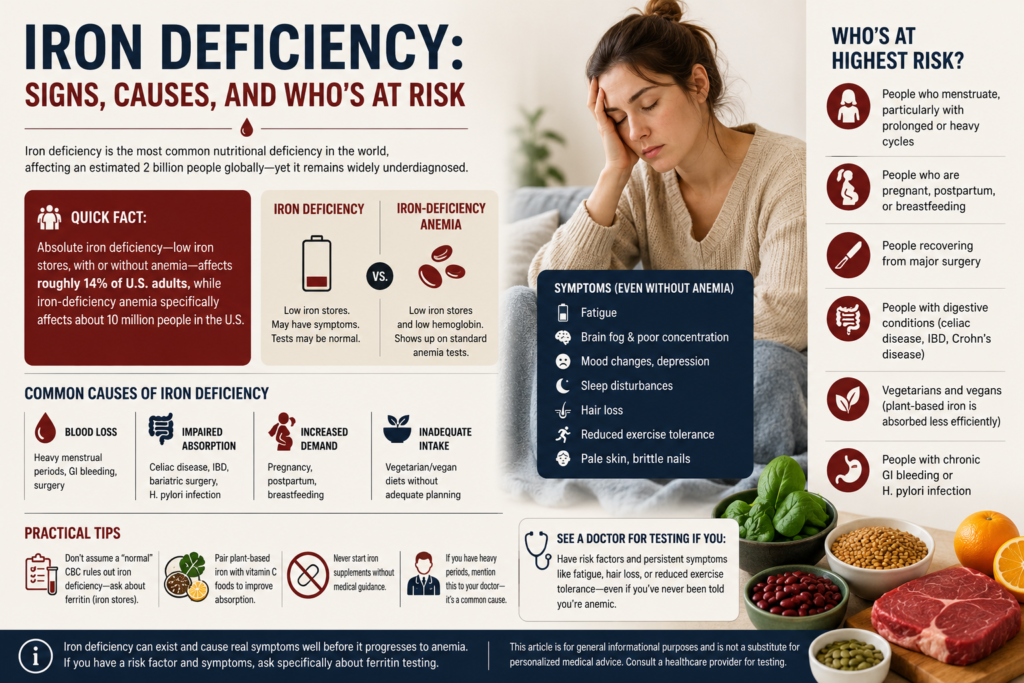
Iron deficiency is the most common nutritional deficiency in the world, affecting an estimated 2 billion people globally — yet it remains widely underdiagnosed. Part of the problem is a misconception baked into how most people think about it: iron deficiency and anemia aren’t the same thing, and you can have real, symptomatic iron deficiency well before it shows up on a standard anemia test.
Quick Fact: Absolute iron deficiency — low iron stores, with or without anemia — affects roughly 14% of U.S. adults, while iron-deficiency anemia specifically affects about 10 million people in the U.S., a meaningfully smaller number that undercounts the full scope of the problem.
Iron Deficiency vs. Iron-Deficiency Anemia
This distinction matters more than most people realize. Iron deficiency happens when your body’s iron stores run low. Iron-deficiency anemia is a later stage, when those stores are low enough that your body can’t produce adequate hemoglobin, the protein in red blood cells that carries oxygen. Standard blood tests (like a basic complete blood count) are designed to catch anemia — they don’t reliably catch iron deficiency before anemia develops, which means people can have real, debilitating symptoms from low iron stores while their standard bloodwork still looks technically normal.
Symptoms Beyond “Just Tiredness”
The classic anemia symptoms — fatigue and pale skin — are well known, but iron deficiency without anemia produces its own real, if vaguer, set of symptoms: fatigue, depression, burnout, sleep disturbances, hair loss, and reduced exercise tolerance. Because these overlap so heavily with stress, poor sleep, or “just being busy,” iron deficiency is frequently missed or misattributed, particularly in people whose standard labs come back in the normal range.
Who’s at Highest Risk
- People who menstruate, particularly with prolonged or heavy cycles — this is one of the most common causes of iron deficiency in adults
- People who are pregnant, postpartum, or breastfeeding, due to increased iron demand
- People recovering from major surgery, especially procedures involving blood loss or gastric bypass and duodenal surgeries that affect absorption
- People with digestive conditions like celiac disease, ulcerative colitis, or Crohn’s disease that impair iron absorption
- Vegetarians and vegans, since iron from plant sources (non-heme iron) is absorbed less efficiently than iron from animal sources (heme iron)
- People with chronic gastrointestinal bleeding, including from conditions like H. pylori infection, which research has increasingly linked to iron deficiency through chronic gastric inflammation and reduced absorption
Quick Reference: Common Causes of Iron Deficiency
| Cause Category | Examples |
|---|---|
| Blood loss | Heavy menstrual periods, GI bleeding, surgery |
| Impaired absorption | Celiac disease, IBD, bariatric surgery, H. pylori infection |
| Increased demand | Pregnancy, postpartum, breastfeeding |
| Inadequate intake | Vegetarian/vegan diets without adequate planning |
Why Iron Deficiency Deserves More Attention Than It Gets
Beyond the well-known fatigue and cognitive symptoms, iron deficiency has been linked to less obvious effects — including, in some research, an increased risk of blood clots. This isn’t the reason to become alarmed about mild, common iron deficiency, but it reflects why the condition is described in recent literature as “more than just anemia” and worth taking seriously even when it hasn’t progressed to a low hemoglobin count.
Practical Tips
- Don’t assume a “normal” complete blood count rules out iron deficiency — ask specifically about ferritin (iron stores) testing if you have risk factors and relevant symptoms.
- If you’re vegetarian or vegan, pair plant-based iron sources (lentils, spinach, fortified cereals) with vitamin C-rich foods, which improves absorption of non-heme iron.
- Never start iron supplements without medical guidance — too much iron can build up and damage the liver and other organs over time.
- If you have heavy menstrual periods, mention this specifically to your doctor as a possible iron deficiency risk factor, since it’s one of the most common and often overlooked causes.
If you’re evaluating your broader nutrient intake, it’s worth pairing this with our guides on vitamin B12 deficiency and do you need a multivitamin, since iron and B12 deficiencies can sometimes overlap and share several overlapping symptoms.
When Should You See a Doctor?
See a doctor for testing if you have a risk factor (heavy periods, pregnancy, a digestive condition, a vegetarian/vegan diet, or recent major surgery) combined with symptoms like persistent fatigue, hair loss, or reduced exercise tolerance — even if you’ve never been told you’re anemic. Never self-diagnose or self-treat with iron supplements, since a doctor needs to confirm true deficiency and rule out underlying causes like gastrointestinal bleeding before treatment begins.
Frequently Asked Questions
Can I have iron deficiency without being anemic? Yes, and it’s common. Iron deficiency without anemia can still cause real symptoms — fatigue, hair loss, reduced exercise tolerance — even when standard blood tests appear normal, since those tests are designed to catch anemia, not earlier-stage iron deficiency.
Is it safe to take iron supplements without a doctor’s guidance? No. Excess iron can build up in the body and damage the liver and other organs over time, so supplementation should be guided by confirmed lab results and medical advice, not self-diagnosis.
Why is iron deficiency more common in women? Menstrual blood loss, pregnancy, and breastfeeding all increase iron demand or loss, which is why women of reproductive age are among the highest-risk groups for iron deficiency.
Can iron deficiency cause hair loss? Yes, hair loss is a recognized symptom of iron deficiency, even in cases without anemia, and is often overlooked as a possible cause when standard bloodwork looks normal.
The Bottom Line
Iron deficiency is far more common — and more often missed — than most people realize, largely because it can exist and cause real symptoms well before it progresses to anemia on a standard blood test. If you have a known risk factor and persistent, unexplained symptoms like fatigue or hair loss, ask specifically about ferritin testing rather than assuming normal bloodwork rules it out.
This article is for general informational purposes and is not a substitute for personalized medical advice. Consult a healthcare provider for testing before starting iron supplementation.
References
- Mayo Clinic — Iron Deficiency Anemia: Symptoms and Causes
- American Society of Hematology — Iron-Deficiency Anemia
- JAMA — Iron Deficiency in Adults: A Review (2025)