The instinct is that raw is best and cooking destroys nutrients. It’s half right, and the half it gets wrong is the more interesting part.
Some nutrients do degrade with heat. Others become more available because cooking breaks down the plant cell walls trapping them. Which means the right cooking method depends less on general rules and more on what nutrient you’re trying to keep.
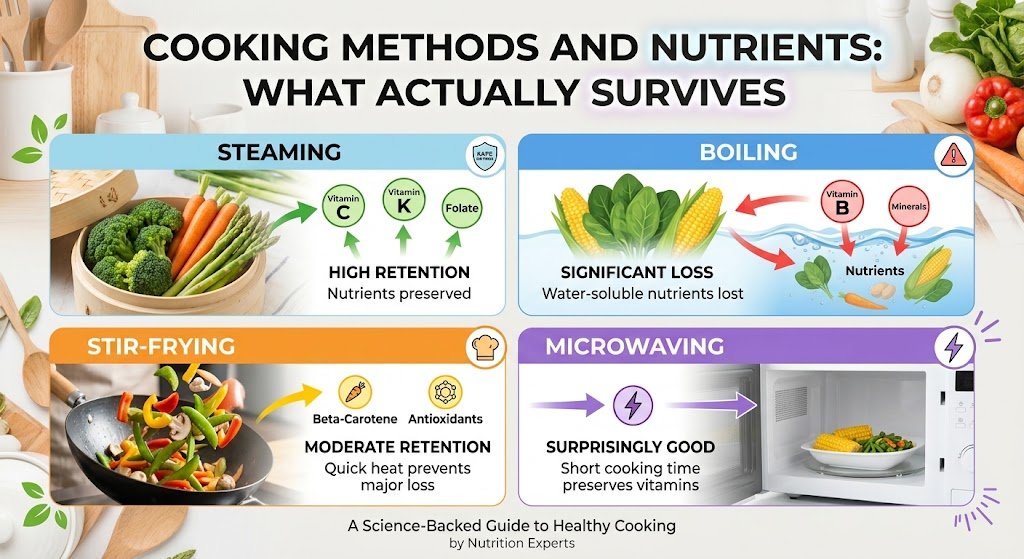
There’s also a finding that surprises almost everyone: across multiple studies, the microwave — the method with the worst nutritional reputation — often preserves nutrients better than nearly anything else.
Quick Fact: In a study of six commonly consumed vegetables, boiling reduced vitamin C by as much as 70.9%, with spinach suffering the greatest loss. Microwaving preserved over 90% of the original content.
Last reviewed: September 2026
Why Boiling Loses the Most
The mechanism is simple: water-soluble vitamins leach into the water.
Vitamin C and the B vitamins dissolve readily. Submerge vegetables in boiling water for ten minutes, and a substantial portion of those vitamins ends up in liquid most people pour down the drain.
One meta-study assessing vitamin C retention across vegetables found boiling sometimes produced losses exceeding 70%, while microwaving and steaming showed considerably better retention.
Two practical modifications reduce this:
- Use minimal water — less water means less to leach into
- Keep it short — time in water matters as much as temperature
- Keep the liquid — if you’re making soup or a sauce, the leached vitamins are still in the pot
That last point is worth emphasizing. Boiling isn’t destroying the vitamins so much as relocating them. If the water becomes part of the dish, the loss largely disappears.
Why the Microwave Wins More Often Than Expected
Microwaving performs well for a specific reason: short cooking time and minimal water.
A study examining boiling, steaming, and microwave cooking across six vegetables concluded that microwaving was the most effective method for retaining nutritional value, with steaming having a moderate impact.
Research on total phenolics and antioxidant activity across multiple vegetables — pepper, squash, green beans, peas, leek, broccoli, spinach — found that microwaving often preserved or even increased measured antioxidant levels compared to conventional cooking.
The microwave’s poor reputation appears to be cultural rather than nutritional.
Quick Reference: Method vs. Nutrient Retention
| Method | Water-Soluble Vitamins | Overall Assessment |
|---|---|---|
| Microwaving | Excellent (>90% vitamin C in one study) | Best overall retention |
| Steaming | Good | Strong for beta-carotene; good texture |
| Roasting/Baking | Moderate | No leaching; some heat degradation |
| Grilling | Moderate | Fast, but nutrients lost in drippings |
| Stir-frying | Moderate to good | Fat aids absorption of fat-soluble nutrients |
| Boiling | Poor (up to 70%+ loss) | Best only if you keep the liquid |
Where Cooking Actually Helps
This is the part the “raw is best” framing misses entirely.
Fat-soluble compounds become more available. Research found that deep-frying and stir-frying significantly improved retention of essential amino acids and bioactive compounds compared to conventional boiling. Oil-based methods enhance the release of lipophilic compounds — those requiring fat for absorption.
This is why a drizzle of olive oil on cooked vegetables isn’t just flavor. Fat-soluble vitamins (A, D, E, K) and carotenoids need dietary fat to be absorbed properly.
Minerals can concentrate. In the six-vegetable study, calcium and iron content increased in most cooked vegetables — by 6-17% and 6-12% respectively. Cooking reduces water content, concentrating what remains.
Antinutrients decrease. Cooking reduces compounds like phytates and oxalates that bind minerals and limit absorption. There’s a genuine trade-off here: some nutrient loss in exchange for better bioavailability of what remains.
Digestibility improves. Breaking down cell walls makes many nutrients more accessible than they are in raw form.
The Trade-Off Nobody Mentions
Research explicitly frames this as a balance: nutrient preservation versus bioavailability improvement.
A raw carrot contains more vitamin C than a cooked one. A cooked carrot delivers more usable beta-carotene, because heat breaks down the cell walls holding it.
Neither is simply “better.” They’re different outcomes from the same vegetable, which is why the most sensible approach isn’t picking one method — it’s varying them.
Quick Reference: Best Method by Goal
| Goal | Best Approach |
|---|---|
| Preserve vitamin C | Microwave or steam, briefly |
| Maximize carotenoid absorption | Cook, and add a source of fat |
| Retain B vitamins | Microwave, steam, or keep the cooking liquid |
| Improve mineral absorption | Cook (reduces antinutrients) |
| Keep texture and color | Steam |
| Maximize flavor development | Roast or grill |
What Actually Matters More Than Method
Worth stating plainly: the differences between cooking methods are smaller than the difference between eating vegetables and not eating them.
Someone who steams everything perfectly but eats two servings a day is worse off than someone who boils carelessly but eats six. Method optimization is a refinement, not a foundation.
If a cooking method makes you eat more vegetables — because you prefer roasted to steamed, or because the microwave is what you’ll actually use on a weeknight — that method is better for you than the technically superior one you’ll skip.
What People Actually Get Wrong
The most common misconception is avoiding the microwave on the assumption it degrades food. The research consistently shows the opposite: short cooking time and minimal water make it one of the better methods for nutrient retention. This one belief probably costs more nutrients than any technique error.
The second pattern is discarding cooking water reflexively. People boil vegetables, drain them thoroughly, and pour a substantial share of the vitamin C down the sink. Using that liquid in soup, sauce, or gravy recovers most of it — and this is a habit change, not a skill.
Third: many people overcook by default, particularly vegetables. Cooking time matters as much as method — extended boiling progressively degrades ascorbic acid and phenolics, with longer times adversely affecting antioxidant capacity. Vegetables that still have some bite retain considerably more than fully softened ones.
A related habit: peeling everything. Many vitamins and minerals concentrate in or just under the skin. Cooking vegetables with skins on retains more, and it’s less work rather than more.
Common Mistakes
Avoiding the microwave. It repeatedly outperforms other methods for nutrient retention in the research. The reputation isn’t earned.
Draining and discarding cooking water. The leached vitamins are in that liquid. Use it in soups, sauces, or grain cooking.
Boiling in large volumes of water. More water means more leaching. Use the minimum needed.
Cooking vegetables until fully soft. Extended heat progressively degrades heat-sensitive compounds. Stop while there’s still texture.
Peeling before cooking. Nutrients concentrate near the skin, and the skin also limits leaching during cooking.
Cooking fat-soluble vegetables without any fat. Carotenoids and vitamins A, D, E, and K need dietary fat for absorption. Steamed carrots with no fat deliver less than the label suggests.
Assuming raw is always superior. Cooking increases bioavailability of several compounds and reduces antinutrients that block mineral absorption.
Practical Tips
- Default to microwaving or steaming for vegetables you’d otherwise boil — it’s faster and retains more.
- If you boil, keep the water and use it in the dish rather than draining it away.
- Add a source of fat — olive oil, nuts, avocado — to cooked vegetables to improve carotenoid and fat-soluble vitamin absorption.
- Leave skins on when practical; nutrients concentrate there and it reduces leaching.
- Cook until just tender rather than soft, since time under heat matters as much as method.
- Vary your methods across the week rather than optimizing one — different techniques preserve different things.
If you’re planning meals around this, it’s worth pairing this with our guides on 6 gut-healthy recipes and meal prep: the component method, since batch cooking and reheating raise the same retention questions.
Frequently Asked Questions
Does microwaving destroy nutrients? No — research consistently finds the opposite. One study of six vegetables concluded microwaving was the most effective method for retaining nutritional value, preserving over 90% of vitamin C in some cases.
Which cooking method preserves the most nutrients? Microwaving generally performs best, followed by steaming. Both use short cooking times and minimal water, which limits both heat degradation and leaching.
Are raw vegetables healthier than cooked? Not universally. Raw retains more vitamin C, but cooking increases the bioavailability of carotenoids, concentrates some minerals, and reduces antinutrients that block mineral absorption.
Why should I keep the water I boiled vegetables in? Because water-soluble vitamins leach into it. Using that liquid in soup, sauce, or for cooking grains recovers most of what would otherwise be discarded.
Do I need to add oil to cooked vegetables? It helps. Fat-soluble vitamins (A, D, E, K) and carotenoids require dietary fat for absorption, so a small amount of oil, nuts, or avocado meaningfully improves uptake.
The Bottom Line
Cooking doesn’t simply destroy nutrients — it redistributes them, concentrates some, and makes others more available. Boiling loses the most, and mostly to the water rather than to the heat. Microwaving performs better than its reputation, steaming is close behind, and adding a little fat improves absorption of everything fat-soluble. But the honest ranking is this: the method matters far less than whether the vegetables get eaten at all.
References
- Heliyon — Effect of Cooking Methods on the Nutritional Quality of Selected Vegetables
- Nutrients (MDPI) — Effects of Household Cooking on Mineral Composition and Retention in Widespread Italian Vegetables (2025)
- Journal of Food Science and Nutrition — The Impact of Cooking Methods on Nutrient Retention