Most meal prep advice starts with recipes. That’s the reason most meal prep attempts fail by Wednesday.
Cooking five identical containers of chicken and rice on Sunday is efficient and miserable. By day three, you don’t want it, you order something else, and the food goes in the bin — taking your motivation with it.
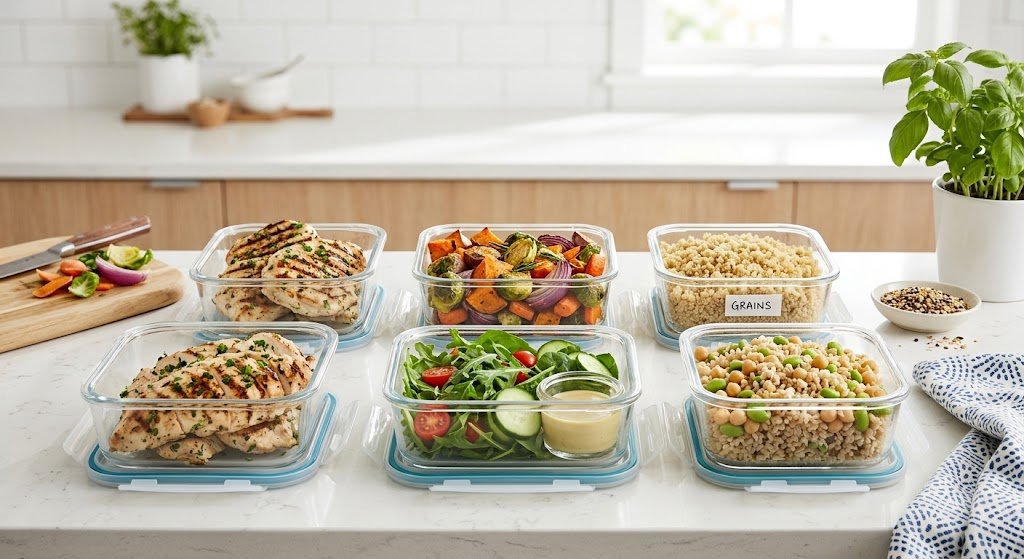
There’s a better structure: prep components, not meals. Same session, same time investment, but you assemble different combinations each day instead of eating the same plate five times.
Quick Fact: Cooked food stays safe in the refrigerator for 3 to 4 days at or below 40°F — which means a Sunday prep session realistically covers Monday through Wednesday or Thursday, not the full week. Anything beyond that belongs in the freezer.
Last reviewed: September 2026
Why Components Beat Complete Meals
A complete meal is a fixed decision made days in advance. A component is an ingredient that can go several directions.
Roast a tray of vegetables and cook a pot of quinoa, and you have the base for a grain bowl, a wrap, a salad, or a side. Cook a container of shredded chicken, and it becomes tacos, soup, a bowl, or a sandwich filling — depending on what you feel like that day.
The time investment is identical. The difference is that component prep survives contact with a changing appetite, and complete-meal prep doesn’t.
This also addresses the single biggest failure point: prep burnout from repetition. You didn’t lose discipline on Wednesday. You just stopped wanting the same meal for the third consecutive day, which is a normal response.
The Four-Component Framework
Prep one item from each category and you can build most meals for the next three days.
1. A protein. Shredded chicken, hard-boiled eggs, cooked lentils, baked tofu, ground turkey, or a can of beans ready to go.
2. A grain or starch. Quinoa, brown rice, barley, roasted sweet potato, or whole grain pasta.
3. Roasted vegetables. Anything that holds up to a hot oven — broccoli, peppers, zucchini, red onion, carrots, cauliflower.
4. A sauce or dressing. This is the component most people skip and the one that does the most work. A tahini-lemon dressing, a peanut sauce, a vinaigrette, or a yogurt-herb sauce is what makes the same three ingredients taste like a different meal.
Quick Reference: Component Combinations
| Protein | Grain | Vegetable | Sauce | Result |
|---|---|---|---|---|
| Shredded chicken | Brown rice | Roasted peppers | Peanut sauce | Rice bowl |
| Lentils | Quinoa | Roasted cauliflower | Tahini-lemon | Mediterranean bowl |
| Hard-boiled eggs | — | Roasted vegetables | Vinaigrette | Composed salad |
| Baked tofu | Barley | Broccoli | Ginger-tamari | Stir-fry style bowl |
| Ground turkey | Sweet potato | Roasted onion | Yogurt-herb | Deconstructed plate |
A Realistic 60-Minute Session
The sequence matters more than the recipes. Order tasks by what needs the oven and what needs attention.
Minutes 0-10. Preheat oven to 425°F. Chop all vegetables at once. Put grains on to cook.
Minutes 10-15. Vegetables onto sheet pans with oil and seasoning, into the oven.
Minutes 15-35. Cook protein while vegetables roast. Whisk sauces during any waiting time.
Minutes 35-45. Remove vegetables. Spread grains thin on a sheet pan to cool quickly (this matters for safety — more below).
Minutes 45-60. Portion into containers once everything has cooled. Label with the date.
That’s one hour covering three days of lunches and dinners.
Food Safety: The Part Most Guides Skip
Batch cooking amplifies ordinary food handling mistakes across every portion, and there are three specific pressure points worth knowing.
The temperature danger zone. Between 40°F and 140°F, bacteria including Salmonella, Listeria, and Staphylococcus aureus can double roughly every 20 minutes under ideal conditions. Food left cooling on the counter for hours sits in this range the entire time.
Cool grains fast. Rice, quinoa, and pasta are reliable habitats for Bacillus cereus, a spore-forming bacterium that survives cooking and produces heat-stable toxins during slow cooling. Reheating doesn’t neutralize those toxins. Spreading grains thin on a sheet pan before refrigerating cools them quickly and substantially reduces this risk.
Reheat properly. Food should reach 165°F throughout, not just on the surface. Stir midway through microwaving rather than heating in one continuous run.
Quick Reference: Storage Timelines
| Item | Refrigerator | Freezer |
|---|---|---|
| Cooked chicken, turkey, beef | 3–4 days | 2–6 months |
| Cooked grains (rice, quinoa) | 3–4 days | 1–2 months |
| Roasted vegetables | 3–4 days | 10–12 months |
| Cooked legumes | 3–4 days | 2–3 months |
| Hard-boiled eggs (in shell) | 1 week | Not recommended |
| Homemade dressings | 4–7 days | Varies |
Based on FDA refrigerator storage guidance. Refrigerator should be at or below 40°F.
What Actually Goes Wrong for Beginners
Three patterns come up repeatedly, and none of them involve cooking skill.
Prepping too much on the first attempt. People start with a five-day, three-meal-a-day plan, spend four hours on Sunday, and never do it again. Starting with one meal per day for three days cuts weekly cooking time meaningfully while remaining sustainable — and it’s the version people actually repeat.
Skipping labels. Containers look identical after two days. Without a date, you either eat something past its window or throw out food that was still fine. A strip of masking tape and a marker solves this permanently.
Not batching by cook time. Running the oven three separate times because vegetables were chopped in stages turns a one-hour session into two. Chopping everything first, then cooking, is the single biggest time saver.
There’s also a quieter benefit people report only after a few weeks: fewer decisions. Research from Cornell suggests the average person makes over 200 food-related decisions daily. Prepping consolidates a large share of those into one weekly session made without hunger driving the choice — which is a different thing than deciding what to eat at 7 p.m. when you’re tired.
Common Mistakes
Prepping complete meals instead of components. Fixed meals guarantee repetition. Components allow variation from the same prep time.
Assuming Sunday prep covers the full week. Cooked food is safe for 3-4 days refrigerated. Days four through seven need freezing, not optimism.
Cooling large batches on the counter. Extended time in the 40-140°F range is where bacterial growth happens. Cool quickly, then refrigerate.
Leaving grains to cool slowly in the pot. Bacillus cereus toxins form during slow cooling and aren’t destroyed by reheating. Spread grains thin.
Skipping the sauce component. It’s the cheapest way to make identical ingredients taste different, and it’s the one people leave out.
Buying specialized equipment first. A sheet pan, a pot, a cutting board, and airtight containers cover nearly everything. Gadgets are optional.
Practical Tips
- Start with three days, not seven — the extra days are where both food safety and motivation break down.
- Chop every vegetable before cooking anything; staged chopping is what turns 60 minutes into 120.
- Make two sauces, not one. It’s five extra minutes and the highest-return step for variety.
- Label every container with the date, not just the contents.
- Cool grains spread thin on a sheet pan rather than in the pot — faster and safer.
- Freeze anything intended for day four or later, and thaw in the refrigerator overnight rather than on the counter.
If you’re planning what to actually prep, it’s worth pairing this with our guides on 6 healthy lunch recipes for work and 6 high-protein vegetarian meals, since both are built around components that hold up well for several days.
Frequently Asked Questions
How long does meal prep food actually last in the fridge? Cooked food is generally safe for 3 to 4 days at or below 40°F. Beyond that, freeze it rather than extending the refrigerator window.
Why do I need to cool rice quickly? Rice can harbor Bacillus cereus, a bacterium that survives cooking and produces heat-stable toxins during slow cooling. Reheating doesn’t destroy those toxins, so rapid cooling is the protective step.
How long should a beginner meal prep session take? A realistic first session is about 60 minutes covering three days of lunches and dinners. Sessions that stretch to three or four hours are usually a sign of prepping too much too early.
Do I need special containers? Airtight containers matter for freshness and safety; glass or BPA-free plastic both work. Beyond that, most meal prep gadgets are optional.
What’s the right reheating temperature? Food should reach 165°F throughout, not just at the surface. Stirring midway through microwaving helps heat distribute evenly.
The Bottom Line
Meal prep fails on repetition, not effort. Prepping four components — a protein, a grain, roasted vegetables, and a sauce — takes the same hour as prepping five identical meals but produces different food each day. Add the parts most guides skip: keep it to three days, cool grains fast, and label everything. That’s the whole system.
References
- FDA — Refrigerator and Freezer Storage Chart
- USDA Food Safety and Inspection Service — Safe Food Handling and Storage
- Johns Hopkins Bloomberg School of Public Health — Home Cooking and Diet Quality Research