
In a meta-analysis covering 2.2 million participants, the least fit group carried a hazard ratio of 4.09 for all-cause mortality.
For comparison, in the same analysis: smoking was 1.40. Type 2 diabetes, 1.34. Hypertension, 1.15.
Low cardiorespiratory fitness carried a larger associated risk than any of them. That finding is why the American Heart Association formally recommended in 2016 that fitness be treated as a clinical vital sign — measured routinely, like blood pressure.
Most people have never had it measured once.
Quick Fact: Each 1-MET increase in VO2 max — about 3.5 ml/kg/min — is associated with roughly an 11-13% reduction in all-cause mortality and up to a 15% reduction in cardiovascular mortality.
Last reviewed: September 2026
What VO2 Max Actually Measures
VO2 max is the maximum rate at which your body can take in, transport, and use oxygen during intense exercise. It’s expressed in milliliters of oxygen per kilogram of body weight per minute (ml/kg/min).
Three systems have to work together to produce the number:
- Lungs — bringing oxygen in
- Heart and blood vessels — transporting it, via stroke volume and capillary density
- Muscles and mitochondria — extracting and using it
This is what makes it such a broad health marker. A single number reflects the integrated capacity of your respiratory, cardiovascular, and cellular energy systems. It correlates with mitochondrial function — the cellular machinery that converts nutrients into usable energy.
The Fitness vs. Fatness Finding
This is the result that reframes a lot of standard health advice.
A 2025 systematic review and meta-analysis published in the British Journal of Sports Medicine, covering nearly 400,000 people, examined fitness and BMI together. The findings:
- Obese but fit individuals: hazard ratio 1.11 — no statistically significant increase in mortality risk compared to fit individuals of normal weight
- Normal weight but unfit individuals: hazard ratio 1.92 — nearly double the risk
Read that again. Being unfit at a normal weight was associated with substantially higher mortality risk than being fit at an obese weight.
This doesn’t make body weight irrelevant. It does suggest that focusing exclusively on the scale while ignoring cardiorespiratory fitness may be optimizing the less important variable.
Quick Reference: Risk Comparison from the Research
| Factor | Hazard Ratio (All-Cause Mortality) |
|---|---|
| Least fit category | 4.09 |
| Normal weight, unfit | 1.92 |
| Smoking | 1.40 |
| Type 2 diabetes | 1.34 |
| Hypertension | 1.15 |
| Obese but fit | 1.11 (not statistically significant) |
How to Measure It
Laboratory testing is the gold standard — a graded exercise test on a treadmill or bike while wearing a mask that analyzes expired air. Accurate, but requires a facility and typically costs money.
Wearable estimates from Garmin, Apple Watch, Polar, and similar devices use heart rate and pace data to estimate VO2 max. These are estimates, not measurements, and accuracy varies. But for tracking your own trend over time, they’re reasonably useful — the direction of change matters more than the absolute number.
Field tests provide a middle option: the Cooper 12-minute run test, the 1.5-mile run test, or a submaximal step test. Free, rough, and better than nothing.
Quick Reference: General VO2 Max Ranges (ml/kg/min)
| Age | Men — Poor | Men — Good | Women — Poor | Women — Good |
|---|---|---|---|---|
| 20–29 | <38 | 44–51 | <28 | 33–41 |
| 30–39 | <34 | 41–47 | <27 | 32–39 |
| 40–49 | <30 | 37–44 | <25 | 29–36 |
| 50–59 | <25 | 34–41 | <21 | 27–33 |
| 60+ | <21 | 30–38 | <19 | 24–31 |
Approximate ranges; norms vary by source and testing protocol. Your trend matters more than your percentile.
A useful reference point: research identifies roughly 17.5 ml/kg/min (5 METs) as the aerobic capacity generally associated with maintaining an independent lifestyle. Below that threshold, everyday tasks begin consuming a large share of maximum capacity.
How to Actually Improve It
The good news is the reason VO2 max gets so much attention: unlike age or genetics, it’s highly modifiable.
Research shows that structured training improves VO2 max by 15-30% in sedentary individuals — a substantial change in a marker this strongly linked to mortality.
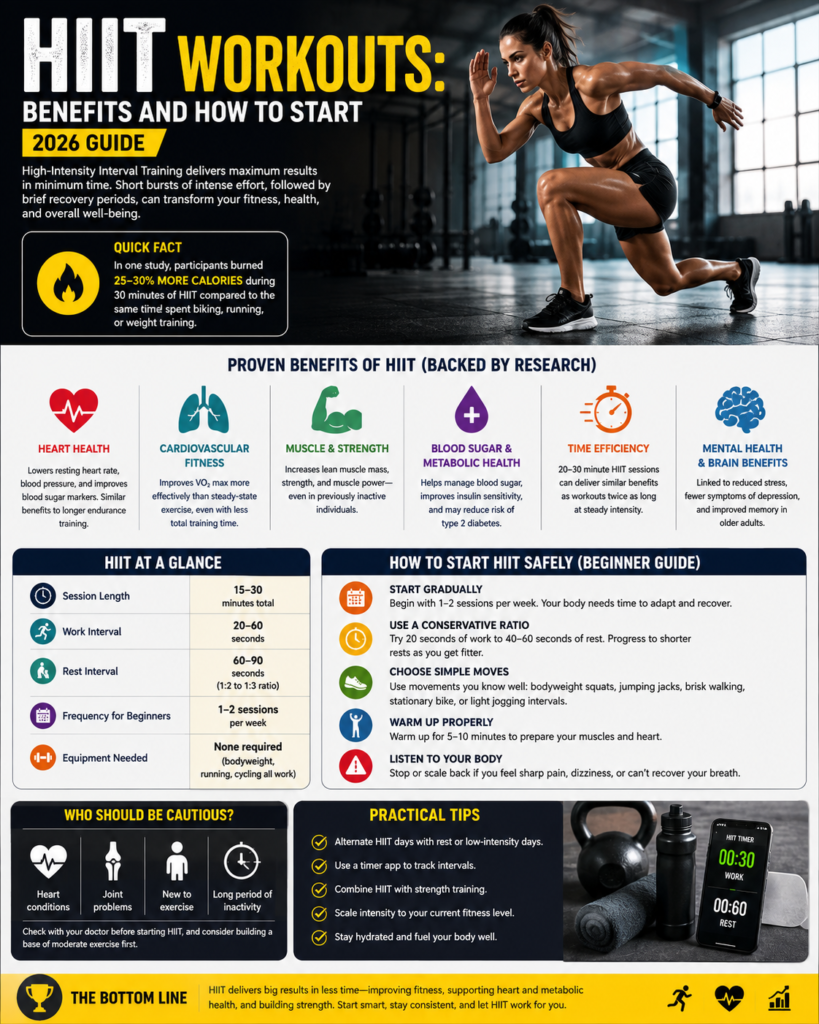
High-intensity interval training. The most time-efficient method. Intervals near maximum effort (2-4 minutes) alternated with recovery periods drive the cardiac adaptations — increased stroke volume in particular — that raise VO2 max fastest.
Moderate-intensity continuous training. Sustained aerobic work at a conversational-to-slightly-hard pace. Slower to produce change than HIIT, but lower injury risk and easier to sustain in volume.
Both together. Research supports both approaches; most effective programs combine a large base of moderate work with one to two higher-intensity sessions weekly.
Zone 2 as a base. Extended work at an easy, conversational intensity builds mitochondrial density and capillary networks — the peripheral machinery that supports a higher ceiling.
Improvements typically become measurable within 6-8 weeks of consistent training.
What People Actually Run Into
The most common frustration is wearable estimates that seem wrong or don’t move.
Two things drive this. First, these are algorithmic estimates from heart rate and pace, not gas analysis — accuracy varies meaningfully between devices and individuals. Second, the algorithms often need consistent outdoor running or cycling data to calibrate; strength training, swimming, and indoor work frequently don’t register at all.
The practical response is to treat the wearable number as a trend line rather than a measurement. If it’s moving up over months, your training is working, regardless of whether the absolute figure matches a lab test.
The second common experience is the plateau. VO2 max improves fastest in the untrained. The 15-30% gain figure applies to sedentary starting points; someone already reasonably fit sees smaller, slower increments. This is normal, not failure — and it’s the point where adding intensity, rather than more volume, usually matters more.
Third: many people discover their number is lower than expected because typical fitness routines skew toward strength or low-intensity movement. Both are valuable, but neither drives VO2 max much. The stimulus is sustained work at genuinely hard intensity, which most casual routines never reach.
Common Mistakes
Training only at moderate intensity. VO2 max responds to work near maximum capacity. A routine that never approaches hard effort won’t move it much.
Treating a wearable estimate as a measurement. Use it for direction over months, not for a precise figure or comparison against other people.
Comparing your number to elite athletes. The mortality research is about moving out of the bottom fitness categories, not reaching the top. The largest health returns are at the low end.
Focusing only on weight. The 2025 meta-analysis found fitness a stronger mortality predictor than BMI. Both matter, but fitness may be the more consequential target.
Expecting improvement in two weeks. Meaningful change typically requires 6-8 weeks of consistent training.
Assuming strength training will raise it. Resistance training has substantial independent health value, but it isn’t the primary driver of VO2 max.
Practical Tips
- Establish a baseline — wearable estimate or a Cooper test — then retest every 8-12 weeks under similar conditions.
- Add one to two higher-intensity sessions weekly rather than converting your whole routine; the base of easier work still matters.
- For a simple HIIT structure: 4 rounds of 4 minutes near maximum sustainable effort with 3 minutes easy recovery between.
- If using a wearable, run or cycle outdoors regularly enough for the algorithm to calibrate.
- Track the trend across months rather than reacting to weekly fluctuation.
If you’re building a complete routine, it’s worth pairing this with our guides on HIIT workouts and grip strength, since aerobic capacity and muscular strength are complementary — not interchangeable — longevity markers.
When Should You See a Doctor?
Talk to a doctor before beginning high-intensity interval training if you have known heart disease, uncontrolled high blood pressure, a history of chest pain or fainting during exertion, or have been sedentary for an extended period — HIIT involves working near maximum cardiac capacity.
Also seek evaluation for a noticeable, unexplained decline in exercise capacity, unusual breathlessness at previously manageable intensities, or chest discomfort during exertion. These warrant assessment rather than being trained through.
Frequently Asked Questions
What is a good VO2 max for my age? It varies substantially by age and sex — roughly 44-51 ml/kg/min is good for men aged 20-29, and 33-41 for women in the same range, with values declining across decades. Your own trend over time is more meaningful than the percentile.
Are smartwatch VO2 max estimates accurate? They’re algorithmic estimates from heart rate and pace, not direct measurements, and accuracy varies by device. They’re useful for tracking your trend rather than for a precise figure.
How long does it take to improve VO2 max? Measurable improvement typically appears within 6-8 weeks of consistent training, with sedentary individuals seeing gains of 15-30% with structured programs.
Is VO2 max more important than body weight for health? A 2025 meta-analysis of nearly 400,000 people found fitness a stronger mortality predictor than BMI, with obese-but-fit individuals showing no significant risk increase versus normal-weight fit individuals.
Does strength training improve VO2 max? Not substantially. Resistance training has significant independent health benefits, but aerobic work at higher intensities is the primary driver of cardiorespiratory fitness.
The Bottom Line
VO2 max earned its case as a vital sign by outperforming smoking, diabetes, and hypertension as a mortality predictor across millions of participants — and by being one of the few risk factors you can genuinely change. The most useful finding isn’t at the elite end: it’s that moving out of the lowest fitness category delivers the largest return. If you’ve never measured it, a rough baseline and one or two harder sessions a week is a reasonable place to start.
This article is for general informational purposes and is not a substitute for personalized medical or fitness advice. Consult a healthcare provider before beginning high-intensity exercise, particularly with existing cardiovascular conditions.
References
- British Journal of Sports Medicine — Cardiorespiratory Fitness, Body Mass Index and Mortality: A Systematic Review and Meta-Analysis (2025)
- American Heart Association — Scientific Statement on Cardiorespiratory Fitness as a Clinical Vital Sign
- Mayo Clinic Proceedings — Cardiorespiratory Fitness and All-Cause Mortality Meta-Analysis