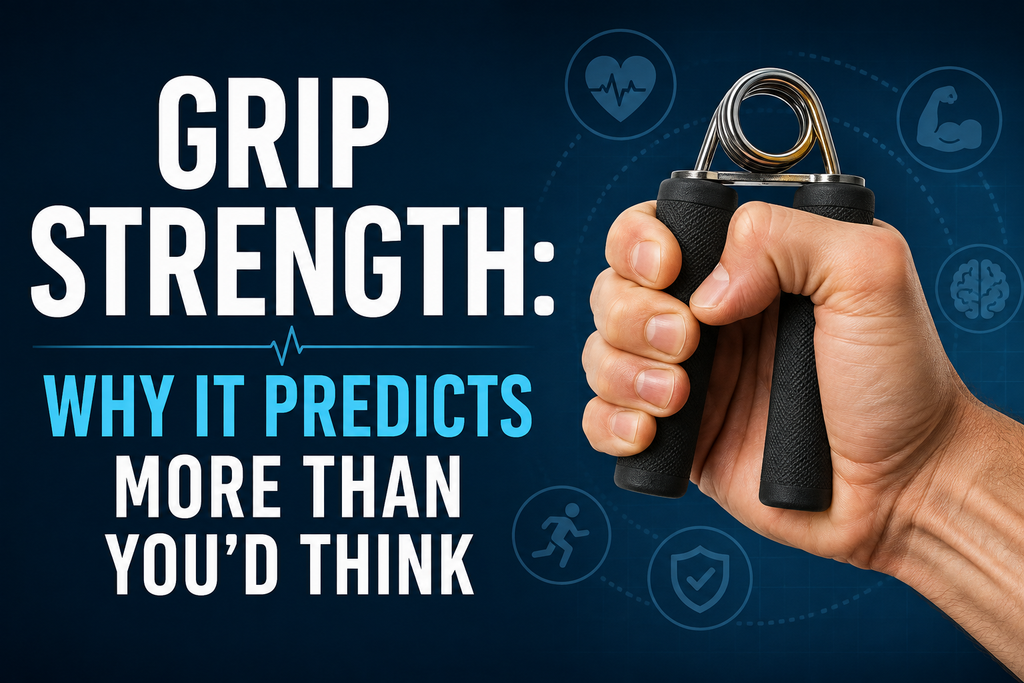
A hand dynamometer costs about twenty dollars and takes five seconds to use. In some research, the number it produces predicts mortality risk more accurately than blood pressure.
That sounds like it shouldn’t be true. Squeezing a device harder doesn’t extend your life. But grip strength isn’t really measuring your hands — it’s a fast, cheap proxy for total muscular reserve, neuromuscular function, and biological aging. Which is why researchers have started calling it a new vital sign.
Quick Fact: A meta-analysis of 42 studies found people with low grip strength had a 67% higher risk of early death from all causes compared with those in the high-strength group.
What Grip Strength Is Actually Measuring
Your grip involves muscles in the hand and forearm, but the number correlates with far more than that.
Total skeletal muscle strength. Handgrip strength reflects overall muscular capacity, which is why it’s used to screen for sarcopenia — the age-related loss of muscle mass and function.
Neuromuscular efficiency. Producing maximal force requires the nervous system to recruit motor units effectively. A declining grip often reflects degraded signaling, not just smaller muscles.
Physiological reserve. This is the concept underneath everything else: the buffer your body has to absorb illness, surgery, or injury and recover. Low reserve is why the same pneumonia is survivable at 60 and life-threatening at 85.
So grip strength isn’t causal. It’s an unusually good window into systems that are hard to measure any other way.
What the Research Actually Found
Each 5 kg decrease in grip strength has been associated with a 16% higher risk of all-cause mortality and a 21% increased risk of cardiovascular mortality, independent of other health factors.
A U.S. study using NHANES data on 9,583 adults found all grip strength metrics inversely correlated with all-cause mortality. Those in the bottom 20% had hazard ratios of 2.20 for men and 2.52 for women — roughly double to two-and-a-half times the risk.
The most interesting finding comes from the Newcastle 85+ Study, which followed 845 adults aged 85 and over for nearly a decade. It examined not just baseline grip strength but the rate of change:
- Participants whose grip declined had a 16% (men) and 33% (women) increased mortality risk per kg/year of decline
- Participants whose grip increased over five years had a 31% decreased mortality risk — regardless of where they started
That last point matters enormously. The trajectory was protective independent of the baseline. Starting weak wasn’t the problem; staying on a downward slope was.
Quick Reference: What the Numbers Show
| Finding | Result |
|---|---|
| Low grip strength (meta-analysis, 42 studies) | 67% higher all-cause mortality risk |
| Each 5 kg decrease | 16% higher all-cause, 21% higher CV mortality |
| Bottom 20% of grip strength | 2.2× (men) / 2.5× (women) mortality risk |
| Improving grip over 5 years (age 85+) | 31% lower mortality risk, regardless of baseline |
| Muscle loss after age 40 | Up to 8% per decade, accelerating later |
How to Test It
With a dynamometer (the standard method): Sit with your elbow bent at 90 degrees, arm at your side, and squeeze maximally for 3-5 seconds. Take three attempts per hand with a minute of rest between, and record the highest value.
Without one, two rough field tests are commonly used:
- Dead hang. Hang from a pull-up bar with a full grip. Under 30 seconds suggests room for improvement; 60+ seconds is a reasonable target for most adults.
- Farmer’s carry. Carry a heavy object in each hand and walk. Being able to carry roughly half your bodyweight total for 60 seconds is a common informal benchmark.
These aren’t clinical measures, but they track the same underlying capacity and require no equipment purchase.
Quick Reference: General Adult Grip Strength Ranges
| Age Group | Men (kg) | Women (kg) |
|---|---|---|
| 20–39 | 45–55 | 27–34 |
| 40–59 | 40–50 | 24–31 |
| 60–74 | 32–42 | 20–27 |
| 75+ | 25–35 | 16–22 |
Approximate ranges for dominant hand; norms vary by population and measurement protocol. Use your own trend over time as the more meaningful signal.
How to Actually Improve It
The single most important point: the best way to improve grip strength is general strength training, not gadgets. Grip trainers and squeeze balls work the forearms in isolation, but they don’t build the total-body muscle mass and neuromuscular capacity that grip strength is a proxy for.
Carries. Farmer’s carries, suitcase carries (one side only), and trap bar carries load the grip under sustained tension while training the whole posterior chain.
Pulling movements without straps. Deadlifts, rows, and pull-ups all tax the grip heavily. Using lifting straps removes exactly the stimulus you want here — save straps for your heaviest working sets only.
Dead hangs. Simple, requires only a bar, and doubles as shoulder decompression.
Progressive overload. A network meta-analysis on resistance training for improving handgrip strength in older adults with sarcopenia confirms this responds to structured progression like any other strength quality — gradually increasing resistance or duration over time.
Frequency. Two to three sessions weekly is sufficient; the forearms recover reasonably quickly but respond better to consistency than volume.
What People Get Wrong About It
The most common misreading is treating grip strength as the goal rather than the indicator.
People buy a grip trainer, squeeze it while watching TV, improve their crushing strength — and change essentially nothing about the underlying physiological reserve the metric was reflecting. It’s a bit like polishing a thermometer to lower a fever. The reading isn’t the thing.
The second common misconception is age fatalism. Muscle mass declines up to 8% per decade after 40 and faster after 60, and many people treat that as a schedule rather than a tendency. The Newcastle finding directly contradicts that: people over 85 who increased grip strength over five years saw a 31% lower mortality risk. Adaptation doesn’t have an expiration date.
Third, people frequently discover their grip is the limiting factor in other lifts before they realize it’s weak. A common experience: your back and legs could pull more on a deadlift, but your hands give out first. That’s useful diagnostic information most people work around with straps rather than addressing.
Common Mistakes
Using grip trainers instead of strength training. Isolated squeezing builds a narrow skill; it doesn’t build the systemic capacity the measurement reflects.
Using lifting straps on every set. Straps let you lift more weight while training your grip less. Reserve them for top-end sets where grip genuinely limits a target training stimulus.
Comparing your number to population averages instead of your own trend. The research on trajectory is more compelling than the research on baseline. Your direction of travel matters more than your percentile.
Testing inconsistently. Different arm positions, times of day, or fatigue states produce meaningfully different readings. Standardize the conditions or the trend is noise.
Assuming it’s only relevant for older adults. Grip strength predicts outcomes across age groups, and the trajectory established in midlife shapes where you start later.
Ignoring a sudden drop. A meaningful, unexplained decline over months is worth mentioning to a doctor — it can accompany underlying conditions rather than simply reflecting reduced training.
Practical Tips
- Test once, record it, and retest every 3-6 months under the same conditions — the trend is the useful data.
- Drop lifting straps from your warm-up and mid-range sets; that alone adds substantial weekly grip work.
- Add a farmer’s carry at the end of two workouts weekly — 30-40 seconds per set, heavy enough that holding on is the challenge.
- Try a dead hang daily for 20-30 seconds; it’s the lowest-friction way to build consistency.
- If your grip fails before your back on pulls, treat that as a training target rather than a problem to engineer around.
If you’re building a broader strength routine, it’s worth pairing this with our guides on strength training for beginners and progressive overload, since grip strength improves through the same principles that drive every other strength quality.
When Should You See a Doctor?
Talk to a doctor about a noticeable, unexplained decline in grip strength over a period of months, particularly if it’s accompanied by unintended weight loss, fatigue, or difficulty with everyday tasks like opening jars or carrying groceries — this pattern can reflect sarcopenia or other underlying conditions worth evaluating.
Also seek evaluation for grip weakness accompanied by numbness, tingling, or pain in the hand or arm, which may indicate a nerve issue rather than a strength issue, and for sudden weakness on one side, which requires urgent assessment.
Frequently Asked Questions
Does improving grip strength actually make you live longer? Not directly. Grip strength is a marker of total muscle strength and physiological reserve rather than a cause of longevity — but improving it through strength training addresses the underlying factors it reflects, and research found improving grip over time was associated with meaningfully lower mortality risk.
How often should I measure my grip strength? Every three to six months is sufficient, using the same equipment, arm position, and time of day so the comparison is meaningful.
Are grip trainers worth buying? For grip strength as a health marker, general strength training is far more effective. Grip trainers can help with specific sports or climbing goals, but they don’t build the systemic capacity that makes grip strength predictive.
Is it too late to improve grip strength if I’m older? No. Research in adults aged 85 and over found those who increased grip strength over five years had a 31% lower mortality risk regardless of their starting point.
Why does grip strength predict health better than some standard vital signs? Because it integrates several systems at once — muscle mass, neuromuscular function, and physiological reserve — into a single measurement, whereas blood pressure or cholesterol each reflect one narrower dimension.
The Bottom Line
Grip strength earned its reputation as a “new vital sign” because it captures something no single lab value does: how much functional reserve you have left. The research on trajectory is the part worth acting on — people who improved their grip saw lower mortality risk regardless of where they began, including well into their eighties. The lever isn’t a grip trainer. It’s the strength training the number was quietly reporting on all along.
This article is for general informational purposes and is not a substitute for personalized medical or fitness advice. Consult a healthcare provider about unexplained strength decline or before beginning a new training program.
References
- Age and Ageing (Newcastle 85+ Study) — Initial Level and Rate of Change in Grip Strength Predict All-Cause Mortality
- Frontiers in Physiology — Optimal Dose of Resistance Training to Improve Handgrip Strength (2025)
- NIH (PubMed Central) — Handgrip Strength as a Predictor of Mortality