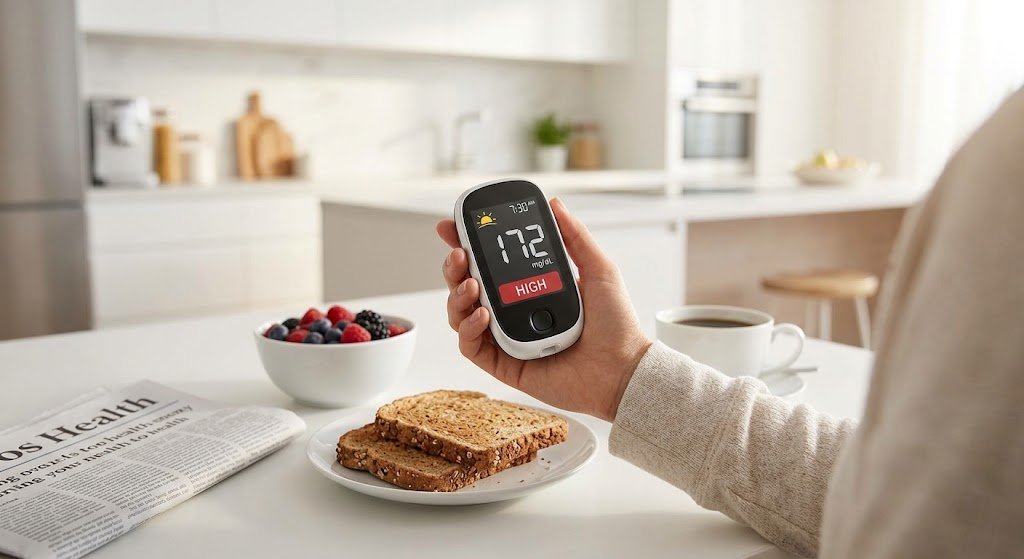
Blood sugar high in the morning is one of the most confusing patterns in diabetes. You go to bed with a stable reading, eat nothing overnight, and wake up higher than when you went to sleep.
It’s one of the most frustrating patterns in diabetes management, partly because it seems to defy arithmetic. No food went in, yet glucose went up.
There are three main explanations, and they require opposite responses. Two of them look identical on a morning reading, which is why getting the diagnosis right matters more than any single adjustment you might make.
Quick Fact: The dawn phenomenon affects more than 50% of people with type 1 or type 2 diabetes — making it far and away the most common cause of morning highs, and considerably more common than the Somogyi effect it’s often confused with.
Last reviewed: September 2026
The Three Causes
1. Dawn phenomenon. In the early morning hours — typically between 2 a.m. and 8 a.m. — your body releases cortisol, growth hormone, and catecholamines to prepare you for waking. These hormones signal your liver to release glucose for energy. In someone without diabetes, the pancreas releases matching insulin and levels stay stable. With diabetes, that compensation falls short, and glucose climbs.
This is a normal physiological process producing an abnormal result. Nothing has gone wrong overnight; the body simply can’t cover a routine hormonal surge.
2. Waning insulin. Longer-acting insulin wearing off before morning, or basal pump settings supplying too little overnight. Not a hormonal event — simply not enough insulin present during the hours it’s needed.
3. Somogyi effect (rebound hyperglycemia). Blood sugar drops too low overnight, and the body responds by releasing the same counterregulatory hormones — adrenaline, cortisol, growth hormone, glucagon — which overcorrect and drive glucose up. The morning reading is high because it was low a few hours earlier.
Quick Reference: Comparing the Three
| Cause | What’s Happening Overnight | Correct Response |
|---|---|---|
| Dawn phenomenon | Hormone surge raises glucose | May need more overnight coverage |
| Waning insulin | Insulin runs out too early | Adjust timing or dose |
| Somogyi effect | Glucose drops too low, rebounds | May need less insulin |
Why the Distinction Actually Matters
Here’s the part that makes this genuinely important rather than academic.
Dawn phenomenon and Somogyi effect can produce identical morning numbers — and the appropriate correction is the exact opposite in each case.
If it’s the dawn phenomenon, you may need more overnight insulin coverage. If it’s the Somogyi effect, more insulin would worsen the overnight low that caused the rebound in the first place, potentially dangerously.
Acting on the morning number alone means guessing between two options where one could be harmful. This is why the diagnostic step below isn’t optional.
How to Tell Them Apart
The method is straightforward: check what’s happening at 2-3 a.m.
- Glucose high or rising at 3 a.m. → dawn phenomenon or waning insulin
- Glucose low at 3 a.m. → suspect the Somogyi effect
Do this over several consecutive nights, not one. A single night can mislead — overnight patterns vary with the previous day’s food, activity, stress, and medication timing.
A continuous glucose monitor makes this considerably easier, since it captures the entire overnight curve rather than a single snapshot. If you have access to one, it answers the question in a night or two rather than a week of alarm-setting.
The Somogyi Debate Worth Knowing About
Honest coverage requires this: the Somogyi effect is scientifically contested.
Named after Dr. Michael Somogyi, who described it in the 1930s, the theory has been challenged by more recent continuous glucose monitoring research. Studies using CGM have disputed the mechanism, and clinicians have observed that patients with early-morning hyperglycemia tend to show high overnight glucose readings rather than low ones.
The American Diabetes Association describes the Somogyi effect as a “much rarer” cause than the dawn phenomenon and waning insulin.
Why include it at all? Because it still appears in clinical guidance, it’s still checked for, and rebound hyperglycemia after a genuine overnight low does occur. But if you’re weighing probabilities before testing, the dawn phenomenon is by far the more likely explanation.
What Actually Helps
For dawn phenomenon:
- Adjusting the timing of long-acting insulin rather than only the dose — taking it later can extend coverage into morning hours
- Basal rate adjustments for pump users, increasing coverage during early morning hours specifically
- Evening physical activity, which can improve overnight insulin sensitivity
- Reviewing evening carbohydrate intake and timing
For waning insulin:
- Later dosing of long-acting insulin
- Discussing a longer-duration insulin formulation with your provider
- Pump basal profile adjustment
For suspected Somogyi effect:
- Reducing evening insulin, not increasing it
- Reviewing whether a bedtime snack is appropriate
- Avoiding intense exercise immediately before bed, which can cause delayed overnight lows
Every one of these is a medication or regimen change. None should be made independently — they require your provider’s involvement, because getting the direction wrong carries real risk.
What People Actually Run Into
The most common instinct is exactly the wrong one: seeing a high morning number and adding insulin.
This is understandable and often correct for the dawn phenomenon. But applied to a Somogyi pattern, it deepens the overnight low that’s driving the rebound. People frequently describe a cycle of escalating evening doses with morning numbers that stay stubbornly high — because they’ve been treating the symptom while worsening the cause.
The second pattern is frustration at the apparent unfairness. Eating nothing and waking higher feels like a failure of effort, and people often assume they’ve done something wrong. The dawn phenomenon is not a behavioral failure — it’s a hormonal event that happens on schedule regardless of what you did the previous evening.
Third: many people never do the 3 a.m. check because it’s genuinely unpleasant. This is understandable, but it’s also why the pattern often goes unresolved for months. A CGM removes this obstacle entirely, and it’s worth raising with your provider specifically for this purpose if the morning highs are persistent.
Common Mistakes
Increasing evening insulin without checking overnight levels. If the cause is a rebound from an overnight low, more insulin makes it worse. Test first.
Judging from a single morning reading. One high morning is normal variation and has little effect on A1C. A consistent multi-day pattern is what warrants investigation.
Checking only once at 3 a.m. Overnight patterns vary night to night. Several consecutive nights give a real picture; one gives a guess.
Assuming you ate something wrong. The dawn phenomenon is hormonal and occurs independent of the previous evening’s meal.
Adjusting your own medication. These corrections move in opposite directions depending on cause, and the wrong direction can cause dangerous hypoglycemia.
Ignoring persistent morning highs as “just mornings.” Occasional highs matter little, but consistent ones raise A1C meaningfully over time.
Practical Tips
- Log bedtime, 3 a.m., and waking readings for three to five consecutive nights before drawing any conclusion.
- Ask your provider about a CGM specifically for overnight pattern detection if morning highs are persistent — it removes the need for alarm-set testing.
- Note evening variables alongside readings: dinner timing, carbohydrate amount, exercise, and medication time. Patterns often emerge from the context, not the numbers alone.
- Bring the full log to your appointment rather than describing the pattern from memory.
- Ask specifically about insulin timing, not just dose — for waning insulin, when you take it matters as much as how much.
If you’re managing blood sugar more broadly, it’s worth pairing this with our guides on normal blood sugar levels and sleep and blood sugar, since overnight glucose patterns and sleep quality influence each other directly.
When Should You See a Doctor?
Contact your provider if morning highs persist for several consecutive days, since consistent elevation raises A1C over time even when individual readings seem manageable. Bring your overnight log — the 3 a.m. data is what allows an accurate adjustment rather than a guess.
Seek prompt guidance if you experience symptoms of overnight lows: night sweats, nightmares, waking with a headache, or unusual morning fatigue. These can indicate nocturnal hypoglycemia, which carries its own risks independent of the morning reading.
Do not adjust insulin doses independently. The correct adjustment differs by cause, and moving in the wrong direction can cause serious hypoglycemia.
Frequently Asked Questions
Why is my blood sugar higher in the morning than before bed? Most commonly the dawn phenomenon — a normal early-morning hormone surge that signals the liver to release glucose. In diabetes, insulin can’t fully compensate, so levels rise despite eating nothing.
How do I know if it’s the dawn phenomenon or the Somogyi effect? Check your glucose at 2-3 a.m. across several nights. High or rising suggests dawn phenomenon; low suggests a Somogyi rebound. A CGM captures this automatically.
Does the dawn phenomenon affect people without diabetes? The hormonal surge occurs in everyone, but people without diabetes produce matching insulin, so glucose stays stable. The rise only becomes visible when insulin response is impaired.
Should I eat a bedtime snack to prevent morning highs? It depends entirely on the cause. It may help with a Somogyi pattern but is unlikely to help — and could worsen — dawn phenomenon. This is a question for your provider after identifying the pattern.
Is one high morning reading a problem? Generally not. An occasional morning high has little impact on A1C. Consistent highs across multiple days are what warrant investigation and adjustment.
The Bottom Line
Morning highs have three common explanations that produce the same number and demand different responses — sometimes opposite ones. The dawn phenomenon is by far the most likely, affecting over half of people with diabetes, and it isn’t caused by anything you did the night before. The single most useful step isn’t an adjustment at all: it’s checking what your glucose is actually doing at 3 a.m., across several nights, before changing anything.
This article is for general informational purposes and is not a substitute for personalized medical advice. Never adjust insulin or diabetes medication without consulting your healthcare provider.
References
- American Diabetes Association — High Morning Blood Glucose
- Cleveland Clinic — Dawn Phenomenon: Causes, Symptoms & Treatment
- NIH (StatPearls) — Somogyi Phenomenon