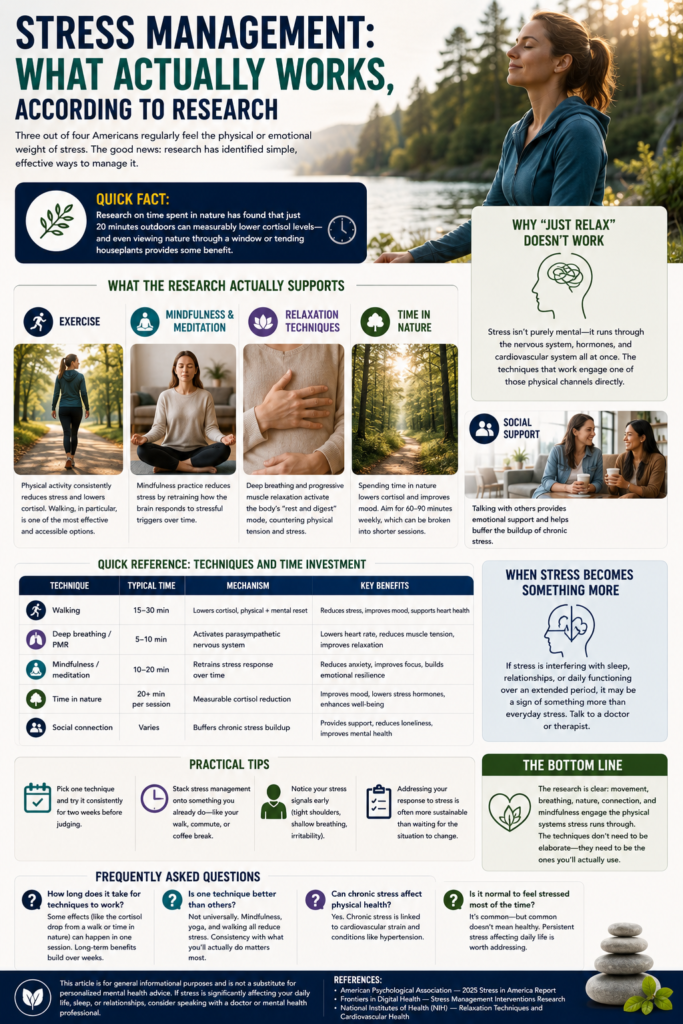
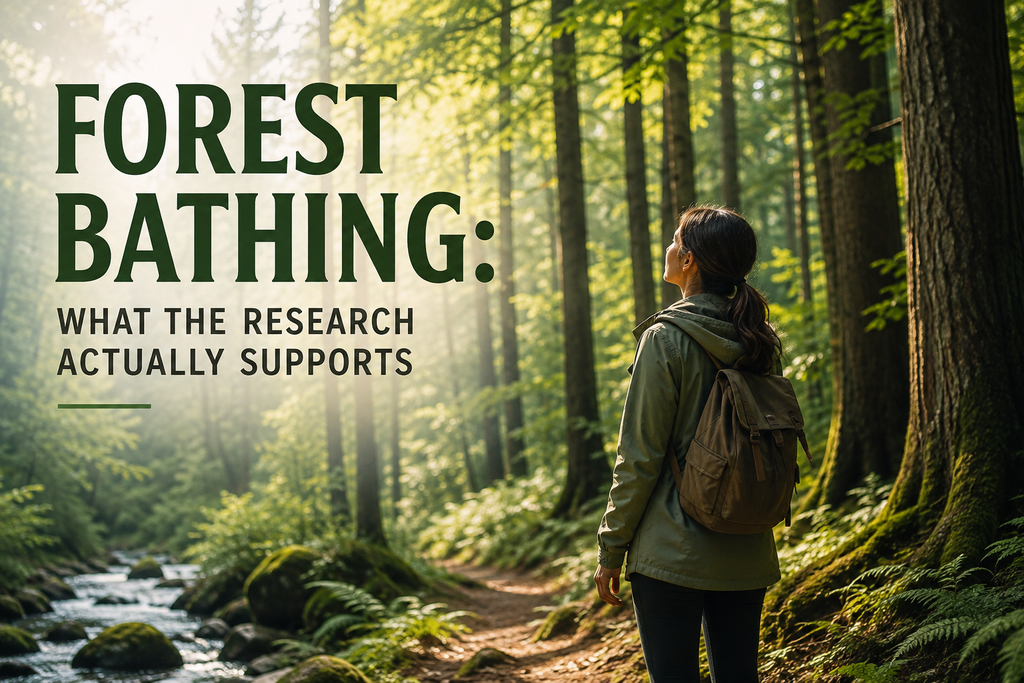
In the 1980s, Japan’s Forestry Agency coined a term for a practice it wanted people to take seriously: shinrin-yoku, or “forest bathing.” It wasn’t hiking, exercise, or tourism. It was slow, deliberate sensory attention to a forest environment.
Four decades later, it has an unusual amount of research behind it for something that sounds like a wellness trend. Studies have measured cortisol, blood pressure, immune cell activity, and mood — and found consistent effects. They’ve also found real limitations that most coverage skips.
Both parts are worth knowing.
Quick Fact: Forest bathing has been associated with enhanced natural killer (NK) cell activity — immune cells that target virus-infected and tumor cells — alongside reduced cortisol and a measurable shift toward parasympathetic nervous system dominance.
What It Actually Is (and Isn’t)
Forest bathing means immersing yourself in a forest atmosphere through all five senses, slowly and mindfully. There’s no destination, no pace target, and no distance.
That distinction matters because it separates the practice from a hike. Hiking is exercise in nature; forest bathing is attention in nature. The research measures the latter, and several studies specifically compare forest bathing against equivalent walking in urban environments to isolate the environment itself from the movement.
A typical session runs two to three hours over a short distance — sometimes under a mile — with frequent stops.
The Physiological Findings
Stress hormones. Reductions in salivary cortisol are among the most consistently replicated findings across studies in Japan, Europe, and the United States.
Autonomic shift. Research documents a shift toward parasympathetic dominance — the “rest and digest” branch of the nervous system — which shows up as lower heart rate and reduced physiological arousal.
Blood pressure. Nature exposure has been associated with reductions in blood pressure across multiple studies, which is why a 2026 Brazilian study examined it specifically as a cardiovascular intervention within a public health system.
Immune markers. This is the most distinctive finding. Studies report enhanced natural killer cell activity, modulation of inflammatory cytokine profiles, and changes in markers like salivary IgA. Some research suggests effects persisting for days to weeks after a session rather than only during it.
Quick Reference: Documented Effects
| Outcome | Evidence Strength |
|---|---|
| Reduced cortisol | Consistent across multiple studies |
| Parasympathetic shift (lower HR) | Well documented |
| Reduced anxiety and stress scores | Consistent |
| Lower blood pressure | Documented, moderate |
| Enhanced NK cell activity | Documented, distinctive to forest exposure |
| Improved sleep quality | Emerging |
| Improved mood/depression scores | Documented, moderate |
The Phytoncide Hypothesis
This is where forest bathing differs from “spending time outdoors” generally.
Trees emit phytoncides — antimicrobial volatile organic compounds, including compounds like alpha-pinene and limonene — as a defense against insects and pathogens. Researchers have proposed these airborne compounds as a mechanism behind the immune effects, particularly the NK cell activity.
Evergreen forests appear to release higher concentrations, which is why some research specifically examines low-latitude evergreen broad-leaved forests as potentially amplifying the benefits.
Worth stating plainly: this remains a hypothesis with supporting evidence, not settled mechanism. Reviews describe phytoncides as playing a “contributory role” rather than a proven causal one.
What the Research Doesn’t Show
Honest coverage requires this section, and most articles omit it.
A 2025 narrative review published in Frontiers in Public Health asked directly whether forest bathing is “a panacea for mental health problems.” The framing itself signals the answer.
Heterogeneity is substantial. Reviews consistently note wide variation in study design, session length, forest type, participant populations, and measured outcomes — which makes pooling results difficult and effect sizes hard to pin down.
Study quality varies. An umbrella review found the reviews it examined were rated moderate to low quality, not high.
Longitudinal data is limited. Most research measures short-term effects. Whether benefits persist over years with regular practice is largely unstudied.
Blinding is impossible. You cannot conceal from participants whether they’re in a forest, so expectation effects can’t be separated from environmental ones.
None of this means the effects aren’t real. It means the confident claims about specific numbers — precise cortisol percentages, exact immune boosts — outrun what the evidence supports.
How Much and How Often
The research doesn’t converge on a single protocol, but some patterns appear:
- Session length: Commonly two hours or more; some benefits documented at shorter durations
- Frequency: Studies vary widely; one Brazilian trial used eight sessions over a period
- Distance: Short — the practice emphasizes slowness over coverage
- Persistence: Some immune effects reported lasting days to weeks post-session
For anyone without access to a forest, related research on general nature exposure suggests shorter, more frequent contact with green space also produces measurable benefits — a useful fallback when a two-hour forest session isn’t realistic.
Quick Reference: Forest Bathing vs. Related Practices
| Practice | Primary Focus | Documented Distinction |
|---|---|---|
| Forest bathing | Sensory immersion, slowness | Immune markers, phytoncide exposure |
| Hiking | Physical exertion | Cardiovascular fitness |
| Urban park walk | Movement + some green space | Mood benefits, weaker immune data |
| Indoor meditation | Attention training | Stress reduction without nature exposure |
What People Actually Experience
The most common obstacle isn’t access — it’s the slowness.
People arrive expecting a nature walk and find the pace genuinely uncomfortable. Covering under a mile in two hours conflicts with how most adults are conditioned to move through outdoor space. Several forest therapy guides describe the first twenty to thirty minutes as the hardest, with the shift usually happening after that.
The second common report involves phones. The practice depends on unplugging, and many people find they reach for a device reflexively within minutes without deciding to. Leaving it in the car is a frequently cited fix that works better than intending to resist.
Third, and reassuringly: people frequently assume they need an old-growth forest to get anything from it. Research on general nature exposure suggests smaller green spaces still produce measurable benefits, which makes a local wooded park a legitimate starting point rather than a compromise.
Common Mistakes
Treating it as a hike. Exercise in nature is valuable, but it’s a different intervention. Forest bathing research specifically measures slow sensory immersion.
Bringing your phone. Notifications reintroduce exactly the stimulus the practice is designed to remove. Leaving it behind is more effective than planning not to check it.
Expecting dramatic, immediate effects. Documented changes are physiological and measurable, not experiential fireworks. People often report the benefit registering after the session rather than during it.
Waiting for the perfect forest. Smaller green spaces show benefits in the broader nature-exposure literature. Access shouldn’t be the barrier.
Rushing the first thirty minutes. This is the period where most people feel restless and give up on the pace. It typically resolves.
Believing precise claims about cortisol percentages or immune boosts. Study heterogeneity is substantial and effect sizes vary. The direction of the effect is better supported than any specific number.
Practical Tips
- Leave your phone in the car rather than silencing it; the reflex to check is stronger than most people expect.
- Aim for slowness over distance — under a mile in two hours is a reasonable target, not a failure.
- Engage senses deliberately: notice sounds, textures, and smell rather than only looking.
- Try evergreen or mixed forests if available, since phytoncide concentrations appear higher, though this is a hypothesis rather than established fact.
- If two hours isn’t realistic, shorter and more frequent green space exposure still has supporting evidence.
If you’re building a broader wellness routine, it’s worth pairing this with our guides on stress management techniques and morning light and your circadian rhythm, since outdoor time delivers both benefits simultaneously.
When Should You See a Doctor?
Forest bathing is low-risk for most people, but talk to a doctor before extended outdoor sessions if you have severe seasonal allergies, asthma triggered by pollen or mold, a condition affecting balance or mobility on uneven terrain, or a compromised immune system that may warrant caution about tick-borne illness.
More importantly: nature-based practices are a complement to mental health care, not a substitute. If you’re experiencing persistent depression or anxiety that affects daily functioning, that warrants professional evaluation regardless of how much time you spend outdoors.
Frequently Asked Questions
Is forest bathing just walking in the woods? No. It’s slow, mindful sensory immersion with no distance or pace goal — typically under a mile over two hours. Research distinguishes it from hiking, which is measured as exercise.
How long does a forest bathing session need to be? Commonly two hours or more in the research, though benefits have been documented at shorter durations. Shorter, more frequent nature exposure also shows measurable effects.
What are phytoncides? Antimicrobial compounds trees release as a natural defense. Researchers propose them as a contributing mechanism behind observed immune effects, though this remains a supported hypothesis rather than proven.
Do the effects last after I leave the forest? Some research reports immune-related effects persisting for days to weeks after a session, though longitudinal evidence on sustained practice is limited.
Can I get the same benefits from a city park? Partially. General nature-exposure research documents benefits from smaller green spaces, though phytoncide-related immune effects are specifically studied in forest environments.
The Bottom Line
Forest bathing sits in an unusual position: better-researched than most wellness practices, and still less proven than its most confident advocates suggest. The consistent findings — lower cortisol, parasympathetic shift, improved mood, enhanced NK cell activity — are worth taking seriously. So is the acknowledgment that study quality is mixed and the mechanism is still a hypothesis. It’s low-risk, low-cost, and reasonably supported, which is a fair standard for something that mostly asks you to walk slowly and pay attention.
This article is for general informational purposes and is not a substitute for personalized medical or mental health advice. Nature-based practices complement but do not replace professional treatment.
References
- Frontiers in Public Health — Is Forest Bathing a Panacea for Mental Health Problems? A Narrative Review (2025)
- International Journal of Environmental Research and Public Health — Shinrin-Yoku and Nature Therapy: A State-of-the-Art Review
- PubMed — Forest Bathing and Preventive Medicine: Immune Modulation and Stress Regulation (2026)