Diet and exercise dominate every conversation about blood sugar management. Sleep barely gets mentioned — which is strange, given that a single night of poor sleep can measurably reduce insulin sensitivity, and a 2025 study found that catching up on sleep over the weekend doesn’t undo the metabolic damage from a short-sleeping workweek.
Sleep isn’t passive downtime. It’s an active metabolic process, and treating it as optional is one of the more consequential blind spots in diabetes prevention and management.
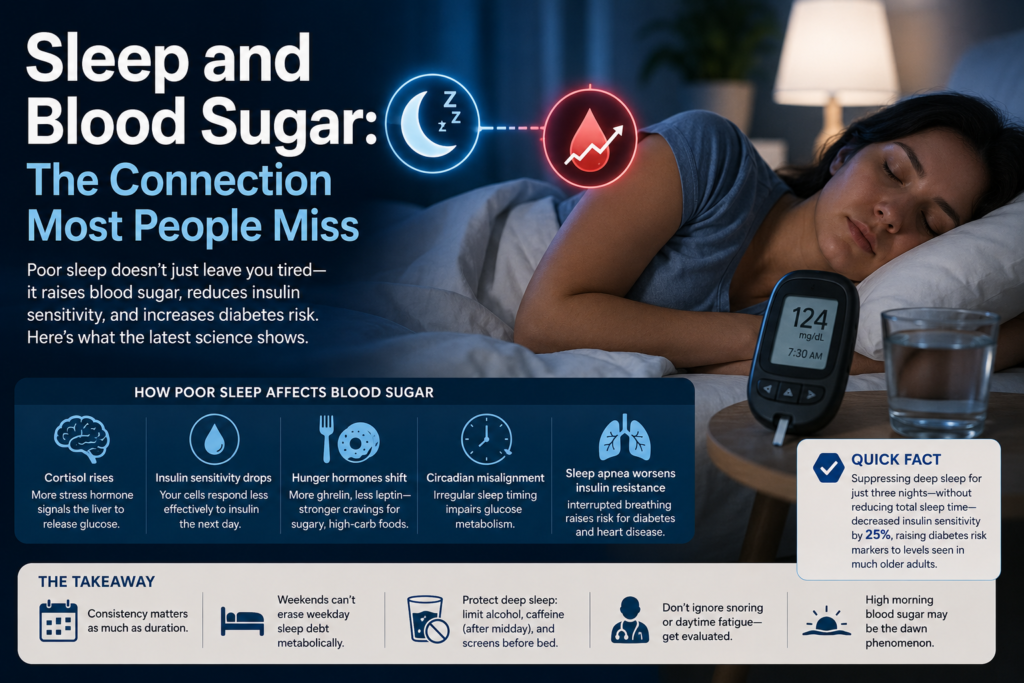
Quick Fact: A landmark study found that selectively suppressing deep sleep for just three nights — without reducing total sleep time at all — decreased insulin sensitivity by 25%, pushing diabetes risk markers to levels typically seen in much older adults.
What Happens to Your Blood Sugar While You Sleep
Blood sugar naturally rises overnight as part of your circadian rhythm, typically peaking between 4 and 8 a.m. — a pattern known as the dawn phenomenon. In someone with normal insulin function, this surge is handled automatically: insulin signals muscle, fat, and liver cells to absorb the extra glucose, and levels stay stable.
For people with diabetes or prediabetes, insulin can’t manage that surge as efficiently, which is why morning fasting blood sugar can read higher than expected even after eating nothing all night. Poor sleep makes this worse — when the body doesn’t get restorative sleep, it overcompensates by releasing more glucose and stress hormones, intensifying the dawn effect.
The Four Mechanisms Behind the Connection
1. Cortisol rises when it should be falling. Sleep deprivation elevates cortisol, particularly in the evening when it should naturally be declining. Cortisol signals your liver to release more glucose into the bloodstream — essentially telling your body to prepare for stress that isn’t coming.
2. Insulin sensitivity drops. This is the most direct effect. Research has found that even partial sleep deprivation over a single night increases insulin resistance, meaning your cells respond less efficiently to insulin the following day.
3. Hunger hormones shift. Sleep loss raises ghrelin (which drives hunger) and lowers leptin (which signals fullness). The practical result: stronger cravings, particularly for high-carbohydrate and sugary foods, at exactly the time your body is least equipped to process them efficiently.
4. Circadian misalignment impairs glucose metabolism. This one is independent of sleep duration. Shift workers and people with irregular schedules show impaired glucose metabolism even when total sleep hours are adequate, suggesting when you sleep matters alongside how much.
Quick Reference: How Sleep Affects Blood Sugar
| Sleep Factor | Metabolic Effect |
|---|---|
| Less than 6 hours nightly | Significantly higher type 2 diabetes risk |
| Suppressed deep sleep | Insulin sensitivity drops up to 25% |
| Irregular sleep schedule | Impaired glucose metabolism, higher diabetes risk |
| Elevated evening cortisol | Liver releases more glucose |
| Sleep apnea (untreated) | Worsens insulin resistance, raises cardiovascular risk |
| More than 9 hours nightly | Associated with higher diabetes risk (mechanism unclear) |
The Weekend Catch-Up Myth
This is the finding worth changing behavior over. A 2025 study published in SLEEP by researchers at the National University of Singapore tested exactly what most people actually do: short sleep on weekdays, extended sleep on weekends.
Forty-eight healthy young adults were assigned to sleep schedules simulating either “stable short sleep” (six hours each weeknight, eight on weekends) or “variable short sleep” (fluctuating between four and eight hours on weeknights, eight on weekends), with glucose tolerance tested throughout.
The finding: insufficient weekday sleep significantly disrupted glucose metabolism even when weekend sleep was extended. The weekend recovery didn’t reset the metabolic cost of the workweek.
This matters because “I’ll catch up on the weekend” is an extremely common strategy — and the research suggests it addresses how you feel far better than it addresses what’s happening metabolically.
Consistency May Matter More Than Duration
A related and slightly counterintuitive finding: data from the UK Biobank, tracking over 84,000 middle-aged and older adults, found that greater night-to-night variability in sleep duration — not just short sleep — was associated with higher type 2 diabetes risk.
In other words, someone sleeping a consistent six and a half hours may be metabolically better off than someone averaging seven hours but swinging between four and ten. Regularity appears to be its own independent factor, separate from total hours.
It’s worth noting the research isn’t entirely one-directional. A 2025 study on healthy university students found that moderate, real-world sleep fluctuations didn’t significantly affect next-day glucose profiles in that specific population — suggesting young, healthy people may be more metabolically resilient to occasional sleep loss than assumed. The concern is chronic patterns, not any single bad night.
The Sleep Apnea Blind Spot
Obstructive sleep apnea is especially common in people with type 2 diabetes and frequently goes undiagnosed. It causes repeated breathing interruptions during sleep, fragmenting rest and reducing oxygen levels — and left untreated, it worsens insulin resistance and elevates cardiovascular risk.
The overlap is significant enough that clinicians increasingly screen for it during diabetes care. Loud snoring, gasping during sleep, and persistent daytime fatigue despite adequate time in bed are the signals that warrant evaluation rather than dismissal.
A Cycle That Runs Both Directions
The relationship isn’t one-way. Poor sleep worsens blood sugar control, but unstable blood sugar also disrupts sleep — nighttime hyperglycemia and hypoglycemia both cause awakenings and next-day fatigue.
This creates a self-reinforcing loop: poor sleep raises blood sugar, unstable blood sugar fragments sleep, fragmented sleep raises blood sugar further. Breaking in at either point — improving sleep hygiene or tightening daytime glucose control — tends to improve both.
Practical Tips
- Prioritize schedule consistency over total hours if you have to choose — going to bed and waking at similar times daily has independent metabolic value.
- Don’t rely on weekend catch-up sleep to offset short weeknights; the research suggests it doesn’t reverse the metabolic effect.
- Protect deep sleep specifically by limiting alcohol, avoiding caffeine after midday, and reducing screen exposure before bed — all of which reduce slow-wave sleep even when total sleep time looks fine.
- Mention loud snoring or persistent daytime fatigue to your doctor rather than treating it as normal, particularly if you have type 2 diabetes or prediabetes.
- If morning fasting readings run high despite no overnight eating, discuss the dawn phenomenon with your doctor rather than assuming it’s a diet problem.
If you’re working on blood sugar management more broadly, it’s worth pairing this with our guides on normal blood sugar levels and sleeping better naturally, since the two areas reinforce each other more directly than most people realize.
When Should You See a Doctor?
Talk to a doctor if you regularly sleep less than seven hours, experience persistent daytime fatigue despite adequate time in bed, or have been told you snore loudly or stop breathing during sleep — especially if you have diabetes, prediabetes, or related risk factors. Also raise it if your morning fasting blood sugar consistently runs higher than expected, since sleep-related factors may be contributing in ways diet changes alone won’t address.
Frequently Asked Questions
How many hours of sleep do I need for healthy blood sugar? Major sleep organizations recommend at least seven hours nightly for adults. Research consistently associates less than six hours with meaningfully higher type 2 diabetes risk, while more than nine hours has also been linked to elevated risk for reasons that remain unclear.
Can catching up on sleep during the weekend fix weekday sleep loss? Not metabolically. A 2025 study found glucose regulation remained disrupted from insufficient weekday sleep even when weekend sleep was extended, suggesting recovery sleep helps how you feel more than how your body processes glucose.
Why is my blood sugar higher in the morning even though I didn’t eat? This is likely the dawn phenomenon — a natural circadian rise in blood sugar between roughly 4 and 8 a.m. In people with insulin resistance, the body can’t manage this surge as efficiently, and poor sleep can intensify it further.
Does sleep apnea really affect diabetes? Yes. Untreated obstructive sleep apnea worsens insulin resistance and raises cardiovascular risk, and it’s notably common — and frequently undiagnosed — among people with type 2 diabetes.
The Bottom Line
Sleep belongs in the same conversation as diet and exercise when it comes to blood sugar, not as an afterthought. The two findings most worth acting on: weekend catch-up sleep doesn’t appear to reverse the metabolic cost of short weeknights, and consistency of schedule may matter as much as total hours. Neither requires a dramatic overhaul — but both suggest that “I’ll sleep when I’m caught up” is a costlier strategy than it feels.
This article is for general informational purposes and is not a substitute for personalized medical advice. Consult a healthcare provider about persistent sleep problems or blood sugar concerns.
References
- NIDDK (National Institutes of Health) — The Impact of Poor Sleep on Type 2 Diabetes
- Sleep Foundation — Sleep and Blood Glucose Levels
- SLEEP (Oxford Academic) — Short and Irregular Weekday Sleep and Glucose Regulation (2025)