How many steps a day do you actually need? The 10,000-step target has been treated as settled science for decades — preloaded as the default goal on nearly every fitness tracker, quoted by trainers, and used as the benchmark people judge themselves against every evening.
It was never based on research. It came from a 1960s Japanese marketing campaign — and a major 2025 analysis of more than 160,000 adults finally established what the actual number looks like.
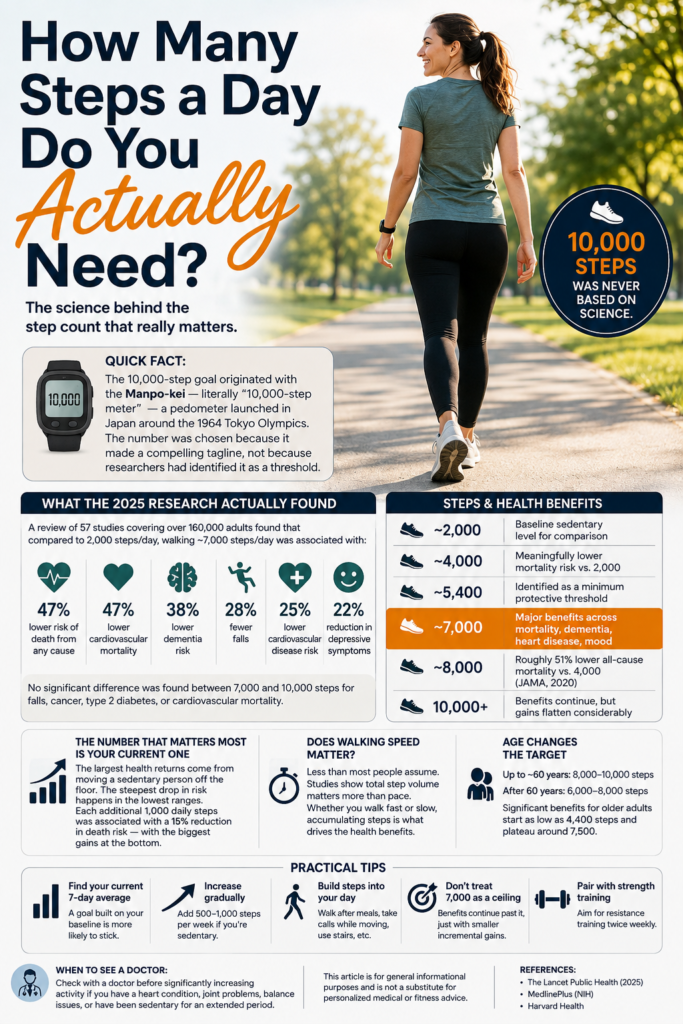
Quick Fact: The 10,000-step goal originated with the Manpo-kei — literally “10,000-step meter” — a pedometer launched in Japan around the 1964 Tokyo Olympics. The number was chosen because it made a compelling tagline, not because researchers had identified it as a threshold.
What the 2025 Research Actually Found
A review led by Professor Melody Ding at the University of Sydney, published in The Lancet Public Health in July 2025, pooled 57 studies from 35 cohorts covering over 160,000 adults. It examined step counts against a wide range of outcomes: all-cause mortality, cardiovascular disease, dementia, falls, cancer, type 2 diabetes, and depressive symptoms.
Compared with a largely sedentary 2,000 steps per day, walking around 7,000 steps was associated with:
- 47% lower risk of death from any cause
- 47% lower cardiovascular mortality
- 38% lower dementia risk
- 28% fewer falls
- 25% lower cardiovascular disease risk
- 22% reduction in depressive symptoms
Critically, the researchers found no significant difference in risk of falls, cancer, type 2 diabetes, or cardiovascular mortality between people walking 7,000 steps and those walking 10,000. The benefits largely plateau — they don’t disappear beyond 7,000, but the additional gains become small and incremental.
Quick Reference: Steps and Health Benefits
| Daily Steps | What the Research Associates With It |
|---|---|
| ~2,000 | Baseline sedentary level used for comparison |
| ~4,000 | Meaningfully lower mortality risk vs. 2,000 |
| ~5,400 | Identified as a minimum protective threshold |
| ~7,000 | Major benefits across mortality, dementia, heart disease, mood |
| ~8,000 | Roughly 51% lower all-cause mortality vs. 4,000 (JAMA, 2020) |
| 10,000+ | Benefits continue, but gains flatten considerably |
The Number That Matters Most Is Your Current One
This is the reframe worth taking away. The largest health returns don’t come from pushing an already-active person higher — they come from moving a sedentary person off the floor.
Research consistently shows the steepest drop in risk happens in the lowest ranges: someone averaging 2,000 steps who moves to 4,000 gains far more health benefit than someone at 9,000 who pushes to 12,000. One analysis published in the European Journal of Preventive Cardiology found that each additional 1,000 daily steps was associated with a 15% reduction in overall death risk — with the biggest absolute gains at the bottom of the range.
For anyone who has looked at 10,000 and decided the goal was out of reach, this is the practical point: your target isn’t a universal number. It’s your current baseline plus a manageable increase.
Does Walking Speed Matter?
Less than most people assume. Multiple studies have examined whether cadence — how briskly you walk — independently affects outcomes, and the answer has been surprisingly consistent.
An NIH-supported study following nearly 17,000 older women found that the number of steps mattered more than the speed. Whether participants walked quickly or slowly, total daily volume drove the benefit. The 2025 Lancet review reached a similar conclusion, noting that the relationship between cadence and health outcomes was notably less consistent than the relationship with total step volume.
This doesn’t mean intensity is irrelevant for fitness goals — brisk walking builds cardiovascular capacity in ways strolling doesn’t. But for the mortality and disease-risk outcomes these studies measured, accumulating steps appears to matter more than how fast you accumulate them.
Age Changes the Target
The optimal range isn’t identical across age groups, and this is where blanket advice tends to fail people.
Research suggests that for adults up to about age 60, roughly 8,000–10,000 steps daily is a reasonable target for maintaining health. After 60, the benefit curve shifts down: around 6,000–8,000 steps appears sufficient, with benefits leveling off earlier.
The NIH study on older women found significant benefits starting at just 4,400 steps daily — a 41% lower risk of death compared with 2,700 steps — with the effect plateauing around 7,500. For older adults specifically, chasing 10,000 offers little additional documented return over targets that are considerably easier to sustain.
An Honest Note on the Evidence
Worth stating plainly: most of this research is observational. It shows strong, consistent associations, not proof of causation. Reverse causation is genuinely plausible — people who are already sicker walk less, which can make walking look more protective than it independently is. Researchers adjusted for many confounding factors, but couldn’t eliminate this entirely.
The researchers themselves also acknowledge limitations: potential biases in individual studies, and relatively few studies available for some specific outcomes.
None of this undermines the practical conclusion — moving more is clearly better than moving less — but it’s worth knowing the evidence is strong rather than airtight.
Steps Aren’t the Whole Picture
Step counts measure one dimension of physical activity, and it’s easy to over-index on them because they’re so easy to track.
The U.S. federal physical activity guidelines don’t actually recommend a daily step target at all. They focus on time: 150–300 minutes of moderate-intensity activity weekly, or 75–150 minutes of vigorous activity. Steps are a useful proxy, not the official standard.
Several things step counts miss entirely: resistance training, which is independently important for muscle mass, bone density, and metabolic health; prolonged sitting, which carries risk that a good step count doesn’t fully offset; and non-walking activity like swimming or cycling, which contributes real cardiovascular benefit while barely registering on a pedometer.
As Ding put it, movement is worth approaching like diet — balance matters more than optimizing a single metric.
Practical Tips
- Find your current 7-day average before setting a target; a goal built on your actual baseline is far more likely to stick than an arbitrary round number.
- If you’re sedentary, add 500–1,000 steps per week rather than jumping to a large target — the biggest health returns are in that lower range anyway.
- Build steps into things you already do: a walk after meals, taking calls while moving, parking further away, or using stairs.
- Don’t treat 7,000 as a ceiling if you’re already active — the research shows benefits continue past it, just with smaller incremental gains.
- Pair walking with resistance training twice weekly rather than relying on steps alone, since step counts don’t capture strength, bone density, or muscle mass.
If you’re building a complete routine, it’s worth pairing this with our guides on how much exercise you actually need and strength training for beginners, since official activity guidelines and resistance work both cover ground that step counting alone leaves out.
When Should You See a Doctor?
Check with a doctor before significantly increasing your activity level if you have a heart condition, joint problems, balance issues, or have been sedentary for an extended period. Also worth raising: new or worsening pain during walking, unusual shortness of breath, or dizziness — these warrant evaluation rather than pushing through toward a step target.
Frequently Asked Questions
Is 10,000 steps a day bad or unnecessary? Neither. It’s simply not a scientifically derived threshold. Benefits continue beyond 7,000 steps, but they grow more gradually — so 10,000 remains a fine goal for people who are already active, just not a requirement for meaningful health gains.
How many steps should older adults aim for? Research suggests roughly 6,000–8,000 steps for adults over 60, with significant benefits documented starting as low as 4,400 steps daily and leveling off around 7,500 in one large study of older women.
Does walking faster give me more health benefits? For mortality and disease-risk outcomes, research has repeatedly found total step volume matters more than pace. Brisk walking has fitness benefits, but slower walking still counts toward the outcomes these studies measured.
Can I skip other exercise if I hit my step goal? Not ideally. Step counts don’t capture resistance training, which independently supports muscle mass, bone density, and metabolic health — most guidance recommends strength work at least twice weekly alongside aerobic activity.
The Bottom Line
The 10,000-step rule was a marketing slogan that outlived its origins by about sixty years. The current evidence points to roughly 7,000 steps as the point where major benefits are captured — and, more usefully, to the fact that the biggest gains come from getting off the lowest end of the range rather than optimizing the top. If you’re at 3,000 steps, getting to 5,000 will do more for you than anyone’s move from 8,000 to 12,000.
This article is for general informational purposes and is not a substitute for personalized medical or fitness advice. Consult a healthcare provider before significantly increasing your activity level, especially if you have an existing health condition.
References
- The Lancet Public Health — Daily Steps and Health Outcomes: Systematic Review and Meta-Analysis (2025)
- MedlinePlus (NIH) — Rethinking 10,000 Steps
- Harvard Health — Just 7,000 Daily Steps Reduces Heart Disease Risk