The article’s own table contradicted its own recipes.
The quick-reference grid credited four of the six dishes with live cultures. But recipe one bakes its miso at 200°C for twelve to fifteen minutes, and recipe six sears its tempeh until golden. Heat inactivates the microbes in a fermented food — the article said so itself, in its practical tips, and then wrote two recipes that ignore it.
That is not a small inconsistency. The live-culture claim is the entire reason a fermented food appears in an article like this. If the miso goes into a 200°C oven, what reaches the plate is a salty soybean paste with some interesting metabolites in it and nothing alive. Good flavour, real food, no probiotic.
So this rebuild starts with an audit rather than a claim, and then adds what the original left out entirely: the sodium, the fiber, and the plant count — because the article’s own headline statistic is a plant count, and it never told you what its own six recipes deliver against it.
Quick Fact: Every table in this article has the same six recipes in the same order. Each one adds a single column. By the last of them you can read across one row and see what a dish actually gives you, which is a different list from what it was sold on.

Audit One: Which Recipes Actually Deliver Live Microbes
This is the original’s table, with one column added.
| Recipe | Claimed as fermented | Method | Live microbes as eaten |
|---|---|---|---|
| Miso-Glazed Salmon & Kimchi Rice | Miso, kimchi | Miso baked at 200°C; kimchi added raw | Kimchi only |
| White Bean & Garlic Soup | — | — | None claimed, none present |
| Yogurt Parfait | Live-culture yogurt | Layered cold | Yes |
| Sauerkraut & Sausage Skillet | Sauerkraut | Added off the heat | Yes |
| Lentil & Roasted Vegetable Bowl | — | — | None claimed, none present |
| Tempeh Stir-Fry | Tempeh | Seared until golden | No |
Two of the six deliver live microbes as written. A third delivers them through its kimchi while its headline ingredient is baked dead.
The principle is established in the research literature, and the clearest published example is sourdough: the microbes do the fermenting, and then the baking kills them. What remains is the metabolites they produced — which are not nothing, and are not probiotics. Baked miso and seared tempeh sit in the same category.
This does not make those recipes bad. The sauerkraut recipe’s instruction to add it off the heat is exactly right and the original deserves credit for it. The fix for the other two is the same move: if you want live cultures from recipe one, brush the salmon with something else and stir a spoonful of raw miso into the rice at the table. Tempeh has no fix — it is eaten cooked, always — so stop counting it as a probiotic and count it as what it is, which is fermented soy protein.
Audit Two: The Sodium Nobody Mentioned
Fermentation is preservation, and preservation is salt. A review from the same Stanford group behind the fermented-food trial makes the point explicitly: serving recommendations for fermented foods have to account for sodium, particularly for anyone with high blood pressure or cardiovascular disease. Miso can run as high as 20% salt. The original article discussed fermented foods for six recipes and never used the word.
| Recipe | Live microbes | Est. sodium per serving |
|---|---|---|
| Sauerkraut & Sausage Skillet | Yes | ~1,100 mg |
| Miso Salmon & Kimchi Rice | Kimchi only | ~765 mg |
| Tempeh Stir-Fry | No | ~500 mg |
| White Bean & Garlic Soup | — | ~200 mg |
| Yogurt Parfait | Yes | ~150 mg |
| Lentil & Roasted Vegetable Bowl | — | ~50 mg |
Sauerkraut carries about 661 mg of sodium per 100 g. A cup of it is roughly 925 mg before you add anything else, and that recipe adds two sausages.
A daily ceiling of 2,300 mg leaves roughly 700 to 800 mg for a main meal. The sausage skillet is around 1,100, which is the single highest-sodium dish in any recipe article on this site — in the one article that never mentions salt. Our low-sodium recipes cover the swaps that bring numbers like that down.
These are estimates from standard ingredient values and brand variation is enormous, especially for kimchi and sausage. Read your own labels.
Audit Three: The Sausage Problem
While we are on that recipe, it has a second issue, and it is specific to this article’s subject.
Processed meat — which includes chicken and turkey sausage, not only pork — is classified by the International Agency for Research on Cancer as carcinogenic to humans, on the evidence for colorectal cancer. Colorectal cancer is a gut outcome. So the fourth recipe in a gut-health article is built on the one food category most clearly linked to harm in the organ the article is about.
The sauerkraut is genuinely good. The pairing is the problem, and it is easy to fix: the same skillet works with chicken thigh, pork tenderloin, white beans or a fried egg, and the apple and sauerkraut carry the dish. Keep the recipe, change the protein.
Audit Four: The Fiber, Which the Title Promised
“Fiber-rich” is in the subtitle and no fiber figure appears anywhere in the original.
| Recipe | Live microbes | Sodium | Est. fiber per serving |
|---|---|---|---|
| Lentil & Roasted Vegetable Bowl | — | ~50 mg | ~10 g |
| White Bean & Garlic Soup | — | ~200 mg | ~8.5 g |
| Tempeh Stir-Fry | No | ~500 mg | ~6 g |
| Yogurt Parfait | Yes | ~150 mg | ~5 g |
| Miso Salmon & Kimchi Rice | Kimchi only | ~765 mg | ~4 g |
| Sauerkraut & Sausage Skillet | Yes | ~1,100 mg | ~4 g |
Read the first two columns together and a pattern falls out that the original could not have seen, because it had neither number: the two recipes with the most fiber contain no fermented food, and the two with live cultures are at the bottom of the fiber column.
That is not a flaw in the recipes. It is the structure of the foods. Fiber comes from legumes and vegetables in quantity; live cultures come from small portions of salty or dairy things. A single dish rarely does both well, which means the pairing the article recommends happens across a day rather than inside a bowl. Worth saying plainly, since the original implied each recipe was doing both.
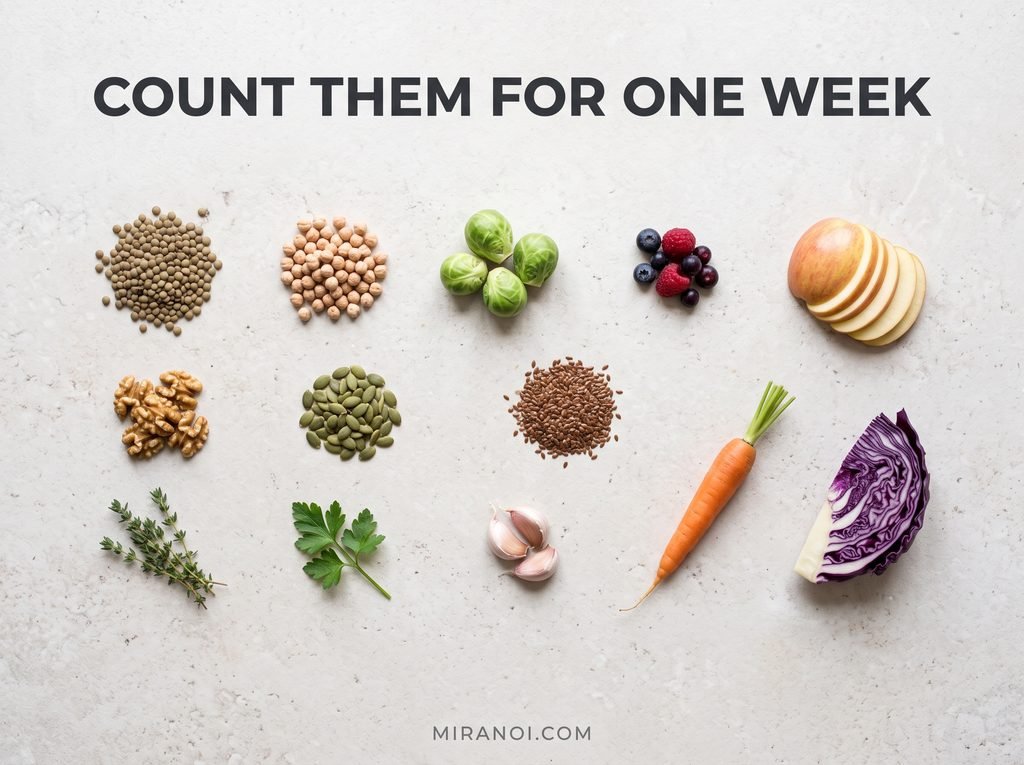
Audit Five: The Plant Count Against the Article’s Own Target
The original’s Quick Fact was the thirty-plants figure, and its practical tips told you to aim for thirty or more different plant foods a week. It never said what its own recipes contribute.
| Recipe | Live microbes | Sodium | Fiber | Approx. distinct plants |
|---|---|---|---|---|
| Lentil & Roasted Vegetable Bowl | — | ~50 mg | ~10 g | 6 |
| Miso Salmon & Kimchi Rice | Kimchi only | ~765 mg | ~4 g | 6 |
| Tempeh Stir-Fry | No | ~500 mg | ~6 g | 5 |
| White Bean & Garlic Soup | — | ~200 mg | ~8.5 g | 4 |
| Yogurt Parfait | Yes | ~150 mg | ~5 g | 4 |
| Sauerkraut & Sausage Skillet | Yes | ~1,100 mg | ~4 g | 2 |
Cook all six in one week and you reach roughly 23 distinct plant types once you remove the overlaps. That is short of thirty, and it is most of the way there — which is a far more useful thing to tell a reader than the target alone. Three handfuls of herbs, a different fruit, a few nuts and some seeds closes it.
Note which recipe sits at the bottom. The sausage skillet contributes cabbage and an apple.
The Evidence, Which Is Thinner Than It Reads
This table breaks the format, because it is about the research rather than the recipes.
| What the original said | What the study actually found |
|---|---|
| A Stanford study found fermented food raised diversity and lowered inflammatory markers | Correct. 36 healthy adults, 10 weeks, published in Cell in 2021. Diversity rose, four immune cell types showed less activation, and 19 inflammatory proteins fell, including IL-6 |
| A high-fiber diet over the same period did not raise diversity | Correct, and worse than stated: none of the 19 inflammatory proteins decreased in the fiber arm either. Stool showed more undigested carbohydrate at higher fiber intakes |
| People eating 30+ plant types weekly had more diverse microbiomes | From the American Gut Project: 41 people eating 30+ compared with 44 eating 10 or fewer. Self-reported diet, in a crowdfunded, self-selected sample who paid for their own kits |
| Fermented foods and fiber work through different mechanisms, so combining them does more | Plausible and untested. The trial compared the two arms; it did not test them combined |
Three things follow.
The fermented-food result is real and it is one small trial in healthy adults. Thirty-six people for ten weeks is a reason to be interested, not a reason to be certain, and the researchers themselves framed the fiber result as possibly needing longer than ten weeks or needing the right microbes present to begin with.
The thirty-plants figure, which has become the most repeated number in gut health, rests on an observational comparison of forty-one people against forty-four, from self-reported food surveys in a sample that selected itself by buying a kit. It is a reasonable heuristic and a good habit. It is not a finding of the weight its popularity implies, and the project that produced it says its results are associations and that researchers cannot yet say whether they affect health.
And the combination claim — the article’s whole organising idea — was not tested by the study it cites. It may well be right. Nobody has shown it.
The Six Recipes
Quantities as the original gave them, with corrections where the method undermined the claim.
1. Miso-Glazed Salmon with Kimchi Rice Bowl
Serves 2 · ~765 mg sodium · ~4 g fiber · live cultures from the kimchi only
- 2 salmon fillets
- 1 tbsp miso paste, 1 tsp honey, 1 tsp soy sauce
- 1 cup cooked brown rice, ½ cup kimchi, 1 cup steamed broccoli
Whisk the miso, honey and soy sauce, brush over the salmon, bake at 200°C (400°F) for 12 to 15 minutes, to 63°C (145°F) internal. Serve over the rice with the kimchi and broccoli.
The correction: the baked miso is a glaze, not a probiotic. The kimchi, which goes on cold, is the live component. If you want the miso’s cultures too, stir a half-teaspoon of raw miso through the rice at the table — and note that this adds sodium to a dish that already has plenty.
2. White Bean and Garlic Soup
Serves 4 · ~200 mg sodium · ~8.5 g fiber
- 2 cans white beans, drained and rinsed
- 1 onion, 4 cloves garlic, minced
- 4 cups low-sodium vegetable broth, 2 tbsp olive oil, fresh thyme
Soften the onion and garlic in the oil, add the beans and broth, simmer 20 minutes. Blend half, stir it back in.
Honest labelling: nothing fermented here, which the original’s table correctly showed. What it has is prebiotic fiber from the beans and the alliums, and it is the second-highest fiber dish on the list at a tenth of the sausage skillet’s sodium.
3. Yogurt Parfait with Berries and Ground Flaxseed
Serves 1 · ~150 mg sodium · ~5 g fiber · genuinely live
- 1 cup plain yogurt with live active cultures
- ½ cup mixed berries, 1 tbsp ground flaxseed, 1 tbsp chopped walnuts
Layer.
Why this one holds up: nothing is heated, so the cultures arrive intact. Check the label says live or active cultures — plenty of yogurt is heat-treated after fermentation and says so in small print. The flaxseed must be ground; whole seeds pass through largely undigested.
4. Sauerkraut and Sausage Skillet
Serves 2 · ~1,100 mg sodium · ~4 g fiber · 2 plant types · live cultures, if you follow the method
- 2 chicken or turkey sausages, sliced — or chicken thigh, pork tenderloin, or two eggs
- 1 cup unpasteurized, refrigerated sauerkraut
- 1 apple, sliced; 1 tbsp olive oil
Brown the protein in the oil, add the apple and cook until soft, then stir in the sauerkraut off the heat, just before serving.
Two changes. The off-heat instruction is the best technical note in the original article and it stays exactly as written. The sausage is the problem — processed meat, in a gut-health article, and the largest sodium contributor in a dish that is already the saltiest on the list. Swap it. Nothing else about the recipe changes.
Buy the refrigerated kind. Shelf-stable sauerkraut in a jar on a warm supermarket shelf has almost always been pasteurized, and pasteurization leaves the metabolites and kills the microbes.
5. Lentil and Roasted Vegetable Bowl
Serves 3 · ~50 mg sodium · ~10 g fiber · 6 plant types · the best dish on this list
- 1 cup cooked lentils
- 2 cups roasted vegetables — sweet potato, Brussels sprouts, red onion
- 2 tbsp olive oil, lemon juice, tahini
Roast the vegetables at 220°C (425°F) for 25 minutes. Serve over the lentils with the oil, lemon and tahini.
Why it wins: highest fiber, joint-highest plant count, lowest sodium. It contains nothing fermented at all, which is the most interesting fact in this article: the best recipe on a fermented-foods list is the one with no fermented food in it.
One carry-over note: cooked lentils keep three to four days refrigerated. Cool them fast — spread on a tray rather than left in the pan.
6. Tempeh Stir-Fry with Ginger and Vegetables
Serves 2 · ~500 mg sodium · ~6 g fiber · no live cultures
- 8 oz (225 g) tempeh, cubed
- 2 cups mixed vegetables — snap peas, carrots, bell peppers
- 1 tbsp fresh ginger, 1 tsp sesame oil, 1 tbsp low-sodium tamari
Sear the tempeh in the sesame oil until golden. Add the vegetables and ginger, stir-fry until crisp-tender, add the tamari off the heat.
The correction: tempeh is a fermented food and it is not a probiotic food, because it is eaten cooked — always, including in this recipe. It is excellent plant protein with fermentation-derived compounds in it. Count it as that.
Watch the tamari. Even low-sodium tamari runs several hundred milligrams a tablespoon. Add it at the end, where you taste it and use less.
Who Should Be Careful
The second table that breaks the format, because it is about people rather than recipes. The Stanford review names these groups specifically as needing professional advice before loading up on fermented food.
| If you are | Why it matters |
|---|---|
| Immunocompromised, or on immunosuppressant medication | Live-culture foods are live organisms; this is a conversation for your clinician |
| Pregnant | Unpasteurized foods carry their own risk category in pregnancy |
| Managing high blood pressure or cardiovascular disease | The sodium in this article’s own table is the issue, not the microbes |
| Living with histamine intolerance | Fermentation generates histamine; fermented foods are a common trigger |
| Living with IBS or SIBO | Both fermented foods and a rapid fiber increase can worsen symptoms |
None of this is a reason for most people to avoid fermented food. It is a reason the blanket instruction to eat six servings a day, which is where the trial’s dose came from, is not advice that suits everyone who reads a recipe article.
What People Actually Run Into
The first week is uncomfortable and people stop. Going from twelve grams of fiber a day to twenty-eight, while also adding fermented food, produces bloating and wind for roughly a week to ten days. It settles. Increase one thing at a time and increase it slowly — the original’s advice to introduce these gradually was right and is worth repeating.
The second is the pasteurization trap, and it is almost universal. People buy sauerkraut or kimchi from a warm shelf, eat it diligently, and get the metabolites without the microbes. If it did not come out of a fridge, assume it was pasteurized.
The third is the reheated lunch. Somebody makes the tempeh stir-fry or the miso salmon, takes it to work, microwaves it, and counts it as probiotic food. It was not probiotic when it was cooked and it is less so now.
Common Mistakes
Baking or searing the fermented ingredient. Heat inactivates the microbes. The article’s own table credited two dishes that cook theirs.
Counting tempeh as a probiotic. It is eaten cooked. It is fermented soy protein.
Buying shelf-stable sauerkraut or kimchi. Refrigerated and unpasteurized, or you are buying flavour.
Ignoring the sodium. One cup of sauerkraut is about 925 mg before anything else goes in the pan.
Pairing a probiotic with processed meat in a gut-health dish. Processed meat is the food category most clearly linked to colorectal cancer.
Treating the thirty-plants figure as a trial result. It is an observational comparison of 41 people with 44, from self-reported surveys.
Expecting one bowl to deliver both fermented food and high fiber. In practice they trade off. Do it across a day.
Practical Tips
Add every fermented ingredient off the heat, at the table if possible. This single habit is the difference between the claim and the thing.
Buy fermented food from the refrigerated section and check for “live” or “active cultures” on the label.
Cook the lentil bowl and the white bean soup for fiber, and keep the yogurt and a jar of refrigerated sauerkraut for the cultures. That is the pairing, and it happens across a day rather than in one dish.
Swap the sausage. The skillet works with chicken thigh, pork tenderloin, white beans or a fried egg, and loses nothing.
Count your plants once, for one week, to see where you actually are. Herbs and spices count. Most people are surprised in both directions.
Increase fiber over two to three weeks and add fermented food separately, so that if something disagrees with you you know which thing it was.
Our guides to gut health and your microbiome and ten ways to improve gut health naturally cover the mechanisms, and our high-fiber recipes carry the fiber side further than these six do.
When Should You See a Doctor?
Speak to your clinician before adding live-culture foods regularly if you are immunocompromised, on immunosuppressant medication, or have a central line. Live cultures are live organisms, and this is a decision for someone who knows your case.
Ask about unpasteurized fermented foods if you are pregnant. The precautions around unpasteurized products in pregnancy exist for reasons unrelated to gut health, and they still apply.
See a doctor for a change in bowel habit lasting more than a few weeks, blood in the stool, unexplained weight loss, or persistent abdominal pain. These are not questions for a recipe article, and “gut health” content is a common reason people delay asking about them.
Ask for advice before a large increase in fermented food if you have IBS or SIBO, or if fermented foods reliably give you flushing, headache or palpitations — the last pattern can point to histamine intolerance.
Talk to your doctor about probiotic supplements rather than deciding from an article. The evidence for them is condition-specific and much narrower than the marketing, and food is not the same intervention as a capsule.
Frequently Asked Questions
Do I need to eat fermented foods every day? The trial that produced the diversity result used up to six servings a day for ten weeks, which is a research dose and not a recommendation. The Stanford group’s own clinical review suggests including some fermented food daily, in amounts you tolerate, increased gradually.
Are pasteurized fermented foods still worth eating? Yes, differently. Pasteurization kills the microbes and leaves the compounds they produced. In one trial comparing pasteurized and unpasteurized sauerkraut in IBS, symptom relief was comparable — so this is not a worthless category. It is just not a probiotic one.
Can I get the benefit from fiber alone? On the evidence of that trial, not the same benefit. Over ten weeks the high-fiber arm showed no increase in diversity and no decrease in any of the 19 inflammatory proteins. The researchers suggested ten weeks may not be long enough, or that the fiber-consuming microbes need to be present first. Fiber remains among the best-supported things in nutrition for other reasons.
Is the thirty-plants target real? It is a good habit built on thin evidence — an observational comparison of 41 people against 44, self-reported. Use it as a prompt to eat more variety, not as a threshold you have hit or missed.
How will I know if it worked? You will not, and that is the honest answer. See below.
The Bottom Line
There is no way for you to check whether any of this improved your gut health.
Microbiome diversity is a research measurement, not a clinical one. Consumer gut-testing kits are not validated to tell you whether your diversity went up or what to do if it did. “Gut health” has no agreed clinical definition, which is precisely why it works so well as a marketing phrase — a claim that cannot be specified cannot be falsified.
What you have instead is symptoms. Regularity, comfort, bloating, wind, how you feel two hours after eating. Those are crude, they are subjective, and they are the only instrument available to you — so use them, give any change three weeks before judging it, and change one thing at a time so the signal means something.
And be suspicious of anyone offering to sell you a measurement.
The thirty-plants number is probably popular for exactly this reason: it is the one thing in gut health you can actually count. Not because the evidence behind it is strong — it is a comparison of forty-one people with forty-four — but because a tally of foods is a real number in a field that otherwise offers you none. Count your plants, eat the lentil bowl, keep the sauerkraut cold and off the heat, and treat anyone promising to optimise your microbiome as someone making a claim they cannot check either.
This article is for general informational purposes and is not a substitute for professional medical advice. Speak to a healthcare provider before substantially changing your diet, particularly if you are immunocompromised, pregnant, or living with a digestive condition.
- Wastyk HC, Fragiadakis GK, Perelman D, et al. (2021). Gut-microbiota-targeted diets modulate human immune status. Cell, 184(16):4137–4153.
- Caffrey EB, Perelman D, Ward CP, Sonnenburg ED, Gardner CD, Sonnenburg JL (2025). Unpacking Food Fermentation: Clinically Relevant Tools for Fermented Food Identification and Consumption. Advances in Nutrition, 16(5):100412.
- McDonald D, Hyde E, Debelius JW, et al. (2018). American Gut: an Open Platform for Citizen Science Microbiome Research. mSystems, 3(3):e00031-18.
- International Agency for Research on Cancer (2015). IARC Monographs evaluate consumption of red meat and processed meat. IARC Press Release No. 240.
- Harvard T.H. Chan School of Public Health. Fiber and Fermented Foods May Aid Microbiome, Overall Health.