
In 2026, researchers at the US National Institute of Standards and Technology did something simple and clarifying. They took one sample of homogenised human stool, split it into identical portions, and sent them to seven commercial gut-microbiome testing companies — in triplicate, twenty-one tests in all. Every portion was the same stool. Any difference in the results had to come from the testing, not from a gut.
The companies identified between under 100 and over 1,700 species. Of 1,208 taxa found in total, three genera appeared in every single sample. Portions of the same stool sent to different companies came back as different from each other as samples from different donors analysed the same way. Three companies reported Clostridioides difficile present; four reported it absent. And replicates of that one stool were classified as both healthy and unhealthy, with conflicting recommendations attached.
That is the state of measurement in this subject, and it sets a limit on what any article titled “10 proven ways to improve gut health” can honestly claim. Proven requires an outcome you can measure, and there is no agreed definition of a healthy gut microbiome to measure against. One of the study’s authors put it precisely: healthy is not the same as typical.
So this page does something narrower and more useful than its title promised. It keeps all ten ways — they are sensible and none of them will hurt you — and attaches to each one the specific endpoint it has actually been measured against: microbial diversity, inflammatory proteins, a named diagnosis, or nothing yet. Three of the ten have real randomised evidence. Four are mechanism. Three have an evidence base that runs partly in the opposite direction from the advice.
One of those reversals is the single most useful finding here, and it contradicts the ranking almost every gut-health article uses, including the earlier version of this one.
The Ten, and the Endpoint Each Was Measured Against
| # | The advice | The endpoint it was actually measured against | Verdict |
|---|---|---|---|
| 1 | Fermented foods | Microbial diversity (increased) and 19 inflammatory blood proteins (decreased) in a randomised 10-week trial | Randomised human evidence, measured outcomes |
| 2 | Fibre-rich whole foods | The same two endpoints in the same trial — diversity stayed flat on average, and none of the 19 proteins fell | Randomised, and the result was not what the advice predicts |
| 3 | Diverse plant foods | No trial endpoint. The “30 plants a week” figure comes from a large observational citizen-science project, not a trial | Mechanism and observation |
| 4 | Resistant starches | Short-chain fatty acid production; no trial against a clinical or inflammatory endpoint cited here | Mechanism |
| 5 | Polyphenol-rich foods | Shifts in bacterial populations; no clinical endpoint cited here | Mechanism |
| 6 | Antibiotics only when necessary | Documented microbiome disruption, with recovery measured in a human study | Well evidenced — and the follow-up advice is where it goes wrong |
| 7 | Sleep | Association with bacterial composition. No trial that improved sleep and measured a gut outcome is cited here | Association |
| 8 | Movement | Association with diversity, reported as independent of diet | Association |
| 9 | Stress management | Gut-brain mechanism, well described; no measured gut endpoint cited here | Mechanism |
| 10 | Increase fibre gradually | Symptoms — bloating and gas. This is the one entry whose endpoint is how you feel, and it is correct | Sound, and measurable by you |
Four things in that table are worth saying plainly.
Entry 10 is the most honest item on the list, because its endpoint is your own symptoms rather than a bacterial profile nobody can reliably measure. Increase fibre gradually, and you will know within a week whether it worked. No kit required.
Entry 2 did not do what the advice says it does. Fibre is the lever every gut-health page puts first, and in the only head-to-head randomised trial of the two, it moved neither diversity nor inflammation over ten weeks. That has caveats, and they are in the next section, but the result is real and the earlier version of this page had fibre at number one calling it “the most consistently supported lever.”
Entries 7, 8 and 9 are associations and mechanisms, not interventions with measured gut outcomes. They are all worth doing for reasons established elsewhere — sleep and exercise have enormous evidence bases of their own. What does not exist is a trial showing that fixing them improved a gut endpoint.
Entry 6 is correct and incomplete. Using antibiotics only when necessary is well founded. What most articles add next — take probiotics afterwards to restore your gut — has a human study pointing the other way, and it has its own section below.
Fermented Foods Against High Fibre, Head to Head
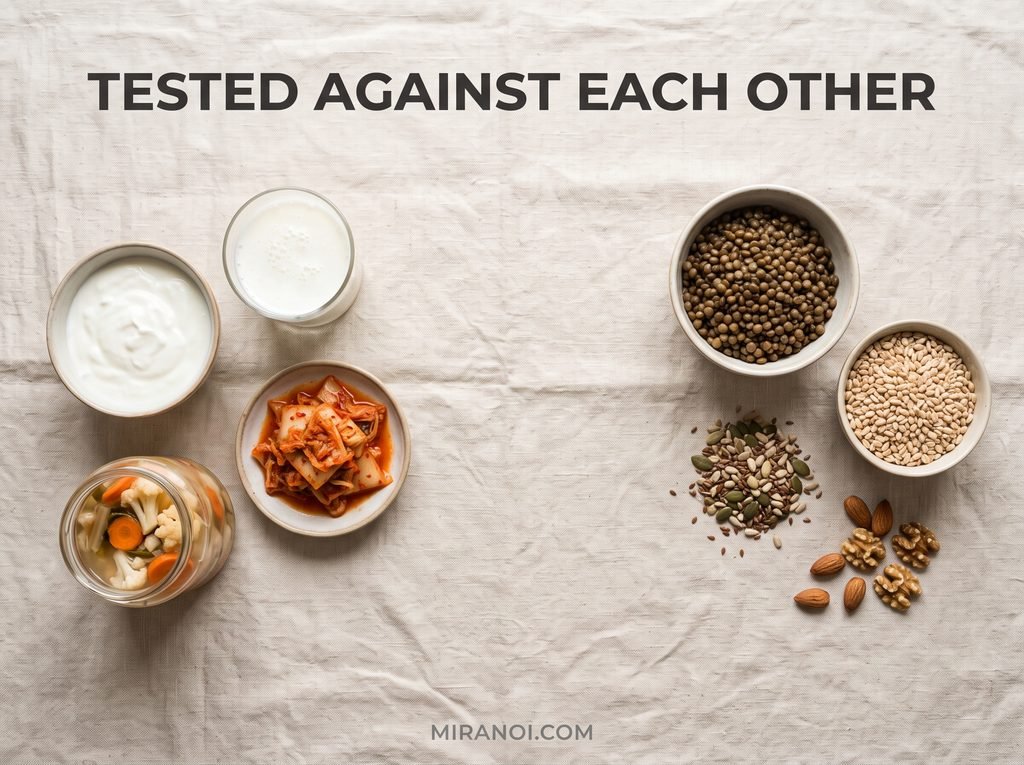
Stanford researchers randomised 36 healthy adults to one of two diets for ten weeks — one built on fermented foods, one built on fibre — with a three-week lead-in before and four weeks of free eating after. Then they measured the gut microbiome and the immune system in both groups.
| Fermented-food diet | High-fibre diet | |
|---|---|---|
| What it contained | Yogurt, kefir, kimchi, fermented vegetables, vegetable brine drinks, kombucha | Legumes, seeds, whole grains, nuts, vegetables, fruits |
| Microbial diversity | Increased | Stayed stable on average |
| 19 inflammatory blood proteins | All 19 decreased, including interleukin-6 | None of the 19 decreased |
| Immune cell activation | Four cell types showed less activation | Not reported as changed |
| An unexpected finding | Larger servings produced stronger effects on diversity | More fibre meant more carbohydrate left in stool — the microbes were not fully breaking it down |
| Duration | 10 weeks | 10 weeks |
This is the most important table on the page, and it needs its caveats stated as loudly as its result.
It is one trial of 36 healthy adults, described by its own senior author as a proof-of-concept study. Thirty-six people split across two arms is small, and no single trial settles a question.
The authors did not conclude that fibre does not work. Their reading was that ten weeks may be too short for the gut community to adapt to a large fibre increase, and they raised the possibility that the microbes which ferment fibre may need to be introduced before extra fibre has anywhere to go. That is a hypothesis about sequencing — fermented foods first, then fibre — rather than a verdict against fibre.
And fibre’s own evidence base does not live in this trial. Fibre has large, long-standing evidence for cardiovascular outcomes, bowel regularity, glycaemic control and colorectal cancer risk. What this trial tested was narrower: whether raising fibre over ten weeks moved microbial diversity and inflammatory proteins. It did not.
So the honest conclusion is not “eat fermented food instead of fibre.” It is that the two are not interchangeable and the usual ranking is backwards for these particular endpoints. If your goal is diversity and lower inflammatory markers, the trial favours fermented foods. If your goal is the rest of what fibre does, fibre’s case was never built on this.
The practical version, which is also what the trial’s design suggests: add fermented food in meaningful amounts, and raise fibre slowly alongside it. Entry 10 on the list — increase fibre gradually — turns out to be better advice than entry 1.
Why No Test Can Tell You Whether Your Gut Is Healthy
The NIST experiment described at the top of this page is worth laying out in full, because it is the ceiling on everything else here. One stool sample, homogenised so every portion was identical, sent in triplicate to seven companies.
| What was tested | What came back |
|---|---|
| Sequencing depth across companies | From under 20,000 reads to over 10 million |
| Species identified | From under 100 to over 1,700 |
| Taxa found in total | 1,208 unique taxa — and only 3 genera appeared in every sample |
| After removing one outlier replicate | Still only 17 genera shared across all datasets |
| Same donor, different companies | As dissimilar as, or more dissimilar than, different donors processed identically |
| Methodological vs biological variability | For 17 of 18 common genera, the method’s variability was equal to or greater than real biological variability |
| C. difficile | Three companies said present. Four said absent. Same stool |
| The health verdict | Replicates of the same stool were classified both healthy and unhealthy, with conflicting recommendations |
| Consistency within a company | Variable. One company issued a consumer report on a replicate with over 50% unidentified reads |
| Regulation | Described as very lightly regulated, if at all, by the FDA |
The authors’ own summary was that methodological variability can be of the same magnitude as biological variability, which means caution in interpreting or acting on these results. One author’s phrasing is the sentence to remember: healthy is not the same as typical. A test that tells you your bacteria differ from a reference population has told you about the reference population.
This matters beyond the kits themselves for three reasons.
It explains why “proven” is the wrong word in a gut-health headline. You cannot prove an intervention improved something you cannot reliably measure. The trials that do produce results — like the fermented-food trial above — work because they measured named, specific things: diversity within one lab’s consistent method, and 19 identified proteins in blood. Not a wellness score.
It is why the useful endpoints are symptoms and diagnoses. Bloating, regularity, pain, a confirmed infection, a diagnosed condition. Those can be measured by you or by a doctor, and every genuinely proven intervention on this subject is proven against one of them.
And it is a reason to be careful about advice that comes attached to a product. Companies selling tests frequently sell the supplements the tests recommend, which several gastroenterologists have described as a conflict of interest rather than a service. The documented potential harms are not trivial either: delayed diagnosis of something serious, including colon cancer, and people stopping prescribed medication on the strength of a report.
“Probiotics” Is Not an Intervention
The American Gastroenterological Association’s guideline on probiotics made a methodological decision that tells you everything about this field: it refused to evaluate “probiotics” as a category. Instead it assessed each single-strain and multi-strain formulation independently, because bacterial function is specific to the strain, not the species.
That is why no gut-health list can recommend probiotics usefully. A recommendation has to name the strains and the condition.
| Condition | What the guideline says | Named strains | Certainty |
|---|---|---|---|
| Preventing C. difficile infection in adults and children on antibiotics | Suggests specific formulations over no probiotic or other probiotics | S. boulardii · L. acidophilus + L. casei · L. acidophilus + L. delbrueckii subsp. bulgaricus + B. bifidum · the same three plus S. salivarius subsp. thermophilus | Low |
| Preventing necrotising enterocolitis, sepsis and mortality in preterm infants under 36 weeks | Suggests specific formulations over no probiotic or other probiotics | Lactobacillus spp. + Bifidobacterium spp. · B. animalis subsp. lactis · L. reuteri | Moderate to high |
| Acute infectious gastroenteritis in children (North America) | Suggests against using probiotics | — | Moderate |
| Irritable bowel syndrome, adults and children | No recommendation — recommends use only in the context of a clinical trial, and suggests patients consider stopping probiotics given the cost and insufficient evidence of harmlessness | — | Knowledge gap; overall evidence very low |
| C. difficile treatment, Crohn’s disease, ulcerative colitis, pouchitis | Covered in scope; no supportive recommendation to report here | — | — |
Read that table against a shelf of supermarket probiotics and the problem is obvious. The two conditions with supportive recommendations are an antibiotic-associated infection and premature babies in neonatal care. Neither describes a healthy adult buying a capsule to improve their gut.
Three consequences follow.
The guideline names strains, not brands — and products rarely name strains properly. A label reading “Lactobacillus acidophilus, 10 billion CFU” has not told you which strain. The guideline’s logic says that matters, and E. coli Nissle 1917 is cited as an example of a strain with real documented effects where the species name alone would tell you nothing.
For IBS, the guideline’s advice points at stopping rather than starting, and its stated reasons are the cost and the absence of evidence that probiotics are harmless. That is unusually direct for a clinical guideline and it is worth quoting accurately: not that probiotics are dangerous, but that nobody has established they are free.
And the guideline does not address healthy people taking probiotics at all, because no body of evidence exists to address. Absence of a recommendation is not a recommendation against. It means the question has not been answered, which is a reasonable thing for a page like this one to say out loud.
The Finding That Runs the Other Way
Almost every gut-health article pairs “use antibiotics only when necessary” with “take probiotics afterwards to restore your gut.” The first half is sound. The second half has a human study pointing in the opposite direction, and it is the most counterintuitive result on this page.
Researchers compared three things after a course of antibiotics: a multi-strain probiotic, an autologous faecal microbiome transplant (the person’s own stool, collected before the antibiotics and returned afterwards), and simply letting the microbiome recover on its own. They measured stool and gut mucosal microbiomes and the host’s own gut gene expression, in mice and in people.
| What was given after antibiotics | What happened to microbiome recovery |
|---|---|
| Nothing — spontaneous recovery | The comparison baseline |
| Multi-strain probiotics | Markedly delayed and persistently incomplete reconstitution of the person’s own stool and mucosal microbiome — slower and less complete than doing nothing. Recovery of the host’s own gut gene expression was also incomplete |
| Autologous faecal transplant (own pre-antibiotic stool) | Rapid and near-complete recovery within days |
| Mechanism tested | Soluble factors secreted by Lactobacillus contributed to the inhibition of recovery, in a laboratory experiment |
| An incidental finding | Antibiotics made probiotic strains colonise the human gut mucosa more readily — so they took hold better, and that was not a benefit |
The probiotic group recovered their own native microbiome more slowly than the people who took nothing. The mechanism was partly identified: substances secreted by the Lactobacillus in the product appeared to suppress the return of the native community.
Three honest qualifications. This is one research programme, not a settled literature. An autologous faecal transplant is a research procedure, not something available or appropriate to recommend to a reader. And the probiotic used was a specific multi-strain product, which — by the strain-specificity logic above — means the finding belongs to that product rather than to every capsule on every shelf.
But it is enough to retire a sentence that appears on thousands of pages. “Take probiotics after antibiotics to restore your gut” is not established, and the best available human evidence on native microbiome recovery points the other way. The AGA’s supportive recommendation for probiotics alongside antibiotics is for a different purpose entirely — preventing C. difficile infection, a specific and serious complication — not for restoring your microbiome.
Those are two different goals, and conflating them is how a reasonable piece of advice becomes a wrong one.
Fibre, Honestly — and Where “30 Plants a Week” Comes From
The previous version of this page had one number in it: aim for 30 or more different plant foods a week. It is a good heuristic and it deserves to know what it is.
| The claim | What it rests on | What that means for you |
|---|---|---|
| 30+ different plants a week | A large citizen-science microbiome project, which found that people eating more plant varieties had more diverse microbiomes | Observational. People who eat 30 plant types differ from people who eat 10 in many other ways too. It is a useful target, not a tested dose |
| Fibre feeds bacteria that produce short-chain fatty acids | Well-established microbiology | True, and a mechanism rather than an outcome |
| Fibre raises microbial diversity | Tested head to head against fermented foods over 10 weeks — diversity stayed flat on average | Not demonstrated on that timescale. May need longer, or may need the right microbes present first |
| Fibre lowers inflammation | Tested in the same trial — none of the 19 inflammatory proteins fell | Not demonstrated on that timescale |
| Undigested fibre shows up in stool | Measured in that trial: more fibre meant more carbohydrate left in stool | Direct evidence that the microbes were not fully breaking it down — the capacity has to be built |
| Fibre’s real evidence base | Cardiovascular outcomes, bowel regularity, glycaemic control, colorectal cancer risk — large and long-standing | This is why you eat fibre. None of it depends on a microbiome measurement |
| Increase it gradually | Symptoms — bloating, gas | Correct, and the most immediately verifiable advice on the whole list |
The last two rows are the resolution of the apparent contradiction in this article. Fibre’s case was never built on the microbiome, and it does not weaken because one ten-week trial found no movement in diversity or inflammatory proteins. It is one of the best-evidenced components of a diet, for outcomes that matter more than a bacterial profile.
What changes is the reason given for eating it. “Fibre feeds your good bacteria and lowers inflammation” is a mechanism dressed as a result, and in the one head-to-head test the result did not appear. “Fibre is strongly associated with lower cardiovascular and colorectal cancer risk, and it keeps your bowels regular” is a better sentence and a truer one.
And the 30-plants target survives all of this, for a reason worth stating: it is a diversity heuristic, and its value is that it changes shopping behaviour. Nobody has shown that going from 25 to 30 plant types does anything measurable. What a target like that does is move you from three vegetables on rotation to a dozen — and the whole-diet evidence for eating that way is strong, whatever the bacteria are doing. How your gut microbiome actually works covers the biology in more depth.
Sleep, Movement, Stress — and When It Is Not a Diet Question
Three of the ten entries are associations rather than tested interventions, and one subject is missing from the list entirely: when gut symptoms mean something that no amount of fermented food will fix.
| Entry | What is established | What is not |
|---|---|---|
| Sleep | Poor sleep is associated with a less favourable bacterial composition, and the gut-brain link runs both ways | No trial here improved sleep and then measured a gut outcome. Sleep’s own evidence base is large and separate |
| Movement | Associated with greater microbial diversity, reported as independent of diet | Association. Exercise is worth doing on evidence that has nothing to do with bacteria |
| Stress management | The gut-brain mechanism is real and well described, and stress genuinely affects gut symptoms | No measured gut endpoint from a stress intervention is cited here. Symptom relief is a legitimate goal in itself |
| Blood in the stool, unexplained weight loss, persistent change in bowel habit, night-time symptoms, iron-deficiency anaemia, a family history of bowel cancer | These are red flags that warrant medical assessment | Nothing on this list addresses them. A diet change that delays this conversation is a harm, not a neutral choice |
| A diagnosed condition — IBS, inflammatory bowel disease, coeliac disease | Each has its own evidence base and its own management | General gut-health advice is not a substitute. For IBS specifically, the AGA points at stopping probiotics rather than starting them |
The three associations are worth acting on, and the reason is not microbiome diversity. Sleep and exercise have among the largest evidence bases in medicine for outcomes that matter enormously — cardiovascular risk, metabolic health, mortality, mood. If better sleep also improves your gut flora, that is a bonus on top of an already decisive case. Presenting it the other way round, as though the bacteria were the reason to sleep, makes a strong recommendation sound weaker than it is.
For stress, the honest framing is almost the reverse: the gut-brain connection means stress affects how your gut feels, and symptom relief is a real and sufficient reason to address it. You do not need a bacterial justification for managing stress when the symptom improvement is the point. Stress management techniques that work covers the approaches with actual evidence behind them.
The red-flag row is the one this list most needed. Gut symptoms are the most common reason people look up gut health, and the overlap between “my digestion is off” and symptoms that need investigating is large. A list of ten natural ways is the wrong tool for blood in the stool, unexplained weight loss, or a change in bowel habit that has not settled. That is a doctor, promptly, and the documented harm of microbiome-focused self-management is exactly this: delayed diagnosis of something serious.
Frequently Asked Questions
What is the single best-evidenced thing I can do for my gut? Eat fermented foods in meaningful amounts. In the only randomised head-to-head trial against a high-fibre diet, the fermented-food arm increased microbial diversity and lowered all 19 inflammatory blood proteins measured, while the fibre arm moved neither over ten weeks. It is one proof-of-concept trial in 36 healthy adults, so hold it loosely — but it is the strongest measured result on this subject.
Should I get a gut microbiome test? No, on current evidence. When one homogenised stool sample was sent to seven companies in triplicate, species counts ranged from under 100 to over 1,700, only three genera appeared in every result, portions of the same stool came back as different from each other as samples from different people, and replicates were classified both healthy and unhealthy with conflicting advice. Three companies said C. difficile was present; four said absent.
Should I take a probiotic? For general gut health, there is no evidence base to answer that — the AGA guideline does not address healthy people at all. Where it does make supportive recommendations, they are narrow and strain-specific: preventing C. difficile infection in people taking antibiotics, and preventing necrotising enterocolitis and sepsis in preterm infants. For IBS it makes no recommendation and suggests considering stopping probiotics, citing cost and insufficient evidence of harmlessness.
Should I take probiotics after a course of antibiotics? Not to restore your microbiome. In a human study, a multi-strain probiotic produced markedly delayed and persistently incomplete recovery of the person’s own microbiome — slower than taking nothing — while an autologous faecal transplant recovered it within days. That is a different question from preventing C. difficile infection during antibiotics, which is the one indication where the guideline is supportive.
Is fibre still worth eating? Yes, and the reason has changed. Fibre’s evidence base is cardiovascular risk, bowel regularity, glycaemic control and colorectal cancer risk — large, long-standing, and independent of any microbiome measurement. What the head-to-head trial failed to show is the microbiome claim specifically: no diversity increase and no fall in inflammatory markers over ten weeks. Eat fibre for what it is actually proven to do.
Why do I get bloated when I eat more fibre? Because the capacity to ferment it has to be built. The trial measured this directly: more fibre meant more undigested carbohydrate in stool, meaning the microbes were not breaking it all down. Increasing gradually is the correct fix and is the best advice on the original list.
Do I really need 30 different plants a week? It is a heuristic from an observational project, not a tested dose, and nobody has shown that 30 beats 25. Its value is behavioural: a target like that moves you from three vegetables on rotation to a dozen, and the whole-diet evidence for eating that way is strong regardless of what the bacteria do.
How long before I notice anything? For symptoms — bloating, regularity — days to a couple of weeks, and you can judge it yourself. For the measured biology, the trial ran ten weeks. For anything you would see on a test, see the second question: the test cannot reliably tell you.
The Bottom Line: Where the Money Should Go
Gut health is one of the few health subjects where the spending runs almost exactly inverse to the evidence. So here is the whole article as a budget, from best-evidenced to worst.
| What you could spend money on | What the evidence supports | Cost |
|---|---|---|
| Fermented foods, in real amounts — yogurt, kefir, kimchi, fermented vegetables | The only randomised head-to-head win on this page: diversity up, all 19 inflammatory proteins down over 10 weeks | Low. Supermarket prices, and kefir and kimchi can be made at home |
| A wider range of plants, raised gradually | Fibre’s own large evidence base — cardiovascular, colorectal, glycaemic, regularity — plus a sound diversity heuristic | Low. Legumes and seeds are among the cheapest foods there are |
| Sleep and movement | Enormous evidence bases of their own. Associated with microbial diversity | Free |
| Nothing — just increasing fibre slowly and watching your symptoms | The most verifiable advice on the list, with an endpoint you can actually read | Free |
| A strain-specific probiotic, for a named indication, discussed with a doctor | Supported for preventing C. difficile infection on antibiotics, and in preterm neonatal care. Not for general gut health | Moderate, and only worth it for those indications |
| A generic supermarket probiotic for general gut health | No evidence base. The guideline does not address healthy people, and a label naming only a species has not told you the strain | Moderate, recurring, for an unanswered question |
| A probiotic to restore your gut after antibiotics | The best available human evidence points the other way — delayed and incomplete recovery of your own microbiome, slower than taking nothing | Moderate, for a likely negative |
| A direct-to-consumer microbiome test | One stool, seven companies: 3 of 1,208 taxa shared, same sample called both healthy and unhealthy, C. difficile reported present by three and absent by four | The highest cost on this list, for the least reliable information |
The table inverts. The two things with the best evidence are the two cheapest, and the two things people spend the most on are the two with either no evidence or evidence running backwards. That is not a coincidence — fermented vegetables have no marketing budget and a sequencing kit does.
And the honest summary of the ten ways is shorter than the list. Of the ten, one has a randomised win behind it, one has a large evidence base that was never about bacteria, one has an endpoint you can read yourself in a week, and the rest are mechanisms and associations that are fine to follow and have not been measured against a gut outcome. Nothing on the list is harmful. It is simply not ten things — it is about three, plus a shopping habit.
So if you want the version that fits on a till receipt: buy kefir or kimchi and eat it regularly, add plants slowly until your symptoms say stop, and spend nothing on finding out what your bacteria are doing — because nobody can currently tell you.
This article is for general informational purposes and is not a substitute for medical advice. Blood in the stool, unexplained weight loss, a persistent change in bowel habit, night-time symptoms or iron-deficiency anaemia need medical assessment rather than dietary experimentation. If you have a diagnosed digestive condition, or are immunocompromised, discuss probiotics with your doctor before taking them.
References
- Wastyk HC, et al. Gut-microbiota-targeted diets modulate human immune status. Cell, 2021 — Stanford Medicine summary of the fermented-food versus high-fibre randomised trial
- Wastyk HC, et al. Gut-microbiota-targeted diets modulate human immune status. Cell, 2021 — full paper
- Direct-to-consumer microbiome tests show wide variability — NIST study of seven commercial services, reported in GI & Hepatology News, April 2026
- Are Direct-to-Consumer Microbiome Tests Clinically Useful? — gastroenterologists on analytical and clinical validity
- International consensus statement on microbiome testing in clinical practice. The Lancet Gastroenterology & Hepatology
- Su GL, et al. AGA Clinical Practice Guidelines on the Role of Probiotics in the Management of Gastrointestinal Disorders. Gastroenterology, 2020 — full guideline text
- AGA probiotics guideline — named strain formulations and recommendation wording by condition
- AGA Issue Brief — Probiotics: conditions, directions and certainty of evidence
- Suez J, et al. Post-Antibiotic Gut Mucosal Microbiome Reconstitution Is Impaired by Probiotics and Improved by Autologous FMT. Cell, 2018
- Suez J, et al. 2018 — PubMed record