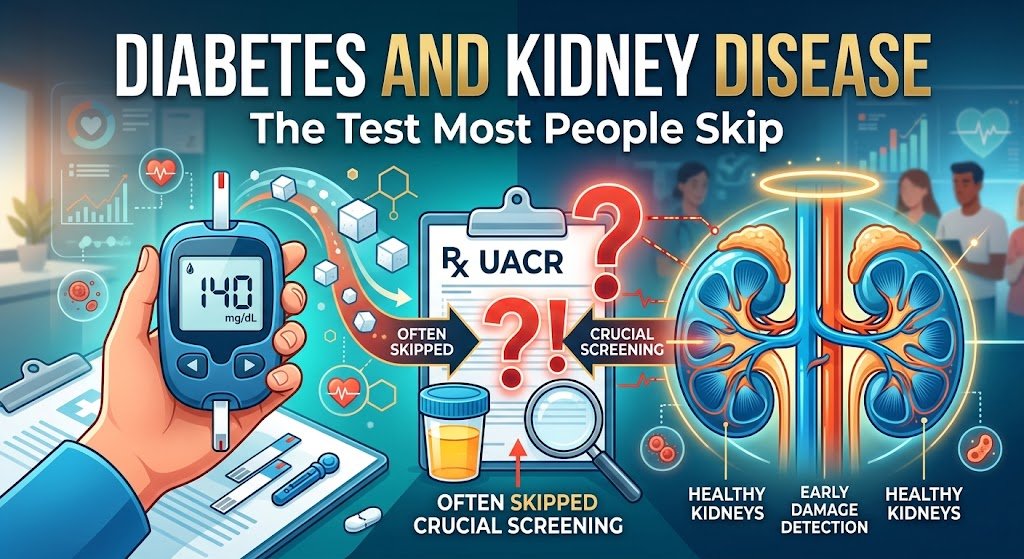
Diabetic kidney damage is silent in its early stages. By the time symptoms appear, a substantial share of kidney function may already be gone.
There’s a test that catches it years earlier. It costs very little, needs no blood draw, and takes minutes.
And a 2025 systematic review found it is badly underused — with undiagnosed albuminuria estimated at 20 times more prevalent than detected cases among adults with hypertension.
Quick Fact: A positive result on this urine test was associated with a tripling in the initiation of protective kidney medication — meaning the test doesn’t just detect the problem, it reliably changes treatment.
Last reviewed: September 2026
Why the Kidneys Are Vulnerable
Your kidneys filter blood through roughly a million tiny filtering units, each built from an intricate network of small blood vessels.
Sustained high blood sugar damages those vessels. As the filters deteriorate, they start leaking albumin — a protein that should stay in the blood — into the urine.
That leak is the earliest measurable sign of trouble, and it appears long before kidney function declines enough to show up on standard tests.
This is the core issue: standard kidney bloodwork measures how well the kidneys are currently filtering. By the time that number moves, damage has accumulated. The urine test measures something earlier — whether the filters have started to leak.
What the ACR Test Actually Is
The urine albumin-to-creatinine ratio (ACR or uACR) measures albumin in your urine against creatinine, which corrects for how concentrated or dilute the sample is.
The practical details:
- No blood draw. A small urine sample in a container.
- First-morning sample preferred, because it’s more concentrated and gives a more accurate reading.
- Fasting generally not required.
- Results in minutes with point-of-care testing, or a day or two through a lab.
It detects microalbuminuria — slightly elevated albumin — well before conventional tests show any problem.
Quick Reference: Interpreting ACR Results
| ACR Level | Stage | What It Suggests |
|---|---|---|
| Under 30 mg/g | A1 — Normal | No detectable albumin leak |
| 30–300 mg/g | A2 — Moderately increased | Early diabetic kidney disease |
| Over 300 mg/g | A3 — Severely increased | Advanced albuminuria |
A single abnormal result usually needs confirmation — see below.
How Often You Should Be Tested
The guidelines are specific, and they differ by condition:
Type 2 diabetes: Annual uACR testing, starting at diagnosis. Kidney damage can already be present when type 2 is diagnosed, since the condition often develops silently for years beforehand.
Type 1 diabetes: Testing begins 5 years after diagnosis, then annually.
Hypertension: The 2025 AHA/ACC Hypertension Guideline recommends uACR testing at least annually for all patients to evaluate kidney disease development or progression.
Both the American Diabetes Association and KDIGO support this schedule. Yet the systematic review found screening is substantially underutilized in exactly these populations.
Quick Reference: Who Should Be Tested and When
| Condition | Start Testing | Frequency |
|---|---|---|
| Type 2 diabetes | At diagnosis | Annually |
| Type 1 diabetes | 5 years after diagnosis | Annually |
| Hypertension | At diagnosis | At least annually |
| Existing abnormal result | — | Repeat at intervals set by your provider |
Why Early Detection Genuinely Matters
This isn’t screening for the sake of information. Detection at the microalbuminuria stage opens a real treatment window.
Research shows that early diagnosis and initiation of an ACE inhibitor or ARB — blood pressure medications with specific kidney-protective effects — slows disease progression and improves cardiovascular outcomes.
That’s why the tripling of protective medication initiation after a positive result matters so much. The test converts an invisible process into an actionable one.
The reverse is also true. Kidney disease that progresses undetected leads toward dialysis or transplant, and diabetic nephropathy is described in the research as a leading cause of end-stage kidney disease.
The Kidney-Heart Connection
Worth understanding because it reframes what the test measures.
The American Heart Association now uses the term cardiovascular-kidney-metabolic health to describe how tightly these systems interact. Albuminuria isn’t only a kidney signal — research has found even low levels of urinary albumin excretion are associated with cardiovascular risk factors in the general population.
Practically: a positive ACR result tells you something about your heart risk as well as your kidneys. That’s part of why guidelines now extend the recommendation beyond diabetes to everyone with hypertension.
One Abnormal Result Isn’t a Diagnosis
Albumin levels fluctuate. Several things can temporarily raise a reading without indicating kidney damage:
- Recent vigorous exercise
- Fever or acute illness
- Urinary tract infection
- Significant dehydration
- Very high blood sugar at the time of testing
- Menstruation
For this reason, a diagnosis typically requires two or three abnormal results over a three-to-six-month period, not a single test.
If your first result comes back elevated, the appropriate next step is confirmation — not alarm.
What People Actually Run Into
The most common experience is never being offered the test at all.
This is reflected directly in the research: screening is underutilized despite clear guidelines. Many people with type 2 diabetes have had annual A1C testing for years while their uACR was never ordered. The test isn’t obscure or expensive — it simply doesn’t get requested as reliably as bloodwork does.
Which means this is frequently a test you have to ask for by name.
The second pattern involves false reassurance from normal kidney bloodwork. People see a normal creatinine or eGFR result and conclude their kidneys are fine. Those measure current filtering capacity. The urine test measures leakage, which happens earlier. Normal bloodwork doesn’t rule out early damage.
Third: people frequently don’t know what to do with an abnormal result. Learning you have early kidney damage is unsettling, particularly with no symptoms. The clinically important framing is that the A2 stage is precisely where intervention works best — blood sugar control, blood pressure management, and ACE inhibitor or ARB therapy can slow or stall progression. Finding it early is the favorable scenario, not the bad news.
Common Mistakes
Assuming normal blood tests mean healthy kidneys. Creatinine and eGFR measure filtering capacity; albumin leakage appears earlier and requires a urine test.
Never asking for the test. Screening is documented as underutilized. If it hasn’t been ordered, request it specifically as a “urine ACR” or “urine albumin-to-creatinine ratio.”
Panicking over one abnormal result. Exercise, illness, infection, and dehydration can all raise albumin temporarily. Diagnosis requires repeated testing over months.
Waiting for symptoms. Early diabetic kidney disease produces none. Symptoms indicate that significant function has already been lost.
Testing with a random sample when a first-morning one was advised. First-morning urine is more concentrated and gives a more accurate reading.
Treating an A2 result as a lost cause. This stage is where treatment has the most leverage, and progression can be slowed meaningfully.
Practical Tips
- Ask specifically for a “urine ACR” at your next appointment if you haven’t had one in the past 12 months.
- Use a first-morning sample when possible, and avoid vigorous exercise the day before testing.
- Reschedule the test if you have a fever, an active urinary tract infection, or are menstruating.
- Keep your ACR results alongside your A1C in your own records — the trend over years matters more than any single value.
- If a result comes back in the A2 range, ask directly whether an ACE inhibitor or ARB is appropriate for you.
- Treat blood pressure control as seriously as blood sugar control; both drive kidney progression.
If you’re managing diabetes more broadly, it’s worth pairing this with our guides on diabetes complications warning signs and the A1C test, since kidney screening belongs alongside the routine monitoring most people already do.
When Should You See a Doctor?
Ask your provider about uACR testing if you have type 2 diabetes and haven’t been screened in the past year, if you have type 1 diabetes diagnosed more than five years ago, or if you have hypertension — current guidelines recommend at least annual testing in all three cases.
Contact your provider promptly for swelling in the legs, ankles, or around the eyes, foamy or bubbly urine, or a noticeable change in urination patterns. These can indicate kidney involvement that has progressed beyond the early stage.
Do not stop or adjust blood pressure medication independently, particularly ACE inhibitors or ARBs prescribed for kidney protection.
Frequently Asked Questions
What is a urine ACR test? It measures albumin in your urine relative to creatinine, detecting protein leakage from damaged kidney filters. It catches microalbuminuria well before standard kidney bloodwork shows a problem.
How often should someone with diabetes be tested? Annually for type 2 diabetes starting at diagnosis, and annually for type 1 diabetes starting five years after diagnosis, per ADA and KDIGO guidelines.
Can early diabetic kidney disease be reversed? Progression can often be slowed or stalled, particularly at the microalbuminuria stage, with blood sugar control, blood pressure management, and ACE inhibitor or ARB therapy. Advanced damage is generally not reversible.
Why was my ACR high once but normal later? Albumin levels fluctuate with exercise, illness, infection, dehydration, and blood sugar. This is why diagnosis requires two or three abnormal results over three to six months rather than a single test.
Does a normal eGFR mean my kidneys are fine? Not necessarily. eGFR measures current filtering capacity, while albumin leakage appears earlier. Both tests together give a fuller picture than either alone.
The Bottom Line
Diabetic kidney damage announces itself late and quietly, which is exactly why a test that detects it early matters — and why the research finding it underused is worth acting on personally. The urine ACR costs little, requires no needle, and a positive result reliably changes treatment in ways that slow progression. If your last year of appointments included an A1C but no urine test, that’s a gap worth closing at the next one.
This article is for general informational purposes and is not a substitute for personalized medical advice. Discuss kidney screening and any abnormal results with your healthcare provider.
References
- BMC Nephrology — Underutilization of Albuminuria Screening in Adults with Diabetes Mellitus or Hypertension: A Systematic Review and Meta-Analysis (2025)
- National Institute of Diabetes and Digestive and Kidney Diseases (NIDDK) — Diabetic Kidney Disease
- American Heart Association — Cardiovascular-Kidney-Metabolic Health Presidential Advisory