The A1C test is the standard for diagnosing diabetes and tracking blood sugar control. It’s convenient, doesn’t require fasting, and reflects months of data in a single number.
It’s also less absolute than most people assume. A single A1C test can carry up to a 0.5% margin of error — meaning a reported 7.0% might genuinely be anywhere from 6.5% to 7.5%. And in certain common conditions, the number can be substantially off in either direction without anyone realizing.
Quick Fact: Research presented at an Endocrine Society meeting found the A1C test missed nearly 73% of people with diabetes compared with an oral glucose tolerance test — meaning an A1C below 6.5% doesn’t fully rule out diabetes on its own.
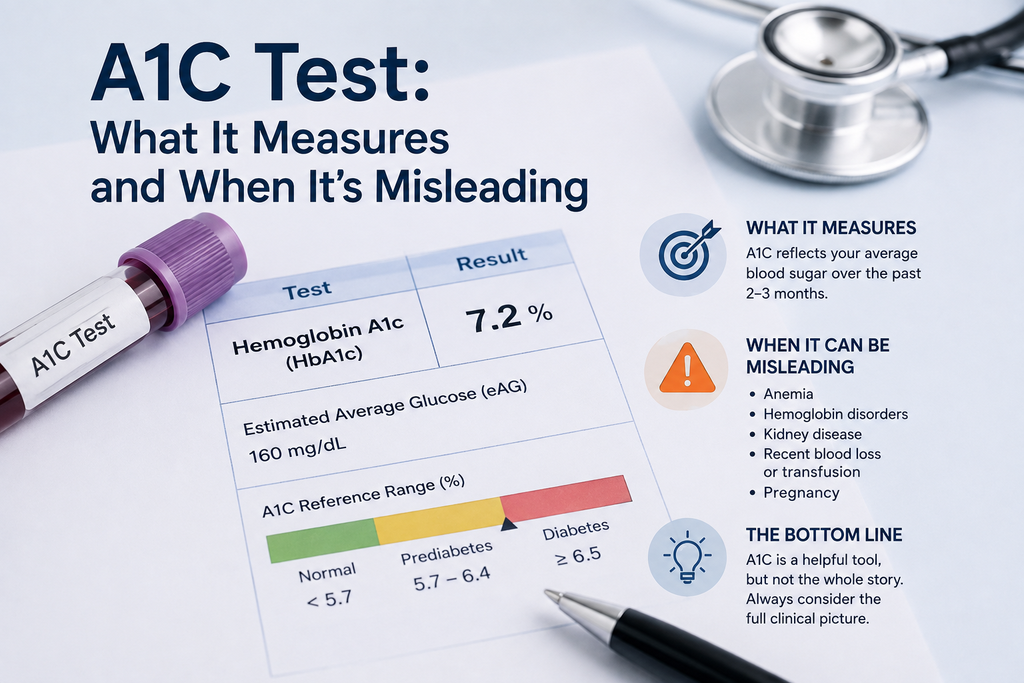
What A1C Actually Measures
Glucose in your bloodstream binds to hemoglobin, the oxygen-carrying protein in red blood cells. That binding — called glycation — is irreversible and stays for the life of the cell.
Red blood cells live roughly 120 days, so A1C reflects a weighted average of blood glucose over the previous 8-12 weeks, with more recent weeks counting more heavily than earlier ones.
This is the key insight that explains every limitation below: A1C isn’t measuring your blood sugar. It’s measuring sugar attached to red blood cells. Anything that changes how long those cells live, or how many there are, changes the result — independent of your actual glucose levels.
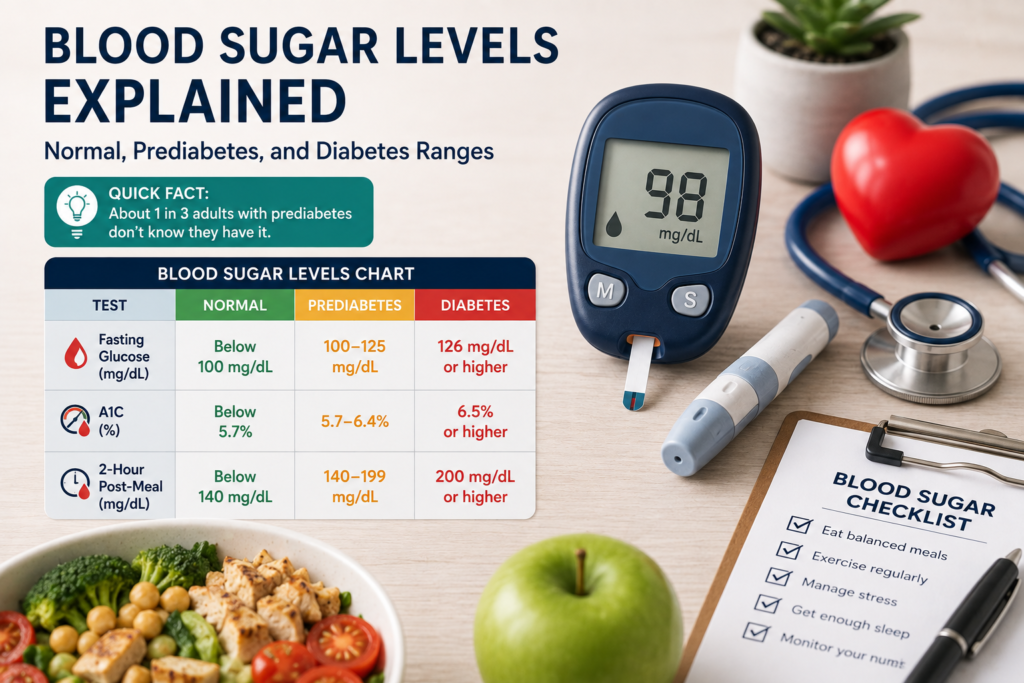
Quick Reference: A1C Ranges
| A1C Level | Category |
|---|---|
| Below 5.7% | Normal |
| 5.7% – 6.4% | Prediabetes |
| 6.5% or higher | Diabetes |
| Below 7.0% | Common treatment target for diabetes |
Conditions That Falsely Raise A1C
Anything that lengthens red blood cell lifespan gives glucose more time to attach, inflating the result:
- Iron deficiency anemia — one of the more common and easily overlooked causes
- Vitamin B12 or folate deficiency anemia
- Asplenia (absent or removed spleen)
- Chronic alcohol use
- Metabolic acidosis, common in advanced kidney disease
The iron deficiency link matters practically: it’s common, frequently undiagnosed, and can push an A1C from the normal range into prediabetes territory on paper alone.
Conditions That Falsely Lower A1C
Anything that shortens red blood cell lifespan reduces glucose exposure, deflating the result:
- Hemolytic anemia of any cause
- Recent blood loss or blood transfusion
- Chronic kidney disease (uremic toxins shorten cell survival)
- Pregnancy — alters red cell turnover even in women without diabetes
- Sickle cell disease and thalassemia
- Erythropoietin (EPO) therapy
- Splenectomy-related conditions
Falsely low results are arguably more dangerous, because they can mask real hyperglycemia. One documented case involved a patient with undiagnosed sickle cell disease and alpha thalassemia whose long-standing high blood sugar and diabetic complications were hidden behind inappropriately low A1C readings.
Quick Reference: Direction of Error
| Factor | Effect on A1C |
|---|---|
| Iron deficiency anemia | Falsely high |
| B12/folate deficiency | Falsely high |
| Chronic alcohol use | Falsely high |
| Hemolytic anemia | Falsely low |
| Chronic kidney disease | Usually falsely low |
| Pregnancy | Falsely low |
| Sickle cell / thalassemia | Falsely low |
| Recent transfusion | Falsely low |
The Ancestry Factor
This is documented in the research and rarely mentioned in patient-facing material.
A1C values have been shown to be less accurate for people of African, Mediterranean, or Southeast Asian descent, because genetic hemoglobin variants — hemoglobin S, C, D, and E — are more common in these populations and alter how glucose binds to hemoglobin.
Studies have also found that people of color, including Black, Asian, Hispanic, and Indigenous individuals, tend to have slightly higher average A1C levels at equivalent blood glucose. The standard A1C thresholds don’t account for these differences, which can lead to both misdiagnosis and overtreatment.
This isn’t a reason to distrust the test — it’s a reason to interpret a borderline result alongside other measures rather than treating it as definitive.
What A1C Can’t Tell You at All
Even when perfectly accurate, an average conceals the pattern that produced it.
Two people can have identical A1C values of 7.0% — one with steady, stable glucose throughout the day, the other swinging between dangerous lows and sharp highs that happen to average out. A1C cannot distinguish between them.
This is why continuous glucose monitoring introduced time in range — the percentage of time spent between 70-180 mg/dL. Roughly 70% time in range corresponds to an A1C of about 7%, but it captures the variability A1C smooths over. It’s also the only way to detect hypoglycemia, which A1C is completely blind to.
What People Actually Run Into
The most common frustration reported by people using CGMs is discovering their GMI (glucose management indicator, the CGM’s A1C estimate) doesn’t match their lab A1C.
This is normal and expected. In one study comparing the two, 22% of participants had differences of one full percentage point or more. Neither number is “wrong” — they measure different things through different mechanisms.
The second common issue: at-home A1C test kits vary enormously in reliability. A study evaluating three commercial home-use tests found results within 5% of the reference value for 82% of samples with one product, but only 29% with another. None met the National Glycohemoglobin Standardization Program’s target. If you use one, the brand genuinely matters.
Common Mistakes
Treating A1C as an exact number. With a margin of error up to 0.5%, small changes between tests — 6.8% to 6.9%, for instance — may reflect measurement variability rather than any real change.
Assuming a normal A1C rules out diabetes. The research is clear that A1C misses a substantial share of cases compared with an oral glucose tolerance test. If you have risk factors and symptoms, a normal A1C isn’t a full clearance.
Not mentioning anemia, kidney disease, or pregnancy. These are among the most common causes of misleading results, and they’re only accounted for if your doctor knows about them.
Comparing results across different labs. Only NGSP-certified labs produce standardized, comparable results. A number from a non-certified lab may not be directly comparable to your previous ones.
Expecting A1C to reflect a recent change quickly. Because it averages 2-3 months, a new medication or diet change won’t show fully for weeks. Fructosamine or self-monitoring reflects short-term changes faster.
Assuming a good A1C means no hypoglycemia. A1C cannot detect low blood sugar at all. Frequent lows can even pull the average down, making control look better than it is.
Curious how continuous monitoring compares? Our guide on continuous glucose monitors for non-diabetics covers what the research actually supports.
Practical Tips
- Ask whether your lab is NGSP-certified, particularly if you’re comparing results over time or across providers.
- Mention any history of anemia, kidney disease, recent transfusion, pregnancy, or known hemoglobin variants before testing.
- If your A1C and your daily glucose readings consistently disagree, raise it — that discrepancy is itself clinically meaningful information.
- Ask about fructosamine or glycated albumin as alternatives if a condition makes A1C unreliable for you; both reflect shorter timeframes and aren’t affected by red cell lifespan.
- Track trends across several tests rather than reacting to any single result.
If you’re working on blood sugar management more broadly, it’s worth pairing this with our guides on normal blood sugar levels and continuous glucose monitors for non-diabetics, since both cover measures that complement what A1C shows.
When Should You See a Doctor?
Talk to your doctor about A1C reliability if you have anemia, chronic kidney disease, a known hemoglobin variant, are pregnant, or have had a recent blood transfusion — all of these can meaningfully distort results. Also raise it if your A1C consistently conflicts with your home glucose readings, or if you have diabetes risk factors and symptoms despite a normal A1C, since additional testing may be warranted.
Frequently Asked Questions
How accurate is the A1C test? It’s well standardized, but a single test can carry up to a 0.5% margin of error, and certain medical conditions can shift results substantially in either direction independent of actual blood sugar.
Can I have diabetes with a normal A1C? Yes. Research comparing A1C to the oral glucose tolerance test found A1C missed a large share of diabetes cases, so a normal result doesn’t fully rule it out when risk factors and symptoms are present.
Why doesn’t my CGM’s estimate match my lab A1C? They measure different things — one estimates from sensor glucose readings, the other measures glycated hemoglobin. Differences of a full percentage point occurred in about 22% of participants in one comparison study.
Are at-home A1C tests reliable? Accuracy varies considerably by brand. In one evaluation of three commercial home tests, results within 5% of the lab reference ranged from 29% to 82% depending on the product.
The Bottom Line
A1C remains genuinely useful — it’s standardized, convenient, and strongly predicts long-term complication risk. But it measures glycated hemoglobin, not glucose, and that distinction is where its limitations live. If you have anemia, kidney disease, a hemoglobin variant, or are pregnant, the number may not mean what it appears to. A single reading is a data point, not a verdict.
This article is for general informational purposes and is not a substitute for personalized medical advice. Discuss your A1C results and any conditions that may affect them with your healthcare provider.
References
- American Diabetes Association (Diabetes Care) — Point-of-Care HbA1c in Clinical Practice: Caveats and Considerations
- NIH (PubMed Central) — Limitations of Hemoglobin A1c in the Management of Type 2 Diabetes Mellitus
- Time in Range Coalition — Inaccuracies of A1C Testing and What Can Be Done About Them