The lactic acid explanation for post-workout soreness has been wrong since the 1980s. It’s still what most people believe, and still what many trainers repeat.
The study that broke it was elegantly simple. Researchers had participants run on a treadmill twice — once on level ground, once at a 10% downhill incline. Level running spiked blood lactic acid, but produced no significant soreness. Downhill running never elevated lactic acid at all — and produced significant delayed soreness.
The two variables moved in opposite directions. That was the end of the theory, at least in the research literature.
Quick Fact: Blood lactate returns to resting levels within about one hour after exercise, even after extremely intense sessions. DOMS doesn’t peak until 24-72 hours later — a timing gap that makes lactic acid a physically impossible cause.
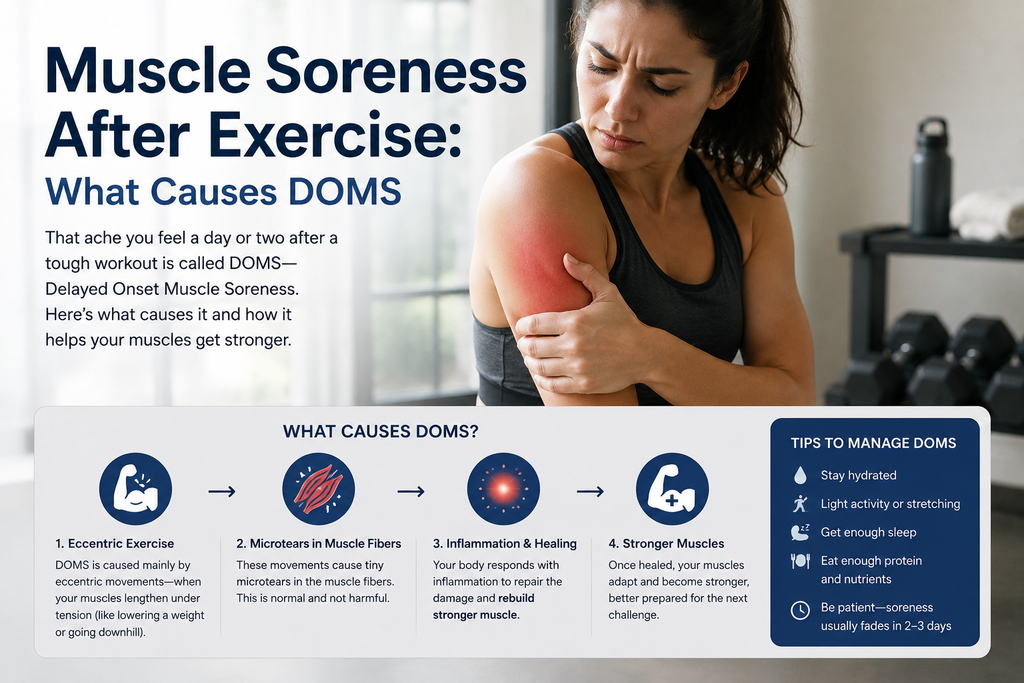
What DOMS Actually Is
Delayed onset muscle soreness typically appears 12-48 hours after unfamiliar or intense exercise, peaks around 24-72 hours, and resolves within 4-6 days.
The current understanding centers on three interacting mechanisms:
- Microscopic tears in muscle fibers, particularly from eccentric contractions
- An inflammatory response to that damage, releasing chemicals like histamine that cause fluid accumulation, swelling, and pain sensitivity
- Connective tissue involvement — newer research found that brachial fascia thickness increased after eccentric exercise, and that thickening correlated with subjective soreness
Crucially: DOMS is not an injury. It’s a normal part of the adaptation process. The damage triggers repair, and the repaired tissue is more resilient than before.
Why Eccentric Movements Cause It Most
This is the pattern that explains almost everything about when DOMS shows up.
Eccentric contractions occur when a muscle lengthens under load — lowering a dumbbell, walking downstairs, running downhill. Concentric contractions occur when it shortens — curling the weight up, walking uphill.
Research directly comparing the two found that concentric loading doesn’t produce DOMS, while eccentric loading does. This is why downhill running wrecks your quads while uphill running of equal effort doesn’t, and why the lowering phase of a lift produces more soreness than the lifting phase.
Quick Reference: DOMS at a Glance
| Aspect | Detail |
|---|---|
| Onset | 12–48 hours post-exercise |
| Peak | 24–72 hours |
| Resolution | Typically 4–6 days |
| Primary trigger | Eccentric (lengthening) contractions |
| Actual cause | Micro-tears + inflammation + connective tissue changes |
| Not the cause | Lactic acid |
| Is it an injury? | No — normal adaptation process |
What Actually Helps
A 2025 randomized controlled trial compared five recovery interventions head to head after inducing DOMS in the quadriceps: massage, cold-water immersion, vibration therapy, static stretching, and functional electrical stimulation.
Different interventions won on different measures — vibration therapy showed the greatest improvement in contraction time at 72 hours and the largest reduction in the inflammatory marker IL-6, while electrical stimulation performed best for concentric power recovery. No single method dominated across every outcome.
More broadly, the interventions with reasonable supporting evidence:
- Active recovery — light movement (walking, easy cycling) increases blood flow and consistently outperforms complete rest
- Massage and foam rolling — controlled studies have found foam rolling reduces DOMS and aids recovery of sprint time, power, and strength-endurance
- Adequate protein and hydration — supports the repair process the soreness represents
- Gradual progression — the most effective intervention is prevention
One important correction: massage doesn’t work by “flushing out lactic acid.” There’s no lactic acid sitting in the muscle to flush. It works by increasing blood flow to the tissue and supporting lymphatic clearance of inflammatory metabolites.
The Repeated Bout Effect
If you’ve noticed that a workout which crippled you the first time barely registers the third time, that’s a documented phenomenon called the repeated bout effect.
After one bout of eccentric exercise, muscles adapt in a way that substantially reduces damage and soreness from subsequent similar sessions — and the protection lasts weeks. This is why DOMS is most severe when returning after a break, trying a new movement, or increasing intensity sharply, and why it fades as a routine becomes established.
What People Get Wrong in Practice
The most common misconception isn’t about lactic acid — it’s the belief that soreness measures workout quality.
It doesn’t. Research is direct on this: DOMS doesn’t indicate how effective a session was. Meaningful strength and muscle gains occur regularly with little or no soreness, particularly in trained individuals. Chasing soreness as a proxy for progress tends to produce erratic, overly aggressive training rather than the consistent progression that actually drives adaptation.
The second common error is complete rest. It feels intuitive when moving hurts, but complete inactivity is rarely optimal. Gentle movement generally supports recovery better — with the caveat that intense training should wait if pain is significant.
A third pattern worth naming: people often assume DOMS means they should stretch aggressively. Overstretching an already-damaged muscle can worsen the problem rather than resolve it.
Common Mistakes
Treating soreness as the goal. Effective training is built on consistency and gradual progression, not discomfort. A session that leaves you fine isn’t a wasted session.
Completely resting until soreness passes. Light activity — walking, easy cycling, gentle mobility — typically speeds recovery compared to doing nothing at all.
Training through significant soreness at full intensity. Mild soreness is fine to train around. Substantial soreness means reducing load or targeting different muscle groups for a day or two, not pushing through.
Aggressive stretching on sore muscles. Overstretching tissue that’s already micro-damaged can extend recovery rather than shorten it.
Ignoring sharp or sudden pain. DOMS is diffuse, dull, and symmetrical, appearing gradually. Sharp, localized, or sudden pain — especially during exercise rather than a day after — is a different signal entirely.
Jumping back into a previous training level after time off. The repeated bout effect fades. Returning after weeks away means the first sessions should be deliberately conservative.
Practical Tips
- Increase training volume or intensity gradually — roughly 10% per week is a common guideline — since progression is the most reliable DOMS prevention.
- Expect the most soreness from new movements, eccentric-heavy work, and returns after a break; plan lighter sessions around those.
- Use light activity rather than complete rest on sore days; blood flow supports the repair process.
- Prioritize protein intake and hydration during heavy training blocks, since both support the tissue repair soreness represents.
- Track training progression (weight, reps, sets) rather than soreness as your indicator of whether a program is working.
If you’re building a complete routine, it’s worth pairing this with our guides on rest days and recovery and progressive overload, since both cover how to progress without either stalling or overreaching.
When Should You See a Doctor?
See a doctor if soreness is severe and accompanied by dark or cola-colored urine, extreme swelling, or muscle weakness that doesn’t improve — these can indicate rhabdomyolysis, a rare but serious condition. Also seek evaluation for sharp, sudden, or localized pain, pain that occurred during exercise rather than a day later, or soreness that persists well beyond a week without improvement.
Frequently Asked Questions
Is lactic acid what makes me sore after a workout? No. Lactate clears from the blood within about an hour after exercise, while DOMS peaks 24-72 hours later. The soreness comes from micro-tears in muscle fibers and the resulting inflammatory response.
Does being sore mean I had a good workout? No. Soreness doesn’t measure workout effectiveness — real progress frequently happens with little or no soreness, especially once you’re trained and adapted to a routine.
Should I exercise when I’m sore? Light activity is generally fine and often helps. Intense training should wait if soreness is significant, or be redirected to different muscle groups for a day or two.
Why am I only sore after certain exercises? Eccentric movements — where the muscle lengthens under load, like lowering weights or running downhill — cause substantially more DOMS than concentric movements, which is why some sessions produce it and others don’t.
The Bottom Line
DOMS comes from micro-damage and inflammation, not lactic acid — a theory the research discarded four decades ago but that still circulates widely. It’s a normal part of adaptation rather than an injury, and it isn’t a measure of whether your training is working. Active recovery beats complete rest, gradual progression beats damage control, and a session that leaves you fine the next day was probably still a good session.
This article is for general informational purposes and is not a substitute for personalized medical or fitness advice. Seek medical attention for severe soreness with dark urine, extreme swelling, or persistent muscle weakness.
References
- NIH (PubMed Central) — Advances in Non-Pharmacological Strategies for DOMS: A Scoping and Critical Review (2025)
- Frontiers in Physiology — The Impact of Various Post-Exercise Interventions on the Relief of Delayed-Onset Muscle Soreness (2025)
- PubMed — Is Lactic Acid Related to Delayed-Onset Muscle Soreness?