
Around $85 a month. Indefinitely.
That’s the price of wearing a continuous glucose monitor as a healthy adult — roughly a thousand dollars a year to watch a number that, in people without diabetes, behaves in ways most buyers find alarming and researchers find unremarkable.
Continuous glucose monitors for non-diabetics are sold on a genuinely appealing premise: see how your body responds to food, in real time, and make better choices. The devices work. The sensors are accurate enough. The open question is narrower and more awkward than the marketing suggests — whether seeing the data changes anything about your health.
Quick Fact: In a study of middle-aged and older adults with normal glucose and A1C, participants spent about 12% of the day — roughly three hours — above 140 mg/dL, and many exceeded 180. The spikes that alarm new CGM users are, to a large extent, normal physiology.
Last reviewed: October 2026
What You’re Actually Buying
Three over-the-counter devices dominate the consumer market, all designed for people who don’t use insulin.
The Consumer CGMs
| Dexcom Stelo | Abbott Lingo | |
|---|---|---|
| Approximate cost | ~$89/month | ~$84/month |
| Sensor wear time | About 15 days | About 14 days |
| Accuracy (MARD) | About 8.3% | About 9.3% |
| Prescription needed | No | No |
| HSA/FSA eligible | Yes | Yes |
| Intended for | Non-insulin users; metabolic health, weight, GLP-1 users | Same |
| Not intended for | Type 1 diabetes, insulin dosing | Same |
Prices and specifications change; check current figures before buying. MARD is mean absolute relative difference — how far readings deviate from a lab reference. Under 10% is considered good, but it means a reading of 100 might truly be 92 or 108. That margin matters when you’re drawing conclusions from a 15-point difference between two breakfasts.
What the Research Says
The evidence divides cleanly into two piles, and the marketing blurs them.
Established vs. Unsettled
| Claim | Status |
|---|---|
| CGMs improve outcomes in insulin-treated diabetes | Well established |
| Sensors track glucose trends accurately enough for non-clinical use | Supported |
| CGM use improves weight or eating behavior in non-diabetics | Unclear — mixed, limited evidence |
| CGM-guided lifestyle change reduces cardiovascular risk in healthy adults | Preliminary |
| “Flattening your curve” improves long-term health in healthy people | Not demonstrated |
| OTC sale implies proven wellness benefit | No — clearance covers accuracy, not outcomes |
A 2025 systematic review examining CGM use in non-diabetic individuals concluded that effectiveness for glycemic control, body weight, and behavior “remains unclear.” That is a cautious phrase for a device sold without a prescription on a metabolic-optimization pitch.
The gap is not about whether the sensor works. It’s about whether the information changes what you do, durably, in a way that improves health — and that link has not been established.

What “Normal” Actually Looks Like
This is the section most CGM articles skip, and it is the one that prevents the most unnecessary worry.
Glucose in People Without Diabetes
| What people expect | What the research found |
|---|---|
| Healthy glucose stays under 140 | Normoglycemic adults spent ~12% of the day above 140 |
| Crossing 140 signals a problem | Roughly three hours a day above it was typical |
| Going above 180 means prediabetes | Many participants with normal A1C exceeded 180 |
| A flat line is the goal | Post-meal rises are normal physiology, not damage |
Those figures come from Framingham Heart Study participants wearing Dexcom G6 Pro sensors, all with normal glucose and A1C by standard testing. Earlier, smaller studies had suggested healthy people spent almost no time above 140 — this larger dataset disagreed.
The practical consequence: a new CGM wearer who eats a bowl of rice, watches the number hit 160, and concludes something is wrong has most likely observed a healthy pancreas doing its job.
The Real Risk Isn’t the Device
Consumer CGMs are safe hardware. The documented concern is behavioral.
Continuous feedback on an unfamiliar number tends to produce food anxiety. People begin eliminating foods that “spike” them, narrow their diets toward whatever keeps the line flat, and experience a normal post-meal rise as a personal failure. For anyone with a history of disordered eating, this is a meaningful risk rather than a theoretical one, and it’s the main reason to think carefully before buying.
There’s also a subtler issue. Glucose is one signal among many, and it’s the one that happens to be measurable at home right now. Optimizing it in isolation — at the cost of fiber, protein adequacy, dietary variety, or simply enjoying meals — can make overall nutrition worse while the graph looks better.
Who It Makes Sense For
Worth It / Probably Not
| Situation | Verdict |
|---|---|
| Type 1 or type 2 diabetes on insulin | Yes — but you need a clinical device, not these |
| Prediabetes, working with a clinician | Reasonable, with someone to interpret the data |
| Strong family history, curious about your own response | A short trial is defensible |
| Training seriously and timing nutrition around sessions | Plausible, though evidence is thin |
| GLP-1 user tracking changes | Reasonable |
| Healthy, no risk factors, general curiosity | A one-time trial at most; indefinite use is hard to justify |
| History of disordered eating | Discuss with a clinician first — real risk |
| Looking for a diagnosis | No — see below |
A CGM cannot diagnose anything. Diabetes and prediabetes are diagnosed by fasting glucose, A1C, or an oral glucose tolerance test. Our guides to normal blood sugar levels and the A1C test cover what the diagnostic numbers actually mean.
If You’re Going to Try One
A time-limited experiment answers more than indefinite wearing does. Two sensors — about a month — is enough.
A Sensible Trial Structure
| Phase | Days | What to do |
|---|---|---|
| Baseline | 1-5 | Change nothing. Eat normally. Just observe. |
| Test meals | 6-14 | Repeat the same 4-5 regular meals, note responses |
| Experiment | 15-24 | Change one variable at a time — meal order, a walk after eating, portion size |
| Decide | 25-30 | Write down 2-3 things you’ll keep doing, then stop wearing it |
The baseline phase is the one people skip and the one that matters. Without it you have no idea what your normal looks like, and every reading gets judged against a number you read online.
Two interventions reliably show up in the data and are worth testing: eating protein and vegetables before carbohydrates, and walking for ten to fifteen minutes after meals. Both are supported outside CGM research too — our guide to exercise and blood sugar covers the second.
What People Actually Run Into
The first week is almost universally described the same way: alarming. Numbers go higher than expected, oatmeal performs worse than ice cream, and the instinct is to conclude something is wrong. Most of that reaction comes from comparing readings against diabetes thresholds, which were never meant to describe a healthy person’s day.
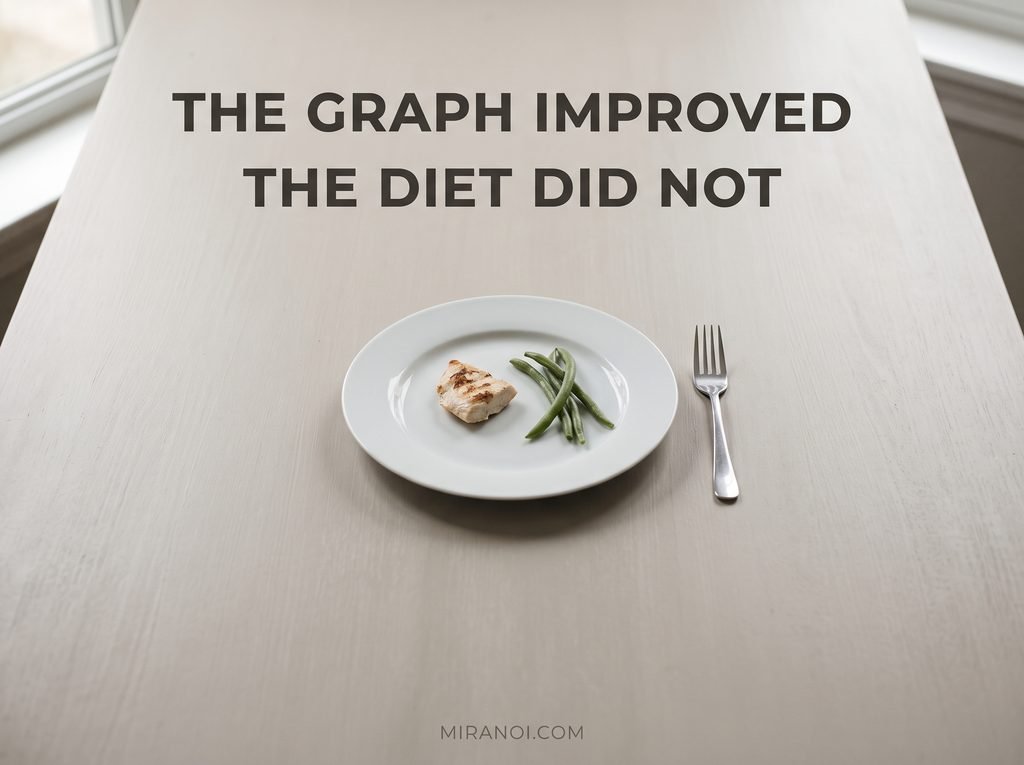
The second pattern is the narrowing diet. People discover a handful of “flat” meals and rotate them. Six weeks later they’re eating less variety, less fiber, and fewer vegetables than before — while the app congratulates them. The graph improved; the diet didn’t.
Third, and most common after a month: the data stops being new. Once you know roughly how you respond to the twenty foods you actually eat, additional sensors tell you what the first two already did. Most people who get genuine value from a CGM got it in the first few weeks and would have been better served by stopping there.
Common Mistakes
| Mistake | Why it happens | Reality |
|---|---|---|
| Judging readings against diabetes thresholds | Those are the numbers online | Healthy people regularly exceed 140 |
| Skipping a baseline period | Eager to start optimizing | Without baseline, nothing has context |
| Trusting small differences | The app shows precise numbers | MARD around 8-9% means ±10 mg/dL is noise |
| Eliminating “spiky” healthy foods | The graph looks worse | Oats, fruit and legumes are not harmed by rising glucose |
| Wearing one indefinitely | Subscription model encourages it | The information value drops sharply after a few weeks |
| Expecting a diagnosis | It measures glucose, so it feels diagnostic | Diagnosis requires standard lab testing |
| Using OTC devices for insulin dosing | They measure the same thing | They are explicitly not intended for it |
Practical Tips
Decide your question before you buy. “How do my usual breakfasts compare?” is answerable. “Is my metabolism healthy?” is not, and a blood test answers it better.
Buy two sensors, not a subscription. Plan to stop.
Spend the first five days changing nothing.
Compare your readings to healthy-population data, not to diabetes thresholds.
Test the same meal twice before concluding anything, since identical meals vary by sleep, stress, and time of day.
Change one variable at a time — meal order, a post-meal walk, portion size.
If the device is making you anxious about food, that is sufficient reason to take it off.
Take anything surprising to a doctor rather than acting on it alone.
When Should You See a Doctor?
See a doctor about standard glucose testing — fasting glucose, A1C, or an OGTT — if you have risk factors such as family history, elevated waist measurement, a history of gestational diabetes, or PCOS. These diagnose; a CGM does not.
Bring CGM data to a clinician rather than acting on it, particularly if you see sustained readings above 180, fasting readings consistently above 100, or readings below 70 with symptoms.
Talk to a clinician before buying if you have a history of disordered eating or food anxiety.
Seek prompt care for symptoms of genuinely high blood sugar — increased thirst, frequent urination, blurred vision, unexplained weight loss — regardless of what a sensor shows.
Frequently Asked Questions
Are continuous glucose monitors worth it for non-diabetics? For a time-limited experiment answering a specific question, possibly. For indefinite use by a healthy adult with no risk factors, the evidence does not support roughly $1,000 a year — research on whether CGM use improves weight, behavior, or health outcomes in non-diabetics remains unclear.
What is a normal glucose range on a CGM without diabetes? Wider than most people expect. Adults with normal glucose and A1C spent about 12% of the day above 140 mg/dL in one study, with many exceeding 180. Post-meal rises are normal physiology.
Can a CGM detect prediabetes? No. It may show patterns worth investigating, but prediabetes and diabetes are diagnosed by fasting glucose, A1C, or an oral glucose tolerance test.
How accurate are over-the-counter CGMs? MARD values around 8-9% for current consumer devices, meaning readings typically fall within roughly 10% of a lab value. Good for trends; not precise enough to draw conclusions from small differences.
Do I need a prescription? Not for over-the-counter devices like Stelo and Lingo. Clinical-grade CGMs used for insulin dosing still require one, and the OTC versions are not intended for insulin dosing.
The Bottom Line
So — are they worth it? For a month, to answer a question you can state in one sentence: reasonably often, yes. As an ongoing subscription for a healthy adult: not on the evidence that currently exists.
This article is for general informational purposes and is not a substitute for personalized medical advice. Prices and device specifications change — verify current details before purchasing. Do not use an over-the-counter CGM for insulin dosing decisions.
References
- Boston University Chobanian & Avedisian School of Medicine —
Ranges of Normal Glucose Levels Among Non-Diabetic Adults
Wearing Continuous Glucose Monitors (2025) - Cell Metabolism — CGMap: Characterizing Continuous Glucose
Monitor Data in Thousands of Non-Diabetic Individuals - Metabolism: Clinical and Experimental — Continuous Glucose
Monitoring in a Healthy Population: Understanding the
Post-Prandial Glycemic Response in Individuals Without Diabetes