Protein is one of the most talked-about nutrients in health circles, yet it’s also one of the most misunderstood. Some people worry they’re not getting enough, while others assume more is always better. So how much protein do you need, exactly? This guide breaks it down by goal, age, and activity level, based on the latest research — not internet guesswork.
Why Protein Matters More Than You Might Think
Protein isn’t just for bodybuilders. Every cell in your body relies on it — from your immune system to your hormones to the enzymes that run your metabolism. It’s also the nutrient most responsible for keeping you full after a meal, which is one reason it plays such a big role in weight management.
When you don’t get enough protein, your body starts breaking down muscle tissue to meet its needs elsewhere. Over time, this can mean slower metabolism, weaker bones, and a harder time recovering from illness or injury — especially as you get older.
The Baseline: RDA vs. Real-World Needs
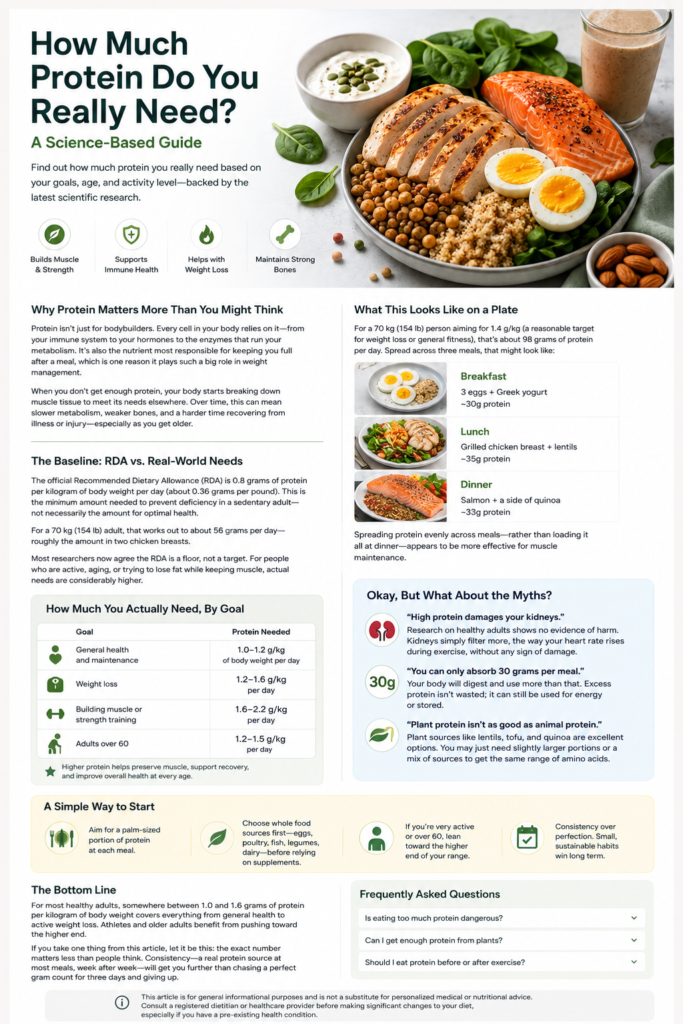
The official Recommended Dietary Allowance (RDA) is 0.8 grams of protein per kilogram of body weight per day (about 0.36 grams per pound). This is the minimum amount needed to prevent deficiency in a sedentary adult — not necessarily the amount for optimal health.
For a 70 kg (154 lb) adult, that works out to about 56 grams per day — roughly the amount in two chicken breasts.
Most researchers now agree the RDA is a floor, not a target. For people who are active, aging, or trying to lose fat while keeping muscle, actual needs are considerably higher.
How Much Protein Do You Need, By Goal
General health and maintenance: 1.0–1.2 g/kg of body weight per day. This supports normal muscle repair and immune function for most healthy adults.
Weight loss: 1.2–1.6 g/kg per day. Higher protein intake during a calorie deficit helps preserve lean muscle mass, so more of the weight you lose comes from fat rather than muscle. It also helps control hunger, which makes sticking to a calorie deficit easier. A 2022 meta-analysis in the Journal of Cachexia, Sarcopenia and Muscle pooling multiple randomized trials found this range was associated with better lean mass retention than lower intakes, in both younger and older adults.
Building muscle or strength training regularly: 1.6–2.2 g/kg per day. Research consistently shows this range maximizes muscle protein synthesis when combined with resistance training.
Adults over 60: 1.2–1.5 g/kg per day, even without exercise. Older adults experience “anabolic resistance” — a well-documented phenomenon in aging research where muscle becomes less responsive to the normal signal protein sends to build tissue, meaning it takes more protein to get the same effect it once did at a lower dose. That’s why higher intake helps offset natural muscle loss (sarcopenia) even in people who aren’t training.
Quick Reference: Daily Protein by Goal (70 kg / 154 lb adult)
| Goal | g/kg body weight | Daily total (approx.) |
|---|---|---|
| Minimum (RDA floor) | 0.8 g/kg | 56 g |
| General health | 1.0–1.2 g/kg | 70–84 g |
| Weight loss | 1.2–1.6 g/kg | 84–112 g |
| Muscle building | 1.6–2.2 g/kg | 112–154 g |
| Over 60 (sedentary or active) | 1.2–1.5 g/kg | 84–105 g |
To find your own number: multiply your weight in kg by the g/kg range for your goal. (Weight in lb ÷ 2.2 = weight in kg.)
What This Looks Like on a Plate
For a 70 kg (154 lb) person aiming for 1.4 g/kg (a reasonable target for weight loss or general fitness), that’s about 98 grams of protein per day. Spread across three meals, that might look like:
- Breakfast: 3 eggs + Greek yogurt (~30g)
- Lunch: Grilled chicken breast + lentils (~35g)
- Dinner: Salmon + a side of quinoa (~33g)
Spreading protein evenly across meals — rather than loading it all at dinner — appears to be more effective for muscle maintenance, since your body can only use so much protein for muscle synthesis in a single sitting. If you’re building this around a broader weight-loss plan, it’s worth pairing this with our guide on 10 Science-Backed Ways to Lose Weight Naturally.
Okay, But What About the Myths?
“High protein damages your kidneys.” This is the one that comes up in the comments section every single time. The concern actually traces back to studies on people who already had kidney disease, not the general population. In 2018, researchers at McMaster University reviewed over two dozen studies on healthy adults and found no evidence that higher protein intake harms kidney function — if anything, kidneys simply filter a bit more, the way your heart rate rises during a workout, without any sign of damage. Their findings were published in The Journal of Nutrition. If you have an existing kidney condition, the calculus is different, and you should follow your doctor’s guidance rather than a general-audience article.
“You can only absorb 30 grams per meal.” Your body will digest and use more than that — it just may not all go toward muscle building in one sitting. Excess protein isn’t wasted; it can still be used for energy or stored.
“Plant protein isn’t as good as animal protein.” Plant sources like lentils, tofu, and quinoa are excellent options. You may just need slightly larger portions or a mix of sources to get the same range of amino acids as animal protein provides.
Practical Tips
- Include a protein source with every meal, not just dinner.
- Choose a mix of lean meats, fish, eggs, dairy, and legumes rather than relying on one source.
- Spread protein evenly across the day instead of front- or back-loading it.
- Stay hydrated — protein metabolism increases water needs slightly, so drink accordingly as you raise your intake.
- Lean toward whole foods first; treat protein powder as a backup, not the main plan.
If you’re managing a specific condition alongside your protein goals — for example, Type 2 diabetes — those numbers may shift slightly, so it’s worth reading alongside a condition-specific guide rather than in isolation.
Frequently Asked Questions
Is it bad to eat protein at every meal? No. Spreading protein across meals is actually the more effective approach for muscle maintenance and appetite control, compared to eating most of it in one sitting.
Do I need protein powder to hit my target? Not necessarily. Whole foods like eggs, chicken, fish, Greek yogurt, and legumes can cover most people’s needs. Protein powder is a convenient add-on, not a requirement.
Can too much protein turn into fat? Excess calories from any source, including protein, can be stored as fat if you’re eating above your total calorie needs. But protein itself is the least likely macronutrient to be converted to fat, since your body prioritizes using it for repair and maintenance first.
Does cooking method affect protein content? No — cooking doesn’t meaningfully change the amount of protein in a food, though very high heat for a long time can slightly reduce protein quality by damaging some amino acids.
?How much protein do you need if you’re not exercising at all
Even at a sedentary activity level, most healthy adults do better around 1.0–1.2 g/kg rather than the bare RDA of 0.8 g/kg, since the RDA is only the minimum needed to avoid deficiency, not the amount for optimal muscle and metabolic health.
Looking for meal ideas? Try our 5 healthy high-protein recipes you can make in 30 minutes or less.
Looking for meal ideas to round out your day? Try our 6 healthy lunch recipes that actually survive a workday.
The Bottom Line
So, how much protein do you need? For most healthy adults, somewhere between 1.0 and 1.6 grams… of protein per kilogram of body weight covers everything from general health to active weight loss. Athletes and older adults benefit from pushing toward the higher end.
Protein isn’t about chasing the highest number possible — it’s about eating enough to support your health, energy, and long-term goals. By understanding your own needs instead of following internet trends, you’ll make choices that are both practical and sustainable.
This article is for general informational purposes and is not a substitute for personalized medical or nutritional advice. Consult a registered dietitian or healthcare provider before making significant changes to your diet, especially if you have a pre-existing health condition.