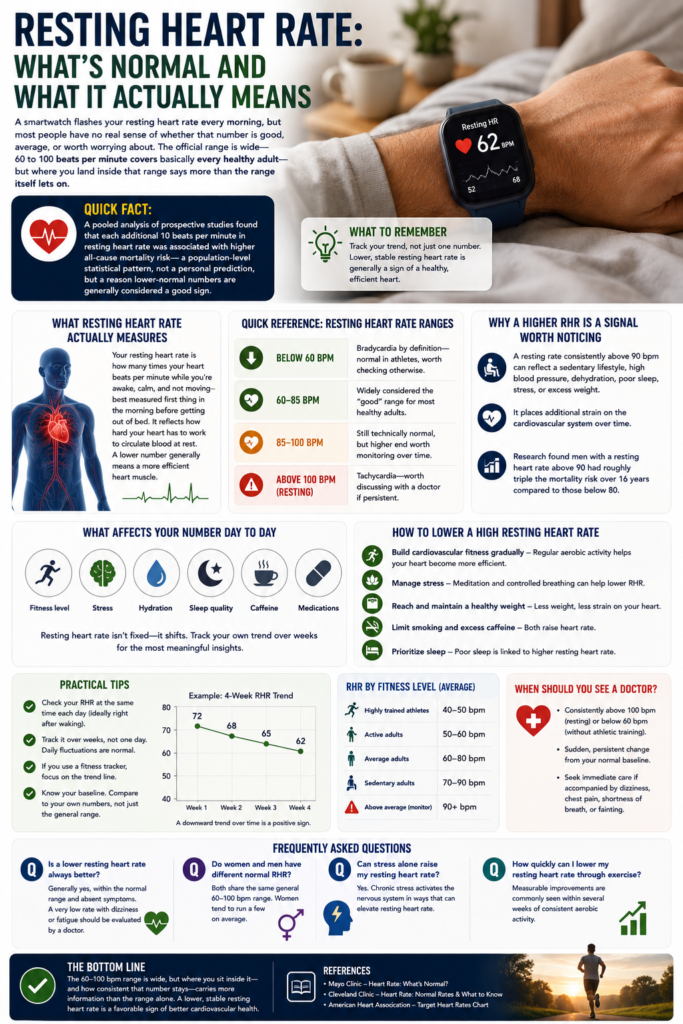
A smartwatch flashes your resting heart rate every morning, but most people have no real sense of whether that number is good, average, or worth worrying about. The official range is wide — 60 to 100 beats per minute covers basically every healthy adult — but where you land inside that range says more than the range itself lets on.
Quick Fact: A pooled analysis of prospective studies found that each additional 10 beats per minute in resting heart rate was associated with higher all-cause mortality risk — a population-level statistical pattern, not a personal prediction, but a reason lower-normal numbers are generally considered a good sign.
What Resting Heart Rate Actually Measures
Your resting heart rate is how many times your heart beats per minute while you’re awake, calm, and not moving — best measured first thing in the morning before getting out of bed. It reflects how hard your heart has to work to circulate blood at rest. A lower number generally means a more efficient heart muscle, similar to a well-tuned engine idling smoothly rather than straining.
The Official Range vs. the “Better” Range
60-100 bpm is the standard normal range cited by essentially every major health organization. But within that range, lower tends to be better: many clinicians consider 55-85 bpm a more meaningful “good” range for most healthy adults, and highly trained athletes often sit in the 40s, reflecting a heart that pumps more blood per beat and simply doesn’t need to beat as often.
Quick Reference: Resting Heart Rate Ranges
| Range | What It Generally Indicates |
|---|---|
| Below 60 bpm | Bradycardia by definition — normal in athletes, worth checking otherwise |
| 60–85 bpm | Widely considered the “good” range for most healthy adults |
| 85–100 bpm | Still technically normal, but higher end worth monitoring over time |
| Above 100 bpm (resting) | Tachycardia — worth discussing with a doctor if persistent |
Why a Higher Resting Heart Rate Is a Signal Worth Noticing
A resting rate consistently above 90 bpm — even while technically inside the “normal” range — doesn’t automatically mean disease, but it’s a signal worth paying attention to. It can reflect a sedentary lifestyle, high blood pressure, dehydration, poor sleep, elevated stress, or excess weight, all of which place additional strain on cardiovascular function over time. Research has found that men with a resting heart rate above 90 had roughly triple the mortality risk over a 16-year follow-up compared to those below 80 — a striking association, though it reflects a broader risk pattern across a population rather than a certainty for any one individual.
What Affects Your Number Day to Day
Resting heart rate isn’t fixed — it shifts with fitness level, stress, hydration, sleep quality, caffeine, certain medications, and even the time of day. This is part of why tracking your own trend over weeks matters more than fixating on a single morning’s reading: if your typical resting rate sits in the 60s and it suddenly, persistently reads 90, that shift is more informative than the absolute number itself.
How to Lower a High Resting Heart Rate
Build cardiovascular fitness gradually. Regular aerobic activity is one of the most reliable ways to lower resting heart rate over time, as the heart becomes more efficient at pumping blood per beat.
Manage stress. Chronic stress keeps the nervous system in a heightened state, which can elevate resting heart rate; practices like meditation and controlled breathing have been shown to help lower it.
Reach and maintain a healthy weight. Excess weight makes the heart work harder to circulate blood, which is reflected in a higher baseline rate.
Limit smoking and excess caffeine. Both are established contributors to elevated heart rate; reducing or eliminating them tends to produce a measurable effect over time.
Prioritize sleep. Poor sleep is linked to elevated resting heart rate the following day, adding another reason consistent, quality sleep supports cardiovascular health broadly.
Practical Tips
- Check your resting heart rate at the same time each day (ideally right after waking) for a more consistent, comparable trend.
- Track it over weeks rather than reacting to a single reading — day-to-day fluctuation is normal.
- If you use a fitness tracker, treat the trend line as more valuable than any single day’s number.
- Know your own baseline rather than comparing yourself directly to the general population range — what’s “high” for you might sit well within the textbook-normal range.
If you’re working on cardiovascular health more broadly, it’s worth pairing this with our guides on foods that naturally lower blood pressure and heart disease prevention habits, since resting heart rate is influenced by many of the same lifestyle factors.
If you’ve noticed your heart racing or skipping beats, it’s worth understanding heart palpitations — the common causes and when they’re worth checking out.
When Should You See a Doctor?
Talk to a doctor if your resting heart rate is consistently above 100 bpm (tachycardia) or below 60 bpm without an athletic training background (bradycardia), or if you notice a sudden, persistent shift from your normal baseline. Seek prompt medical attention if a fast or slow heart rate is accompanied by symptoms like dizziness, chest pain, shortness of breath, or fainting.
Frequently Asked Questions
Is a lower resting heart rate always better? Generally yes, within the normal range and absent symptoms — it typically reflects better cardiovascular fitness. A very low rate accompanied by dizziness or fatigue, however, is worth medical evaluation rather than being assumed as purely positive.
Do women and men have different normal resting heart rates? Both share the same general 60-100 bpm range, though women’s resting rates tend to run a few beats per minute faster on average, often attributed to smaller average heart size and lower blood volume.
Can stress alone raise my resting heart rate? Yes. Chronic stress keeps the nervous system activated in ways that can elevate resting heart rate independent of fitness level or other health factors.
How quickly can I lower my resting heart rate through exercise? Measurable improvements are commonly seen within several weeks of consistent aerobic activity, though the exact timeline varies by starting fitness level and consistency.
The Bottom Line
The official 60-100 bpm range is wide enough to cover nearly everyone, but where you sit inside it — and how consistent that number stays over time — carries more information than the range alone. A lower, stable resting heart rate is generally a favorable sign, while a persistently elevated one is worth investigating rather than dismissing simply because it’s technically “normal.”
This article is for general informational purposes and is not a substitute for personalized medical advice. Consult a healthcare provider if your resting heart rate is persistently outside the normal range or accompanied by symptoms.
References
- Mayo Clinic — Heart Rate: What’s Normal?
- Cleveland Clinic — Heart Rate: Normal Rates & What to Know
- American Heart Association — Target Heart Rates Chart