Not all heart attack warning signs look like chest pain. Chest pain is the symptom most people picture when they think “heart attack” — it’s real and common, but only part of the picture.” It’s real, and it’s common — but it’s also only part of the picture. A meaningful number of heart attacks, especially in women, show up looking like something else entirely: back pain after yard work, nausea mistaken for a stomach bug, fatigue written off as a bad night’s sleep. Knowing the fuller list of signs is what actually gets people to the hospital in time.
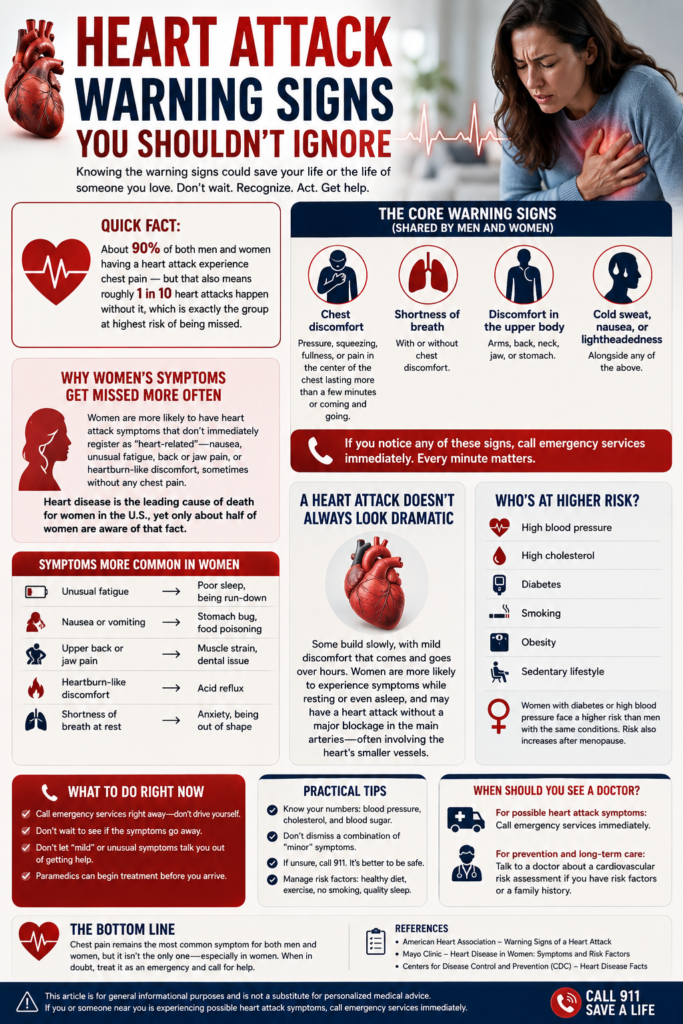
Quick Fact: About 90% of both men and women having a heart attack experience chest pain — but that also means roughly 1 in 10 heart attacks happen without it, which is exactly the group at highest risk of being missed.
The Core Warning Signs (Shared by Men and Women)
- Chest discomfort. Pressure, squeezing, fullness, or pain in the center of the chest, lasting more than a few minutes or coming and going.
- Shortness of breath, with or without chest discomfort.
- Discomfort in the upper body — arms, back, neck, jaw, or stomach.
- Cold sweat, nausea, or lightheadedness alongside any of the above.
If you notice any of these, the guidance is consistent across every major medical source: call emergency services immediately rather than waiting to see if it passes.
Why Women’s Symptoms Get Missed More Often
Women are more likely than men to have heart attack symptoms that don’t immediately register as “heart-related” — nausea, unusual fatigue, back or jaw pain, or heartburn-like discomfort, sometimes without any chest pain at all. Doctors note this isn’t a minor footnote: women more often attribute these symptoms to stress, indigestion, or simply having slept wrong, which delays them from seeking care compared to men. Heart disease remains the leading cause of death for women in the U.S., yet only about half of women are aware of that fact.
Quick Reference: Symptoms More Common in Women
| Symptom | Often Mistaken For |
|---|---|
| Unusual fatigue | Poor sleep, being run-down |
| Nausea or vomiting | Stomach bug, food poisoning |
| Upper back or jaw pain | Muscle strain, dental issue |
| Heartburn-like discomfort | Acid reflux |
| Shortness of breath at rest | Anxiety, being out of shape |
A Heart Attack Doesn’t Always Look Dramatic
Not every heart attack announces itself with sudden, crushing chest pain. Some build slowly, with mild discomfort that comes and goes over hours. Women in particular are more likely to experience symptoms while resting or even asleep, and are also more likely to have a heart attack without a major blockage showing up in the main arteries — a pattern involving the heart’s smaller vessels that can be easy to miss without the “classic” picture in mind.
Who’s at Higher Risk
Risk factors that increase the chances of a heart attack include high blood pressure, high cholesterol, diabetes, smoking, obesity, and a sedentary lifestyle. Notably, some conditions affect women more severely than men with the same diagnosis — for example, women with diabetes or high blood pressure face a proportionally higher heart disease risk than men with those same conditions. Post-menopausal women also see rising risk as estrogen levels decline.
What to Do If You Notice These Signs
Call emergency services right away rather than driving yourself to the hospital — paramedics can begin treatment before you even arrive, which matters for how much heart muscle is preserved. Don’t wait to see if the symptoms resolve on their own, and don’t let an ambiguous symptom (like fatigue or nausea) talk you out of getting checked, especially if it’s combined with anything else on this list.
Practical Tips
- If you have risk factors (high blood pressure, diabetes, smoking, family history), talk to your doctor about your personal baseline risk before an emergency happens.
- Don’t dismiss a combination of “minor” symptoms — fatigue plus nausea plus shortness of breath together is a different signal than any one alone.
- If you’re ever unsure whether what you’re feeling warrants a 911 call, treat that uncertainty as a reason to call, not a reason to wait.
- Know your own numbers — blood pressure, cholesterol, and blood sugar — since all three are modifiable heart disease risk factors.
If you’re working on reducing your long-term heart disease risk, it’s worth pairing this with our guides on foods that naturally lower blood pressure and how to improve cholesterol naturally, since both are directly tied to heart attack risk.
When Should You See a Doctor?
This is the rare case where the answer isn’t “see a doctor” — it’s call emergency services immediately if you or someone near you shows any combination of these warning signs. Outside of an acute event, talk to a doctor about a cardiovascular risk assessment if you have risk factors like high blood pressure, high cholesterol, diabetes, or a family history of early heart disease.
Frequently Asked Questions
Can you have a heart attack without any chest pain? Yes. This is more common in women, and can include symptoms like unexplained fatigue, nausea, or back and jaw pain without chest discomfort at all.
How long do heart attack symptoms typically last before someone seeks help? This varies widely, but research shows women in particular tend to delay care longer than men, often because symptoms feel vague or are attributed to something less serious.
Is it better to drive myself to the hospital or call an ambulance? Call emergency services. Paramedics can begin treatment en route and are prepared for a cardiac emergency in a way a private vehicle isn’t.
Are heart attack symptoms different for older adults? Shortness of breath is more commonly reported in older adults, sometimes appearing before or without chest pain, which is part of why age itself is factored into risk assessment.
The Bottom Line
Chest pain remains the most common heart attack symptom for both men and women, but it isn’t the only one — and the symptoms most likely to be dismissed as “probably nothing” are often the ones that matter most to recognize, especially in women. When in doubt, treat it as an emergency and call for help rather than waiting it out.
This article is for general informational purposes and is not a substitute for personalized medical advice. If you or someone near you is experiencing possible heart attack symptoms, call emergency services immediately.
References
- American Heart Association — Warning Signs of a Heart Attack
- Mayo Clinic — Heart Disease in Women: Symptoms and Risk Factors
- Centers for Disease Control and Prevention (CDC) — Heart Disease Facts