

The article has a section called “How to Raise HDL Naturally.” Four drugs have raised HDL successfully in large trials. Not one of them prevented a heart attack, and the first one killed people.
That is not a reason to distrust the article. It is the central fact about the second half of its own title, and it changes what the advice is for.
HDL is a reliable marker of cardiovascular health. People with high HDL tend to have less heart disease. But when researchers built drugs to raise it and tested whether that reduced events, the answer came back four times, and four times it was no. The marker tracks the thing; moving the marker does not move the thing.
So this rebuild keeps everything the article says about LDL, which is sound, and rewrites what it says about HDL, which is a section advising effort on a number that will not repay it. It also adds the ceiling the word “naturally” has, and the arithmetic that tells you whether you are under it.
Quick Fact: Evacetrapib raised HDL by 130% — more than doubling it — and lowered LDL by 37% in over 12,000 high-risk patients. The trial was stopped early because it made no difference to heart attacks, strokes or cardiovascular death. The lead investigator said the team was “disappointed and surprised.”
The HDL Docket
Every table in this article records what was tried and what happened, rather than what is recommended.
| Drug and trial | Participants | HDL raised by | What happened |
|---|---|---|---|
| Torcetrapib (ILLUMINATE) | 15,067 | +72% | Stopped early. 25% more cardiovascular events. 58% more deaths from any cause |
| Dalcetrapib (dal-OUTCOMES) | 15,871 | +31–40% | No reduction in events (8.0% vs 8.3%, HR 1.04, P = 0.52). Halted |
| Evacetrapib (ACCELERATE) | >12,000 | +130% | No difference on the primary endpoint. Stopped early |
| Niacin (AIM-HIGH, HPS2-THRIVE) | ~29,000 combined | Raised | No benefit; excess adverse events in the larger trial |
The torcetrapib result is partly explained by off-target effects — it raised blood pressure by about 5.4 mmHg and appears to have caused hyperaldosteronism. But dalcetrapib and evacetrapib had no such problems and also did nothing.
There is a mechanistic explanation worth knowing, because it is the clearest statement of what HDL-C actually measures. Torcetrapib raised HDL cholesterol by 53% and raised the number of HDL particles by about 1%. The test counts the cholesterol the particles are carrying, not the particles. It was filling the trucks, not adding trucks.
The genetic evidence is genuinely mixed rather than settled — some CETP variants that raise HDL associate with less coronary disease, while marked HDL elevation from CETP deficiency does not associate with longevity. The honest summary is that HDL function and particle count may matter and HDL cholesterol, the thing on your lab report, is not a lever you can usefully pull.
And “Higher Is Better” Is Wrong at the Top
The article’s table says HDL above 60 mg/dL is protective. The largest study of this question found a U-shaped curve.
| Men | Women | |
|---|---|---|
| Participants | 52,268 | 64,240 |
| HDL at lowest mortality | ~73 mg/dL (1.9 mmol/L) | ~93 mg/dL (2.4 mmol/L) |
| Mortality at ~93 mg/dL | HR 1.36 (1.09–1.70) | — |
| Mortality at ~116 mg/dL and above | HR 2.06 (1.44–2.95) | — |
| Mortality at ~135 mg/dL and above | — | HR 1.68 (1.09–2.58) |
Two Copenhagen population studies, 745,452 person-years of follow-up.
A man with an HDL of 116 mg/dL had roughly double the all-cause mortality of a man at the optimum. Nobody thinks very high HDL causes death — it most likely marks something else, possibly genetic variants that produce dysfunctional HDL particles. But it dismantles the simple reading of the article’s own table, and it means “raise your HDL” is advice with no stated endpoint in a relationship that reverses.
What this does not change: low HDL — under 40 in men, under 50 in women — remains a genuine risk marker. It tells you something real about metabolic health. It just is not a target you aim at directly.
What Actually Lowers LDL
The article’s LDL section is good and this quantifies it.
| Intervention | Typical LDL reduction | Notes |
|---|---|---|
| Replacing saturated fat with unsaturated | 5–10% | The single highest-value dietary change |
| Soluble fiber, 5–10 g/day | ~5% | Oats, barley beta-glucan, psyllium, legumes |
| Plant sterols, ~2 g/day | ~8–10% | Fortified spreads and drinks |
| Nuts, a daily handful | ~3–5% | |
| Soy protein | modest | |
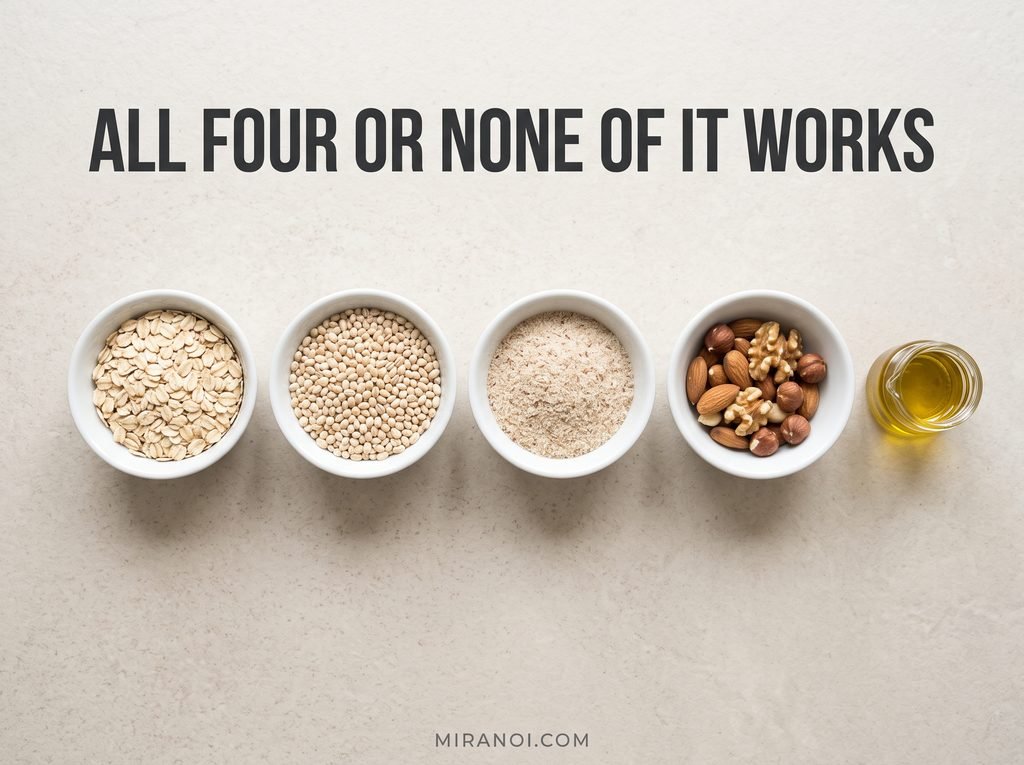
| All four together — the “portfolio” approach | ~17% average; up to 30% | Demanding to follow fully |
| Weight loss, where applicable | Variable | Moves triglycerides more than LDL |
| Exercise | Small on LDL | Moves HDL and triglycerides more |
| Statins | 30–50%+ | For comparison |
Soluble fiber appears here and in our high-fiber recipes guide, which explains why only the viscous kinds — oat and barley beta-glucan, psyllium — do this, and why most fiber does not.
The portfolio figure is the honest ceiling for diet, and it comes from studies where people followed all four components properly. Most people do one or two.
The Single LDL Target Is Not One Number
| What the article says | What guidelines actually do | |
|---|---|---|
| The target | Below 100 mg/dL for most adults | Risk-stratified, with lower targets at higher risk |
| High risk | “aim lower” | Typically below 70 mg/dL |
| Very high risk — existing disease | not addressed | Typically below 55 mg/dL, plus ≥50% reduction |
| Is there a floor? | not addressed | None demonstrated. Lower has been better in every trial so far |
“Below 100” is a reasonable general statement and a poor one for the reader who most needs this page. Somebody who has already had a heart attack is working to a number roughly half that, and will not get there by eating oats.
The practical consequence: your target is not a number you can read off an article. It depends on your age, blood pressure, smoking status, diabetes, family history and whether you already have disease. A risk calculator and a doctor produce it. This page cannot.
What the Standard Panel Misses
| What was measured | What it misses |
|---|---|
| LDL-C | Particle number. Two people with the same LDL-C can carry very different particle counts — ApoB measures that |
| Total, HDL, LDL, triglycerides | Lp(a) — genetic, largely unmodifiable by diet, elevated in roughly one in five people, and not on a standard panel |
| Any blood test | Whether plaque is actually there — a coronary calcium score shows it directly |
Our guide to Lp(a) and why your cholesterol test misses it covers the first of those in full, and our guide to the coronary calcium score covers the third. Lp(a) is worth measuring once in a lifetime and almost nobody has.
This matters for an article about improving numbers naturally, because Lp(a) does not respond to diet, exercise or weight loss. If it is high, nothing in the practical tips section will move it, and the right response is to manage everything else more aggressively rather than to try harder at the things that do not work on it.
The Egg Question, Which Was Tested
| What was believed | What was tested | Where it stands |
|---|---|---|
| Dietary cholesterol raises blood cholesterol proportionally | Decades of feeding studies | The effect is modest in most people and varies a lot between individuals |
| So limit cholesterol to 300 mg a day | The evidence for that specific cap | The 300 mg limit was removed from the US Dietary Guidelines in 2015 |
| Eggs are the problem | Large cohort studies | Mixed and inconsistent. Saturated fat intake predicts LDL better than dietary cholesterol does |
The useful version: for most people, what is on the toast matters more than the egg. Butter, processed meat and pastry carry the saturated fat that moves LDL. A minority of people are strong “hyper-responders” to dietary cholesterol, and the way to find out whether you are one is to test, change one thing, and test again.
What People Actually Run Into
The most common experience is a disappointing second blood test, and the reason is usually that one change was made rather than four. Replacing butter with olive oil is worth perhaps 5%. The portfolio figure of 17% comes from doing four things at once, every day, for months. People do one of them, intermittently, and then conclude that diet does not work on them.
The second is the HDL chase, which this article exists to stop. Somebody reads that HDL is protective, sees their 42, and spends a year on it. The number may well rise — exercise and weight loss do move it — and the heart attack risk will not have moved for that reason. The exercise helped for other reasons entirely.
The third is the fasting confusion. People compare a fasted result with a non-fasted one and read a triglyceride swing as a change in their lipids. Triglycerides move substantially after eating; LDL and HDL much less. If you are comparing two tests, compare like with like — same lab, same fasting state, ideally the same time of day.
The fourth is quiet and matters most: the person who finds a number in the 190s, reads an article about lowering cholesterol naturally, and gives it a year. That number is not a dietary problem and the year is not neutral.
Common Mistakes
Treating HDL as a target rather than a marker. Four drug programmes raised it; none prevented a heart attack.
Reading “above 60 is protective” as “more is better.” Mortality is lowest around 73 mg/dL in men and rises substantially above about 116.
Taking 100 mg/dL as everyone’s LDL target. It is risk-stratified, and people with existing disease work to roughly half that.
Changing one thing and expecting the full effect. The 17% figure is four interventions at once.
Cutting fat instead of replacing it. Removing saturated fat and replacing it with refined carbohydrate does not help LDL and often worsens triglycerides.
Counting any fiber as cholesterol-lowering. Only the viscous kinds — oat and barley beta-glucan, psyllium — do this.
Never testing Lp(a). One lifetime test, not on the standard panel, elevated in about one in five people, and unmoved by anything in a diet.
Comparing a fasted test with a non-fasted one. The triglycerides will mislead you.
Retesting at three weeks. Diet takes six to twelve.
Treating an LDL of 190+ as a diet problem. It is a referral.
Practical Tips
Replace saturated fat rather than just reducing fat. Olive oil, rapeseed oil, nuts, oily fish — swapping is what works, and cutting fat without replacing it usually means eating more refined carbohydrate.
Get soluble fiber from oats, barley and psyllium specifically. Five to ten grams a day, and it must be the viscous kind.
Add plant sterols if your LDL needs more than diet alone is giving you — about 2 g a day from fortified products, worth roughly 8–10%.
Eat fish twice a week. It does more for triglycerides than LDL, and that is still worth having.
Exercise for the triglycerides, the blood pressure and everything else — not for the HDL number. Our guide to strength training for beginners and our foods that lower blood pressure cover the rest of the risk picture.
Stop smoking, which is the only item on this page that outranks the lipid numbers entirely.
Ask for an Lp(a) test once. It is cheap, it is a single lifetime measurement, and it changes how aggressively everything else should be managed.
Recheck after three months, not three weeks.
When Should You See a Doctor?
See a doctor promptly, and do not start with diet, if your LDL is 190 mg/dL or above. That level suggests familial hypercholesterolemia, which affects roughly 1 in 250 people, is largely genetic, and is not a dietary problem. It is also substantially undiagnosed and substantially treatable.
Ask about screening for the rest of your family if you are diagnosed with it. First-degree relatives have a one-in-two chance of carrying it.
See a doctor rather than extending the diet trial if three to six months of consistent change has not moved your numbers to target. Continuing is not neutral — it is continued exposure.
Ask about statins rather than deciding against them from an article. For the people whose arithmetic does not work, they are the difference between reaching a target and not, and the decision belongs with someone who can see your whole risk profile.
Discuss triglycerides above 500 mg/dL urgently. That is a pancreatitis risk, not just a cardiovascular one, and it is managed differently.
Frequently Asked Questions
Can diet alone lower high cholesterol? Sometimes. A fully executed dietary programme averages about a 17% LDL reduction. Whether that is enough depends entirely on the gap between your number and your target — see the arithmetic below.
Should I try to raise my HDL? Not directly. Four drug programmes raised it substantially and none reduced heart attacks; one increased deaths. Low HDL is a useful warning sign about metabolic health. It is not a dial to turn.
How long before my numbers change? Six to twelve weeks for diet to show its full effect. Recheck at three months, and compare like with like — same lab, similar fasting state.
Is all fat bad for cholesterol? No. Saturated fat raises LDL; unsaturated fat lowers it when it replaces saturated. The useful instruction is “replace,” not “reduce.”
Do eggs raise cholesterol? Modestly, in most people, and the 300 mg daily cholesterol limit was dropped from the US guidelines in 2015. Saturated fat predicts LDL better. Some people respond strongly and the only way to know is to test.
What if my LDL is 190 or higher? See a doctor before changing your diet. That number points toward a genetic condition that diet does not fix.

The Bottom Line: Do the Arithmetic on Your Own Number
Whether “naturally” can work for you is not a matter of commitment. It is subtraction, and you can do it now.
Take your LDL. Subtract your target. Divide by your LDL. That is the percentage reduction you need.
| Your LDL | Target 100 | Reduction needed | Diet alone? |
|---|---|---|---|
| 120 | 100 | 17% | Yes — this is exactly the portfolio diet’s average |
| 130 | 100 | 23% | Borderline. Possible with all four components, properly done |
| 160 | 100 | 38% | No |
| 190 | 100 | 47% | No — and see a doctor about the number itself |
| 130 | 70 (high risk) | 46% | No |
Roughly 17% is what a fully executed dietary programme achieves on average, and up to 30% is what the best responders achieve doing everything. If the number in your third column is comfortably under 20, you have a real chance and the practical tips above are your plan.
If it is over 30, no amount of oats will close it, and the honest advice is to do the dietary work anyway — because it lowers risk through routes that are not the LDL number — while having the medication conversation now rather than after six months of a trial you can already see the end of.
That is the part a page titled “naturally” is reluctant to say, and it is the part that matters most to the people reading it who are genuinely at risk.
This article is for general informational purposes and is not a substitute for professional medical advice. Cholesterol targets are individual and depend on your overall cardiovascular risk. Do not start, stop or delay medication on the basis of an article.
References
- Barter PJ, Caulfield M, Eriksson M, et al. (2007). Effects of Torcetrapib in Patients at High Risk for Coronary Events (ILLUMINATE). New England Journal of Medicine, 357(21):2109–2122
- American College of Cardiology — ILLUMINATE Trial Summary, Presented at AHA 2007
- Schwartz GG, Olsson AG, Abt M, et al. (2012). Effects of Dalcetrapib in Patients with a Recent Acute Coronary Syndrome (dal-OUTCOMES). New England Journal of Medicine, 367(22):2089–2099
- Lincoff AM, Nicholls SJ, Riesmeyer JS, et al. (2017). Evacetrapib and Cardiovascular Outcomes in High-Risk Vascular Disease (ACCELERATE). New England Journal of Medicine, 376(20):1933–1942
- Tall AR, Rader DJ. The Trials and Tribulations of CETP Inhibitors — HDL cholesterol versus HDL particle number
- University of Copenhagen — Extremely High HDL Cholesterol Is Associated with Increased Mortality (Madsen, Varbo & Nordestgaard, 2017)
- Madsen CM, Varbo A, Nordestgaard BG (2017). Extreme High HDL Cholesterol Is Paradoxically Associated with High Mortality in Men and Women. European Heart Journal, 38(32):2478–2486 — reported hazard ratios
- HEART UK — Portfolio Dietary Pattern and Cardiovascular Disease: A Systematic Review and Meta-analysis of Controlled Trials
- American Heart Association — Cholesterol