
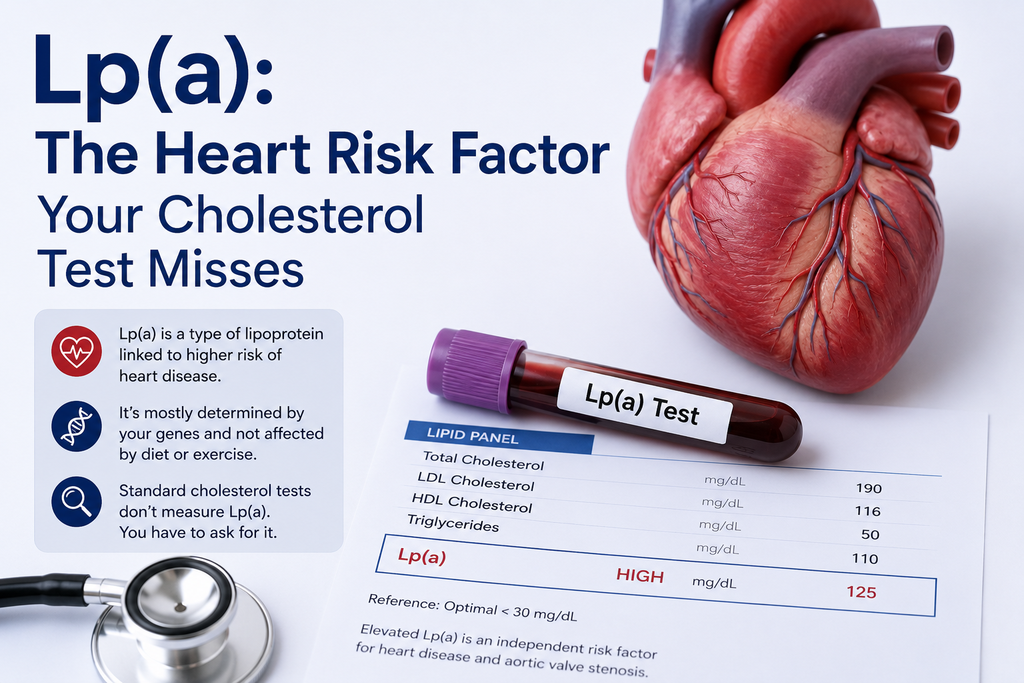
A standard lipid panel measures LDL, HDL, and triglycerides. It doesn’t measure lipoprotein(a) — and roughly one in five people has elevated levels of it.
That gap matters more than it sounds. Elevated Lp(a) is associated with a 2-3 fold increased risk of heart attack and aortic valve stenosis, comparable to the risk carried by people with familial hypercholesterolemia. Yet a retrospective analysis of health records covering 70 million American adults found that only 0.1% had ever been tested.
Quick Fact: Because Lp(a) is roughly 70-90% genetically determined and stays largely stable throughout life, you only need to test it once, ever. One blood draw answers the question permanently.
What Lp(a) Actually Is
Lipoprotein(a) — written Lp(a) and pronounced “L-P-little-a” — is an LDL-like particle with an additional protein called apolipoprotein(a) attached to it.
That extra protein changes its behavior in three ways that matter:
- Pro-atherogenic — it contributes to plaque formation like LDL does
- Pro-inflammatory — it’s the major carrier of oxidized phospholipids, which drive inflammation and calcification
- Anti-fibrinolytic — it interferes with the body’s ability to break down clots
That third property is unique among cholesterol particles, and it’s part of why Lp(a) is associated with stroke risk specifically.
Why It’s Genetic, Not Lifestyle
This is the most important practical difference between Lp(a) and everything else on a lipid panel.
Your Lp(a) level is set by a single gene — the LPA gene accounts for more than 90% of the variation in plasma Lp(a) concentrations between people. It’s essentially fixed at birth and doesn’t respond meaningfully to diet, exercise, or weight loss.
This cuts both ways. It means you can’t lower it through lifestyle changes the way you can lower LDL. But it also means a single test gives you a lifetime answer, and it explains why some people with excellent diets, normal weight, and unremarkable cholesterol panels still have heart attacks in their forties.
Quick Reference: Lp(a) vs. LDL Cholesterol
| Feature | LDL Cholesterol | Lp(a) |
|---|---|---|
| Measured in standard lipid panel | Yes | No |
| Primarily determined by | Diet, lifestyle, genetics | Genetics (~90%) |
| Changes over lifetime | Yes, substantially | Largely stable |
| How often to test | Regularly | Once in a lifetime |
| Lowered by diet/exercise | Yes | Not meaningfully |
| Approved targeted drugs | Many (statins, etc.) | None yet |
What Elevated Lp(a) Actually Predicts
The evidence base here is unusually strong — it includes epidemiological studies, genome-wide association studies, and Mendelian randomization, which together support Lp(a) as a causal risk factor rather than just a correlated marker.
Elevated levels are associated with increased risk of:
- Heart attack and coronary artery disease
- Ischemic stroke
- Calcific aortic valve stenosis — narrowing of the aortic valve
- Peripheral artery disease
- Abdominal aortic aneurysm
A 2026 analysis of more than 20,000 patients across three NIH studies found that Lp(a) at or above 175 nmol/L was independently associated with increased major adverse cardiovascular events, cardiovascular death, and stroke — even after accounting for standard lipid levels and existing treatment.
Notably, research from the Family Heart Foundation found the risk continues climbing across all ascending Lp(a) levels with no apparent plateau — there isn’t a ceiling above which additional Lp(a) stops mattering.
Who Should Get Tested
Major cardiology organizations have converged on this, and the recommendation has broadened over time.
The 2026 ACC/AHA Dyslipidemia Guideline recommends every adult have Lp(a) measured at least once in a lifetime. European and Canadian guidelines reached the same conclusion earlier.
Testing is considered particularly important for:
- Anyone with a family history of premature cardiovascular disease
- People who had a heart attack or stroke without obvious risk factors
- Those at borderline or intermediate calculated risk, where the result may reclassify them
- People with a known family history of elevated Lp(a)
- Anyone with cardiovascular disease that progressed despite well-controlled LDL
The Uncomfortable Part: No Approved Treatment Yet
Honesty matters here, because it’s the most common objection to testing.
There is currently no approved drug that specifically lowers Lp(a). Several are in late-stage trials — pelacarsen, olpasiran, and lepodisiran among them — and the results have been striking, with one siRNA therapy reducing Lp(a) by 94% for six months after a single dose.
But as the American College of Cardiology notes plainly: no published outcome trial has yet definitively shown that lowering Lp(a) reduces cardiovascular events. That question is expected to be answered around 2027.
So why test now? Because knowing changes management even without an Lp(a)-specific drug. An elevated result generally means treating everything else more aggressively — lower LDL targets, tighter blood pressure control, smoking cessation prioritized, and closer monitoring. As one prominent cardiologist framed it, the goal is to identify these patients now so they’re ready when targeted therapies arrive.
What Actually Happens in Practice
The gap between guideline and reality here is one of the widest in cardiology.
A study analyzing testing across 141 million patients found rates rose from 0.009% in 2015 to just 0.032% in 2023. Among genuinely high-risk groups — people with existing coronary artery disease, heart failure, or peripheral artery disease — fewer than 1% had been tested.
The most common reason people report finding out about Lp(a) isn’t a doctor suggesting it. It’s after an unexplained cardiac event in themselves or a family member, when someone finally asks why cholesterol looked fine.
Because most physicians don’t order it routinely, this is often a test patients have to specifically request. That’s an unusual position to be in, but it’s the current reality.
Common Mistakes
Assuming a normal cholesterol panel covers it. Lp(a) is not included in a standard lipid panel and must be ordered separately. Normal LDL says nothing about your Lp(a).
Retesting it repeatedly. Because it’s genetically determined and stable, once is generally sufficient. Repeat testing is usually unnecessary unless a specific clinical reason arises.
Trying to lower it with diet. Lp(a) doesn’t respond meaningfully to dietary change. Effort spent chasing that is better directed at LDL, blood pressure, and other modifiable factors.
Treating a normal result as full reassurance. A normal Lp(a) removes one risk factor from consideration — it doesn’t address LDL, blood pressure, smoking, or diabetes.
Not telling family members about an elevated result. Because it’s inherited, an elevated Lp(a) is genuinely relevant information for siblings, children, and parents. This is one of the few lab results worth sharing with relatives.
Assuming there’s nothing to do about it. Elevated Lp(a) changes how aggressively everything else should be managed — it’s actionable even without a targeted drug.
Practical Tips
- Ask specifically for an “Lp(a)” test — it won’t be included in a standard cholesterol panel by default.
- Request results in nmol/L if possible; molar units are more accurate because they aren’t affected by particle size variation.
- If your result is elevated, tell first-degree relatives, since it’s inherited and they may benefit from testing.
- Use an elevated result as a reason to be more aggressive about the factors you can change, particularly LDL.
- Keep the result in your records — you shouldn’t need to repeat it.
If you’re working on cardiovascular risk more broadly, it’s worth pairing this with our guides on cholesterol explained: LDL vs HDL and heart disease prevention habits, since Lp(a) results are most useful in the context of everything else on your panel.
When Should You See a Doctor?
Ask your doctor about Lp(a) testing if you have a family history of early heart disease or stroke, if you or a close relative had a cardiac event without obvious risk factors, or if you’ve simply never been tested — current guidelines support once-in-a-lifetime testing for all adults. If your result comes back elevated, that’s a conversation about intensifying management of other risk factors, not a reason for alarm on its own.
Frequently Asked Questions
Is Lp(a) included in a standard cholesterol test? No. Standard lipid panels measure LDL, HDL, and triglycerides. Lp(a) must be ordered as a separate test.
Can I lower my Lp(a) with diet or exercise? Not meaningfully. Lp(a) is roughly 70-90% genetically determined and doesn’t respond substantially to lifestyle change, unlike LDL cholesterol.
How often should Lp(a) be tested? Generally once in a lifetime. Because levels are genetically set and remain stable, repeat testing usually adds little information.
If there’s no treatment, why test at all? An elevated result changes clinical management — it typically means treating LDL, blood pressure, and other modifiable risk factors more aggressively, and it identifies people who may benefit from targeted therapies currently in trials.
The Bottom Line
Lp(a) is one of the clearest gaps between what research supports and what routine care actually delivers. It affects roughly one in five people, carries risk comparable to familial hypercholesterolemia, is recommended once-in-a-lifetime by major guidelines — and fewer than one in a thousand Americans has been tested. Until targeted therapies arrive, an elevated result won’t come with its own prescription, but it will meaningfully change how aggressively everything else should be managed.
This article is for general informational purposes and is not a substitute for personalized medical advice. Discuss Lp(a) testing and your individual cardiovascular risk with your healthcare provider.
References
- American Heart Association — Lp(a) Discovery Project
- NIH (PubMed Central) — Lipoprotein(a) as a Causal Risk Factor for Cardiovascular Disease (2025)
- American College of Cardiology — Lipoprotein(a): An Independent Risk Factor For CV Disease