Most people who measure blood pressure at home do it wrong. A study in Kraków filmed 100 diagnosed hypertension patients using their own devices — only 3% did it without a single error, and 60% made three or more..
That finding matters more than it might sound. Home readings increasingly drive real decisions — whether you get diagnosed, whether medication starts, whether a dose changes. And research shows that something as small as where your arm rests can shift a reading enough to change which category you land in.
Quick Fact: A 2024 randomized trial published in JAMA Internal Medicine found that resting your arm on your lap or letting it hang at your side produced meaningfully higher readings than supporting it on a desk at heart level — enough that researchers flagged it as a genuine misdiagnosis risk.
Why the Device You Bought Is Probably Not Validated
Start here, because technique can’t fix a device that was never proven accurate.
Researchers examined the top-selling home blood pressure monitors on Amazon and found that 79% of upper-arm cuff devices and 83% of wrist devices had not been validated for accuracy. Other studies put the figure between 85% and 94% of all available devices.
This surprises people because most monitors advertise FDA clearance. But FDA clearance is not the same as validation — the FDA’s clearance process for these devices has not required rigorous demonstration of measurement accuracy against a reference standard.
Two independent registries list devices that have actually been validated: validatebp.org (maintained by the American Medical Association) and stridebp.org (an international consortium). Checking your model against one of these takes about a minute and is the single highest-value step in this entire article.
Cuff Size: The Error Hiding in Plain Sight
Data from national health surveys indicate that 52% of men and 38% of women with hypertension need a cuff size different from the standard adult size that comes packaged with most monitors.
The direction of the error is predictable:
- A cuff that’s too small overestimates blood pressure
- A cuff that’s too large underestimates it
The magnitude isn’t trivial. In one study, people who needed an extra-large cuff but used a regular one had readings that came out nearly 20 points higher than with the correctly sized cuff — enough to move someone from “normal” into a treatment conversation.
Measure the circumference of your upper arm and match it to the cuff sizing chart, rather than assuming the included cuff fits.
Quick Reference: Cuff Sizes by Arm Circumference
| Arm Circumference | Cuff Size |
|---|---|
| 8–10 inches (20–25 cm) | Small |
| 10–12.8 inches (25–32 cm) | Regular (standard included size) |
| 12.8–16 inches (32–41 cm) | Large |
| 16–22 inches (41–56 cm) | Extra-large |
Upper Arm, Not Wrist
The American Heart Association and American Medical Association both recommend upper-arm cuff devices over wrist devices. Wrist and finger monitors are considerably more sensitive to positioning — small changes in wrist height or angle produce large swings in the reading.
Smartwatch estimates and cuffless devices fall into a similar category. Current European and American hypertension guidelines state plainly that cuffless blood pressure devices should not be used for clinical decision-making, as no cuffless device has yet demonstrated adequate accuracy for that purpose.
The exception: people with very large arms who can’t find a well-fitting upper-arm cuff, or medical conditions preventing upper-arm compression, may reasonably use a wrist device — ideally checked against office readings first.
The Correct Technique, Step by Step
Before measuring:
- No smoking, caffeine, or exercise for 30 minutes beforehand
- Empty your bladder
- Sit quietly for 5 minutes
During measurement:
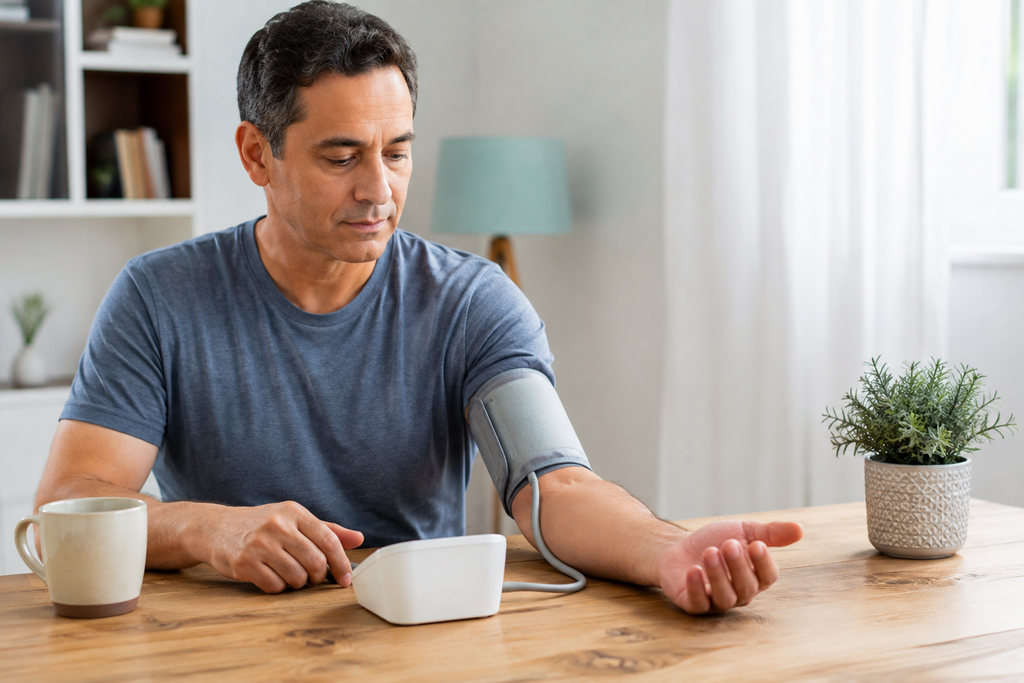
- Sit with your back supported against a chair
- Feet flat on the floor, legs uncrossed
- Arm supported on a flat surface at heart level — not on your lap, not hanging down
- Cuff on bare skin, not over clothing
- Bottom edge of the cuff just above the bend of your elbow
- Don’t talk or use your phone during the reading
How many readings: Take two readings, one to two minutes apart, and average them. For routine monitoring, most guidance suggests two readings in the morning and two in the evening, on most days of the week.
What Actually Goes Wrong in Practice
The Kraków study is worth returning to, because it shows exactly where people slip.
The most common error — made by 76% of patients — was incorrect cuff placement: positioned above or below heart level, or with the indicator mark not aligned over the brachial artery.
Equally telling was why: only 29% had been adequately counselled by a physician on how to measure correctly. Thirty-six percent had relied on the device manual, and 22% received no guidance at all.
Most people aren’t being careless. They were handed a device and expected to figure it out — which is why reviewing technique periodically, rather than assuming you learned it correctly the first time, tends to be worth the few minutes.
Common Mistakes
Buying whatever monitor is on sale. The most consequential decision happens before you ever take a reading. An unvalidated device produces numbers with no known relationship to your actual blood pressure.
Letting the arm rest on the lap or hang at your side. This is the mistake the 2024 JAMA trial specifically quantified — both positions produce falsely elevated readings compared with proper support at heart level.
Measuring over a sleeve. Clothing between the cuff and skin distorts the reading. Roll the sleeve up fully, or remove the garment — a partially rolled sleeve that bunches above the cuff can also constrict the arm.
Taking a single reading and treating it as your number. Blood pressure fluctuates constantly. One reading is a snapshot, not a trend. The average of two readings, taken consistently over days, is what actually means something.
Never rechecking device accuracy. Bring your monitor to your annual appointment and compare its readings against the office equipment. Devices drift over time.
Adjusting your own medication based on home readings. This is the most serious one. Home readings inform the conversation with your doctor — they don’t replace it.
Practical Tips
- Check your model at validatebp.org before buying, or right now if you already own one.
- Measure your upper arm circumference with a tape measure and buy the matching cuff size separately if the included one doesn’t fit.
- Take readings at the same times each day — morning before medication and evening are the standard pattern.
- Log readings in the device memory or a notebook and bring the record to appointments, rather than trying to recall them.
- If your first reading is unusually high, rest a few more minutes and repeat rather than assuming the number is accurate.
If you’re working on your cardiovascular health more broadly, it’s worth pairing this with our guides on foods that naturally lower blood pressure and resting heart rate, since both cover metrics you can track alongside your readings at home.
When Should You See a Doctor?
Contact your doctor if home readings are consistently at or above 130/80 mmHg, or if readings change significantly after starting a new medication. Seek emergency care if a reading is above 180/120 mmHg and accompanied by chest pain, shortness of breath, vision changes, weakness, or difficulty speaking — that combination is a hypertensive emergency, not something to recheck later.
Also worth a conversation: if your home readings differ substantially and consistently from your office readings in either direction, since that pattern itself (white coat or masked hypertension) is clinically meaningful.
Frequently Asked Questions
How do I know if my blood pressure monitor is accurate? Check the model against validatebp.org or stridebp.org, which list independently validated devices. FDA clearance alone does not confirm measurement accuracy.
Are wrist blood pressure monitors reliable? Generally less so than upper-arm cuffs. They’re highly sensitive to arm and wrist positioning, which is why major guidelines recommend upper-arm devices unless a well-fitting upper-arm cuff isn’t an option.
How many times a day should I check my blood pressure? Common guidance is two readings in the morning and two in the evening, averaged, on most days — though your doctor may recommend a different frequency depending on your situation.
Can a smartwatch measure my blood pressure accurately? Not for clinical decisions. Current European and American guidelines state that cuffless devices, including smartwatch-based estimates, should not be used to guide treatment decisions, as none have demonstrated adequate accuracy.
The Bottom Line
Home blood pressure monitoring works — it can even give a more realistic picture than office readings, particularly for people whose pressure spikes in clinical settings. But it only works if the device was validated, the cuff fits, and the arm is supported at heart level. Given that only 3% of patients in one study measured without error, the technique is worth reviewing even if you’ve been doing this for years.
This article is for general informational purposes and is not a substitute for personalized medical advice. Never adjust medication based on home readings without consulting your healthcare provider.
References
- American Heart Association — Monitoring Your Blood Pressure at Home
- Mayo Clinic — Get the Most Out of Home Blood Pressure Monitoring
- Harvard Health — Is Your Home Blood Pressure Monitor Accurate?