Atrial fibrillation increases stroke risk fivefold. Roughly one in ten people over 70 has it.
And a substantial share of them don’t know — because AFib is frequently asymptomatic and intermittent, appearing for minutes or hours and then resolving before anyone thinks to check.
That combination is what makes it unusual among serious conditions: it’s highly treatable, the treatment dramatically reduces stroke risk, and the main obstacle is simply finding it.
Quick Fact: In the EQUAL trial published in JACC in January 2026, six months of smartwatch monitoring in adults over 65 with elevated stroke risk improved detection of new-onset AFib — and frequently identified cases that were asymptomatic and paroxysmal, meaning they would likely have been missed by standard care.
Last reviewed: September 2026
What AFib Actually Is
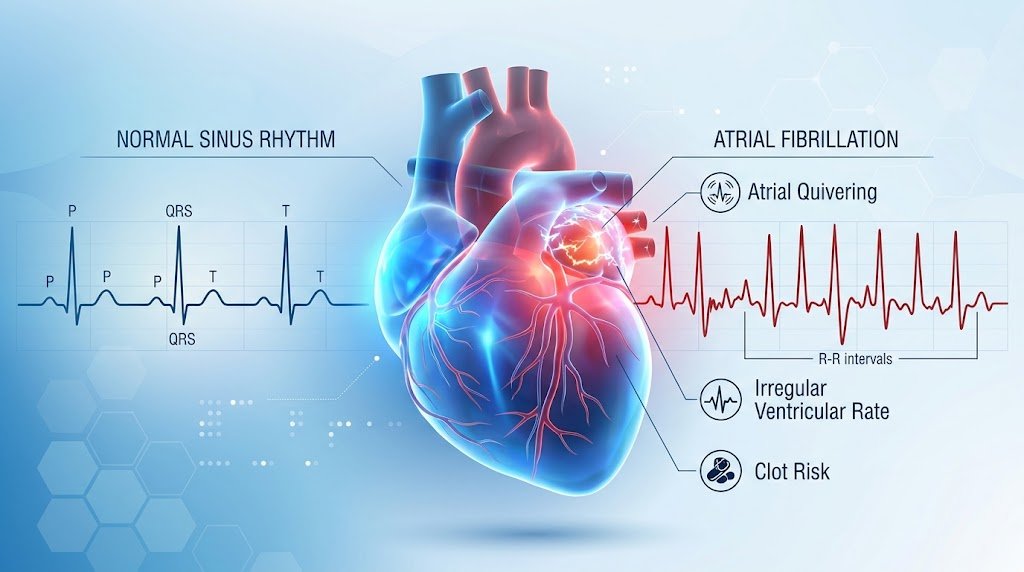
In a normal heartbeat, the atria (upper chambers) contract in a coordinated way, pushing blood into the ventricles below.
In atrial fibrillation, electrical signals in the atria become chaotic. Instead of contracting cleanly, the atria quiver — irregularly and often rapidly. The result is an irregular heartbeat and, critically, blood that doesn’t fully empty from the atria.
Blood that pools can clot. If a clot travels to the brain, it causes a stroke. That’s the entire mechanism behind AFib’s fivefold stroke risk, and it’s why treatment centers on preventing clots rather than only correcting the rhythm.
Why It’s So Often Missed
Three features conspire to keep AFib undiagnosed:
It’s frequently asymptomatic. Many people feel nothing at all. There’s no pain, no obvious distress — the heart is simply beating irregularly.
It’s often paroxysmal. Episodes come and go. Someone can have AFib on Tuesday and a completely normal rhythm at their Thursday appointment.
Standard screening windows are brief. A 30-second ECG in a clinic captures 30 seconds. An episode that happened last week, or happens next week, doesn’t appear.
Research on this is direct: brief episodic screening strategies inherently fail to detect paroxysmal or asymptomatic occurrences. The problem isn’t the test’s accuracy — it’s the sampling window.
Quick Reference: AFib at a Glance
| Aspect | Detail |
|---|---|
| Stroke risk increase | Approximately fivefold |
| Prevalence over age 70 | Roughly 1 in 10 |
| Often asymptomatic? | Yes — frequently |
| Often intermittent? | Yes — paroxysmal episodes are common |
| Main treatment goal | Stroke prevention via anticoagulation |
| Detection challenge | Brief screening windows miss episodes |
Symptoms — When They Appear
Not everyone gets them, but when symptoms occur, they commonly include:
- Palpitations — a fluttering, racing, or pounding sensation in the chest
- Fatigue — often disproportionate to activity
- Shortness of breath, especially with exertion
- Dizziness or lightheadedness
- Reduced exercise tolerance — noticing you can’t do what you could before
- Chest discomfort
The tricky part is that these are nonspecific. Fatigue and breathlessness get attributed to age, stress, or being out of shape far more often than to a heart rhythm problem.
Who’s at Higher Risk
The risk profile is well established and overlaps heavily with general cardiovascular risk:
- Age — risk climbs substantially after 65
- High blood pressure
- Diabetes
- Coronary artery disease
- Structural heart disease — valve problems, heart failure
- Obesity and sleep apnea
- Excessive alcohol intake
- Thyroid disorders
Clinicians use a scoring system called CHA₂DS₂-VASc to estimate stroke risk in someone with AFib, combining age, sex, and conditions like hypertension, diabetes, heart failure, and prior stroke. The score determines whether anticoagulation is recommended — it’s not the diagnosis, it’s the decision tool that follows it.
The Smartwatch Question
This is where AFib detection has genuinely changed, and it deserves an honest look at both sides.
The case for wearables. Devices using photoplethysmography (the optical sensor on the back of the watch) and single-lead ECG can monitor continuously in daily life — precisely addressing the sampling-window problem. The EQUAL randomized trial found smartwatch monitoring improved detection of new-onset AFib in high-risk older adults compared with standard care.
The limitations. A 2025 systematic review examining wearable ECG accuracy against 12-lead ECG found that most wearable algorithms are limited to distinguishing AFib from normal sinus rhythm. This frequently produced false positives or missed arrhythmias in the presence of atrial flutter, frequent premature contractions, or other supraventricular tachycardias.
The new clinical dilemma. Widespread consumer adoption has caused a sharp increase in detection of subclinical AFib — brief episodes in people with no symptoms. Research describes genuine uncertainty about the appropriate threshold for starting anticoagulation in these cases. Finding something isn’t the same as knowing what to do about it.
The practical takeaway: a smartwatch notification is a reason to see a doctor, not a diagnosis. Confirmation requires clinical evaluation.
Quick Reference: Wearables vs. Clinical Testing
| Method | Strength | Limitation |
|---|---|---|
| Clinic 12-lead ECG | Gold standard accuracy | 30-second window only |
| Holter monitor (24-48h) | Continuous, clinical grade | Short window for infrequent episodes |
| Extended patch monitor | Days to weeks of data | Requires prescription |
| Smartwatch PPG/ECG | Continuous, real-world, long duration | False positives; confuses other arrhythmias |
What Treatment Looks Like
AFib management generally addresses three things:
Stroke prevention. Anticoagulation is the intervention that most directly reduces mortality risk. This is typically the first priority once AFib is confirmed and the CHA₂DS₂-VASc score supports it.
Rate or rhythm control. Medications to slow the heart rate, or to restore and maintain normal rhythm. Which approach is chosen depends on symptoms, duration, and individual factors.
Risk factor management. Blood pressure control, weight management, treating sleep apnea, and reducing alcohol intake all influence AFib burden and recurrence.
What People Actually Experience
The most common report is the gap between detection and answers.
Someone gets a watch notification, sees a doctor, has a normal ECG in the office — because the episode ended — and leaves without resolution. This is frustrating but expected: it’s the same paroxysmal nature that made the condition hard to find in the first place. Extended monitoring is usually the next step, and knowing that in advance makes the process less discouraging.
The second pattern: people frequently report that in retrospect, symptoms were present but reinterpreted. Fatigue attributed to work stress, breathlessness attributed to being out of shape, reduced exercise capacity attributed to age. The symptoms weren’t absent; they were filed under something else.
Third, and worth naming: the anxiety that follows detection is real. Learning you have a condition associated with a fivefold stroke risk is unsettling, particularly when you feel fine. The clinically important framing is that AFib’s risk is substantially modifiable with treatment — the danger is in the undiagnosed version, not the managed one.
Common Mistakes
Treating a smartwatch alert as a diagnosis. These devices generate false positives and can misclassify other arrhythmias. Confirmation requires clinical evaluation.
Assuming no symptoms means no AFib. A large share of cases are asymptomatic. Feeling fine is not evidence of normal rhythm.
Concluding a normal office ECG rules it out. A 30-second recording captures 30 seconds. Paroxysmal AFib requires longer monitoring to catch.
Focusing only on rhythm and ignoring anticoagulation. Stroke prevention is the intervention with the clearest mortality benefit, independent of whether rhythm is restored.
Ignoring modifiable risk factors. Untreated sleep apnea, excess alcohol, and uncontrolled blood pressure all drive AFib burden and recurrence.
Stopping anticoagulation because you feel fine. Symptom absence doesn’t reduce clot risk, and stopping without medical guidance is dangerous.
Practical Tips
- If your watch flags an irregular rhythm, save or screenshot the ECG recording and bring it to your appointment — the data matters more than the description.
- Note the date, time, and duration of any episode along with what you were doing; patterns help.
- Ask specifically about extended monitoring if you have symptoms but a normal office ECG.
- Raise sleep apnea with your doctor if you snore heavily or wake unrefreshed — it’s a significant and treatable AFib driver.
- If diagnosed, ask what your CHA₂DS₂-VASc score is and what it means for your anticoagulation decision.
If you’re monitoring your cardiovascular health, it’s worth pairing this with our guides on heart palpitations and stroke warning signs, since AFib sits directly between those two topics.
When Should You See a Doctor?
See a doctor for a smartwatch AFib notification, for palpitations lasting more than a few minutes, or for unexplained fatigue, breathlessness, or reduced exercise tolerance — particularly if you’re over 65 or have high blood pressure, diabetes, or sleep apnea.
Seek emergency care for a rapid or irregular heartbeat accompanied by chest pain, severe shortness of breath, fainting, or any signs of stroke — face drooping, arm weakness, or speech difficulty. Those combinations are not appointment-level concerns.
Frequently Asked Questions
Can you have atrial fibrillation without any symptoms? Yes, and it’s common. AFib is frequently asymptomatic, which is a primary reason it goes undiagnosed and why stroke is sometimes the first indication.
Are smartwatch AFib detections reliable? They’re useful for screening but not diagnostic. Research shows wearable algorithms can produce false positives and may misclassify other arrhythmias such as atrial flutter or frequent premature beats.
Why does AFib increase stroke risk so much? Because the atria quiver rather than contract fully, blood can pool and form clots. A clot traveling to the brain causes a stroke — which is why anticoagulation is central to treatment.
Can AFib go away on its own? Paroxysmal AFib episodes often stop on their own, but the underlying condition typically persists and continues to carry stroke risk between episodes.
What is a CHA₂DS₂-VASc score? A clinical scoring system combining age, sex, and conditions like hypertension, diabetes, and prior stroke to estimate stroke risk and guide whether anticoagulation is recommended.
The Bottom Line
AFib is a condition where the diagnosis is harder than the treatment. It raises stroke risk fivefold, frequently produces no symptoms, and comes and goes in ways that defeat brief clinical screening. Wearables have genuinely changed detection — while creating new questions about what to do with brief, subclinical findings. If a device flags something, or if fatigue and breathlessness have been quietly explained away for a while, that’s worth a real evaluation rather than a reassurance.
This article is for general informational purposes and is not a substitute for personalized medical advice. Never stop or adjust anticoagulation medication without consulting your healthcare provider.
References
- Journal of the American College of Cardiology — Enhanced Detection and Prompt Diagnosis of Atrial Fibrillation Using Apple Watch: The EQUAL Randomized Controlled Trial (2026)
- Frontiers in Cardiovascular Medicine — Wearable Devices in Atrial Fibrillation: Screening, Monitoring, and Management (2026)
- NIH (PubMed Central) — Diagnostic Accuracy of Wearable ECG Devices for Atrial Fibrillation: A Systematic Review (2025)