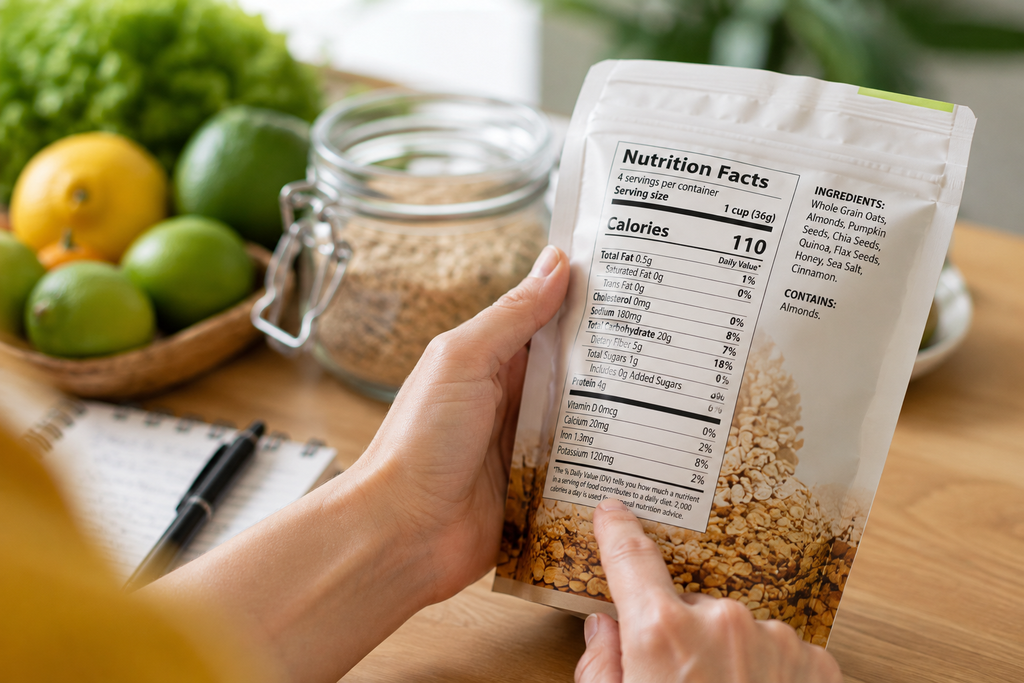
Learning how to read a nutrition label properly takes about thirty seconds — but most people go straight to the calorie number, which is the least useful place to start.
. It’s the biggest text on the panel, so that’s understandable — and it’s also the least useful place to start.
The label is designed to be read in a specific order, and skipping the first line makes everything below it meaningless. Here’s the 30-second version, plus the traps that make otherwise careful shoppers misjudge what they’re buying.
Quick Fact: A 20-ounce bottle of regular soda contains roughly 65 grams of added sugar — about 130% of the recommended daily value. A single bottle exceeds a full day’s limit by nearly a third.
Step 1: Serving Size (Always First)
Every number on the label refers to one serving. If the panel says 200 calories and the container holds 2.5 servings, the package holds 500 calories.
The critical detail most people miss: serving sizes are based on what people typically eat, not what they should eat. This is a legal requirement, not a health recommendation. When the FDA updated the label, the reference amount for soda increased from 8 ounces to 12 ounces and ice cream from half a cup to two-thirds — not because those amounts became healthier, but because they better reflect real consumption.
So the serving size answers “how much do people usually eat?” — never “how much is good for me?”
Check the servings per container line directly above it. That’s where the multiplication happens.
Step 2: The Three Numbers That Matter Most
Once you know the serving size, you don’t need to read every line. Focus on the % Daily Value for three nutrients the FDA specifically flags as “nutrients to get less of”:
- Saturated fat
- Sodium
- Added sugars
These three are the basis of the FDA’s proposed front-of-package labeling rule announced in January 2025, which would put exactly this information on the front of most packages.
Quick Reference: The 5/20 Rule
| % Daily Value | Interpretation |
|---|---|
| 5% or less | Low in that nutrient |
| 6–19% | Moderate |
| 20% or more | High in that nutrient |
This single rule does most of the work. For saturated fat, sodium, and added sugars, aim low. For fiber, vitamin D, calcium, iron, and potassium — the “nutrients to get more of” — aim high.
Step 3: Added Sugars vs. Total Sugars
This is the line that changed food shopping most, and it’s still widely misread.
Total Sugars includes everything — the natural sugar in milk and fruit plus anything added during manufacturing. Added Sugars is the subset that was put in.
The word “Includes” before Added Sugars signals that it’s already counted inside Total Sugars, not stacked on top. So a product listing 15g total sugars and 7g added sugars contains 8 grams of naturally occurring sugar plus 7 grams added.
This distinction is why plain yogurt and sweetened yogurt can look similar on Total Sugars while being completely different products — and why the Added Sugars line is worth more attention than the one above it.
What Actually Trips People Up
In practice, the label isn’t usually what misleads people. The front of the package is.
Front-of-package claims operate under different, looser rules than the Nutrition Facts panel. A cereal can advertise “made with whole grains” while containing minimal fiber. A snack can say “no high-fructose corn syrup” while listing cane sugar, honey, and fruit juice concentrate in the ingredients.
The pattern people report most often: buying something for months based on a front-of-package claim, then reading the panel once and realizing the product was never what the packaging implied. The panel is regulated; the marketing beside it largely isn’t.
A related trap is the ingredient list, which is ordered by weight — first ingredient = most of the product. Manufacturers sometimes split sweeteners across several types (cane sugar, corn syrup, honey, fruit concentrate) so no single one appears near the top, even when their combined weight would.
Added sugar hides under many names: anything ending in -ose (sucrose, dextrose, maltose), plus syrup, nectar, juice concentrate, honey, and molasses.
Common Mistakes
Reading calories before serving size. Every number on the panel is meaningless without the serving size above it. A “100-calorie” snack pack holding 2.5 servings is a 250-calorie snack.
Assuming a serving size is a recommendation. It reflects typical consumption, not portion guidance. Some serving sizes were increased in the label update specifically to match how much people actually eat.
Adding Added Sugars to Total Sugars. They aren’t separate. Added sugars are already included in the total — the word “Includes” is the giveaway.
Trusting front-of-package claims over the panel. “Multigrain,” “natural,” “made with real fruit,” and similar phrases aren’t held to the same standard as the Nutrition Facts panel. Turn the package over.
Relying on “net carbs” or glycemic index labels. Neither term is defined by the FDA, and the American Diabetes Association doesn’t recommend using them. Check total carbohydrates instead.
Ignoring the dual-column format. Some packages list both “per serving” and “per container.” Reading the wrong column can double or halve your estimate.
A Practical 30-Second Sequence
- Serving size + servings per container — establish the multiplier
- Calories — now that it means something
- %DV for saturated fat, sodium, added sugars — apply the 5/20 rule
- %DV for fiber and any nutrient you’re targeting — aim for 10%+
- Ingredient list, first three items — if a sweetener is there, that’s most of the product
That’s it. Steps 1 through 3 take about fifteen seconds once it’s habit.
Practical Tips
- When comparing two products, make sure the serving sizes match before comparing anything else — different serving sizes make %DV comparisons meaningless.
- Use %DV rather than grams when comparing; it accounts for the reference amount automatically.
- Scan the ingredient list for multiple sweetener names, not just one — splitting is common.
- Remember the label assumes a 2,000-calorie diet. If you eat noticeably more or less, the %DV percentages shift accordingly.
- For children, note that added sugar guidance is stricter — general recommendations advise avoiding added sugars entirely for kids under 2.
If you’re working on your broader diet quality, it’s worth pairing this with our guides on ultra-processed foods and high-fiber recipes, since label reading is most useful when it’s connected to what you’re actually trying to eat more or less of.
When Should You See a Doctor?
Talk to a doctor or registered dietitian if you have a condition requiring specific nutrient tracking — diabetes (carbohydrates), hypertension (sodium), kidney disease (potassium and phosphorus), or a diagnosed food allergy. General label reading is a useful skill, but condition-specific targets differ meaningfully from the standard %DV reference values printed on packages.
Frequently Asked Questions
What’s the difference between total sugars and added sugars? Total Sugars includes naturally occurring sugars (from fruit or milk) plus any added during processing. Added Sugars is the portion that was put in — and it’s already counted within the total, not additional to it.
What does % Daily Value actually mean? It shows how much one serving contributes to a full day’s recommended intake, based on a 2,000-calorie diet. 5% or less is low; 20% or more is high.
Are serving sizes a recommendation for how much I should eat? No. By law, serving sizes reflect how much people typically consume, not how much is advisable. They exist to make the numbers comparable, not prescriptive.
Can I trust claims on the front of the package? Less than the panel on the back. Front-of-package marketing follows looser rules than the Nutrition Facts label, which is why “whole grain” or “natural” claims frequently don’t match what the panel actually shows.
The Bottom Line
The nutrition label works when you read it in order: serving size first, then calories, then the %DV for saturated fat, sodium, and added sugars using the 5/20 rule. Most misjudgments don’t come from the panel being confusing — they come from starting in the middle, or from trusting the front of the package instead of turning it over.
This article is for general informational purposes and is not a substitute for personalized medical or nutritional advice. Consult a healthcare provider or registered dietitian for guidance tailored to your specific health needs.
References
- FDA — How to Understand and Use the Nutrition Facts Label
- FDA — The Lows and Highs of Percent Daily Value
- American Diabetes Association — Making Sense of Food Labels