Roughly 75% of American adults take at least one dietary supplement. A 2023 review of 44 studies found that while many people combine supplements or take them alongside prescription medications, only a small fraction are aware of the potential risks.
That gap has real consequences — and it isn’t only about dangerous combinations. Some of the most common mistakes simply waste money, with two supplements canceling each other’s absorption while the person taking them assumes both are working.
Quick Fact: Calcium, magnesium, zinc, and iron all absorb through the same pathways. Taking them together doesn’t cause a dangerous reaction — it causes competition, meaning your body absorbs less of each than if you’d spaced them out.
The Two Types of Interaction
Understanding the distinction makes the rest of this straightforward.
Absorption competition happens when two substances compete for the same uptake pathway or physically bind together in the gut. Nothing harmful occurs; you just absorb less. This is usually solved by spacing doses a few hours apart.
Pharmacological interaction happens when a supplement changes how a medication is metabolized or amplifies its effect. These range from mild to genuinely dangerous, and spacing doses often doesn’t fix them — some combinations need to be avoided entirely.
Supplement Pairs That Compete for Absorption
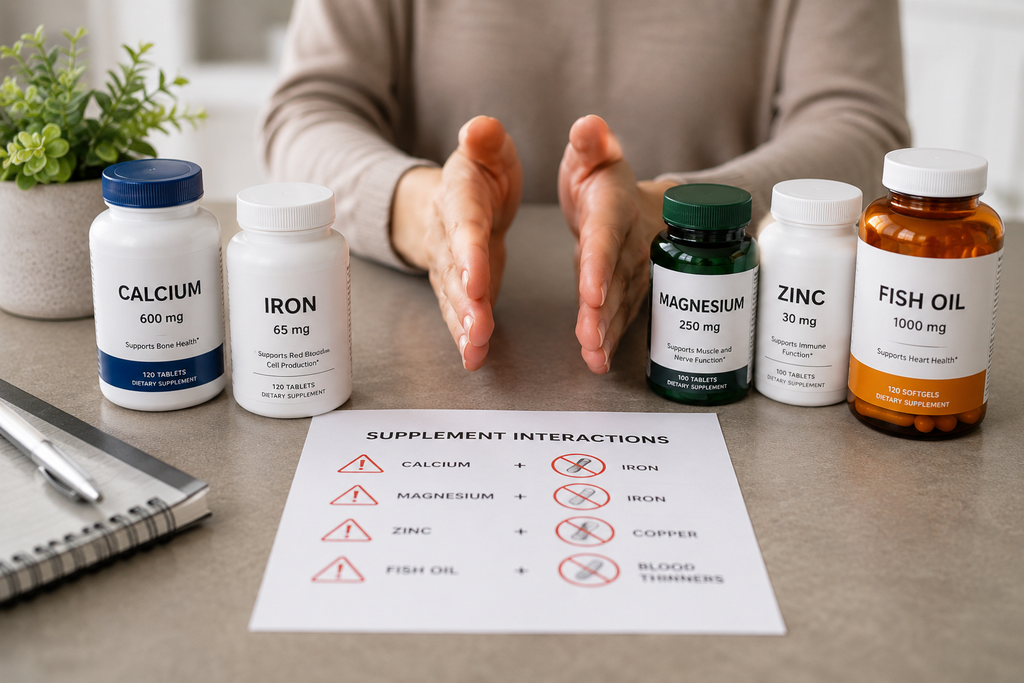
Calcium and iron. Calcium interferes with iron absorption. Separate them by a few hours, and pair iron with vitamin C instead, which improves uptake.
Zinc and copper. Chronic high zinc intake can induce copper deficiency by impairing its absorption, potentially leading to anemia and neurological changes. This is why balanced formulations often include both.
Multiple minerals at once. Calcium, magnesium, zinc, and iron all use overlapping absorption pathways. A calcium-magnesium-zinc combination taken alongside a standalone iron supplement means all four are competing.
Tea and iron. Not a supplement, but worth knowing — tannins in green and black tea bind iron and block its absorption. Drink tea at a different time of day than your iron dose.
Quick Reference: Common Spacing Rules
| Combination | Recommended Action |
|---|---|
| Calcium + iron | Separate by 2+ hours |
| Iron + tetracycline antibiotics | Separate by at least 2 hours |
| Calcium/iron/magnesium + levothyroxine | Take thyroid med on empty stomach; space minerals 4+ hours |
| Zinc (high dose) + copper | Avoid prolonged high-dose zinc without oversight |
| Fat-soluble vitamins (A, D, E, K) | Take with a meal containing fat |
| Iron + tea/coffee | Separate by several hours |
Supplement–Medication Combinations That Matter Most
Blood thinners + vitamin E, fish oil, or ginkgo. This is the highest-stakes category. High-dose fish oil (above 3 grams daily) has antiplatelet activity. Vitamin E above 400 IU daily has mild antiplatelet effects. Ginkgo biloba increases bleeding risk. Combined with warfarin, aspirin, or newer anticoagulants, bleeding risk rises substantially.
Warfarin + vitamin K. The guidance here is frequently misunderstood: the goal isn’t to eliminate vitamin K, it’s to keep intake consistent. Warfarin dosing is calibrated to your typical vitamin K intake, so sudden increases or decreases — from supplements or from leafy greens — destabilize it.
St. John’s Wort + almost anything. This herbal supplement speeds the liver’s breakdown of many drugs, reducing effectiveness of antidepressants, birth control pills, heart medications, HIV treatments, and some cancer drugs. It has one of the highest interaction risk profiles of any common supplement.
Levothyroxine + calcium, iron, or magnesium. These minerals block thyroid hormone absorption. Standard guidance is taking levothyroxine on an empty stomach, waiting 60 minutes before eating, and spacing mineral supplements by four or more hours.
Antibiotics + iron or minerals. Tetracycline-family antibiotics bind with iron and other minerals in the gut, forming compounds the body can’t absorb — reducing the antibiotic’s effectiveness. Spacing by at least two hours helps.
Blood pressure medications + potassium or magnesium. Research in older adults found this among the most common potential interactions, alongside vitamin E with aspirin.
The Reverse Problem: Medications That Deplete Nutrients
This gets less attention but affects more people, because it develops silently over months and years.
Metformin depletes vitamin B12. Long-term use is an established risk factor for B12 deficiency, which is why periodic B12 testing is often recommended for people on metformin for extended periods.
Proton pump inhibitors deplete magnesium and reduce B12 absorption by lowering the stomach acid needed to release it from food.
Neither means you should stop the medication. It means the monitoring conversation is worth having proactively rather than after symptoms appear.
What Actually Happens in Practice
The pattern clinicians describe most often isn’t someone taking a reckless combination — it’s someone taking a reasonable one and never mentioning it.
Patients rarely volunteer their supplement list unprompted, and supplements often aren’t recorded in medical charts the way prescriptions are. One frequently cited estimate suggests pharmacists flag fewer than one in three clinically relevant interactions, largely because the supplement half of the equation is invisible to them.
The second pattern: people assume “natural” implies safe. The FDA addresses this directly — natural does not always mean safe, and supplements aren’t subject to the same pre-market approval process as drugs. Ingredient amounts can vary from what’s labeled.
Common Mistakes
Not telling your doctor or pharmacist about supplements. This is the single most consequential one. If they don’t know what you’re taking, they can’t screen for interactions.
Taking every supplement at the same time each morning. Convenient, but it maximizes absorption competition. Splitting minerals across morning and evening improves uptake of each.
Assuming spacing solves every interaction. Timing helps with absorption competition. It doesn’t help with St. John’s Wort accelerating drug metabolism, or with additive bleeding risk from multiple blood thinners.
Taking fat-soluble vitamins on an empty stomach. Vitamins A, D, E, and K need dietary fat to absorb properly. Taking them with water on an empty stomach reduces how much you actually get.
Stopping supplements abruptly before surgery without guidance. Some supplements do need to be paused before procedures — often two to three weeks ahead — but that decision belongs to your surgical team, not a self-directed guess.
Assuming a multivitamin plus a standalone mineral is additive. If your multivitamin already contains magnesium and you add a magnesium supplement, they compete rather than stack — and total dose may exceed what you intended.
Practical Tips
- Keep a written list of every supplement and medication with doses, and bring it to appointments — including the brand, since formulations vary.
- Split minerals across the day: calcium in the morning, magnesium in the evening is a common and practical pattern.
- Take fat-soluble vitamins (D, K, E, A) and fish oil with a meal containing fat.
- Use an interaction checker before adding anything new, but treat it as a prompt for a pharmacist conversation rather than a final answer.
- Review your full supplement list with a provider periodically — interactions can emerge as doses change or new medications are added.
If you’re evaluating individual nutrients, it’s worth pairing this with our guides on iron deficiency and magnesium benefits, since both cover supplements where timing and absorption matter considerably.
When Should You See a Doctor?
Talk to your doctor or pharmacist before starting any new supplement if you take prescription medication — particularly blood thinners, thyroid medication, antidepressants, birth control, or heart medications. Seek prompt medical attention for unusual bruising or bleeding, which can signal an additive blood-thinning effect. Also mention long-term metformin or proton pump inhibitor use and ask whether periodic nutrient testing makes sense for you.
Frequently Asked Questions
Can I take all my supplements at the same time? You can, but you may absorb less of each. Minerals like calcium, magnesium, zinc, and iron compete for the same absorption pathways, so spacing them across the day generally improves uptake.
How long should I wait between supplements and medications? A commonly cited general rule is at least two hours, though some combinations require longer (four or more hours for minerals and thyroid medication) and others need complete avoidance rather than spacing.
Does “natural” mean a supplement is safe with my medication? No. The FDA states explicitly that natural does not always mean safe — some of the most significant interactions involve herbal supplements like St. John’s Wort and ginkgo biloba.
Should I stop supplements before surgery? Possibly, but only under guidance. Some supplements affect bleeding risk, heart rate, or blood pressure, and providers may recommend stopping two to three weeks beforehand — this should be coordinated with your surgical team.
The Bottom Line
Most supplement interactions fall into two categories with two different solutions: absorption competition, which spacing usually fixes, and pharmacological interaction, which spacing often doesn’t. The highest-stakes combinations involve blood thinners and St. John’s Wort. But the most common failure isn’t a dangerous pairing — it’s simply not telling your pharmacist what’s in your cabinet.
This article is for general informational purposes and is not a substitute for personalized medical advice. Always consult a healthcare provider or pharmacist before combining supplements with prescription medications.
References
- FDA — Mixing Medications and Dietary Supplements Can Endanger Your Health
- NIH MedlinePlus Magazine — Supplements and Medications Can Interact in Unexpected Ways
- American Heart Association — Medication Interactions: Food, Supplements and Other Drugs