Ask anyone why high-protein diets work and you’ll usually hear some version of “protein keeps you full.” That’s accurate, but it skips the interesting part — protein doesn’t just feel more filling, it triggers measurable hormonal changes that suppress hunger signals in the brain.
It also comes with a caveat the research is unusually clear about, and which most protein-focused advice leaves out entirely: the effect appears to be considerably stronger in the short term than the long term.
Quick Fact: A meta-analysis of 49 studies found that protein intake decreased the hormone ghrelin (which drives hunger) by about 20 pg/ml, while increasing cholecystokinin by 30 pg/ml and GLP-1 by 21 ng/ml — the same GLP-1 pathway targeted by modern weight loss medications.
The Hormonal Mechanism
When you eat protein, cells lining your gut detect it and release a set of hormones collectively called anorexigenic — appetite-suppressing:
- GLP-1 (glucagon-like peptide-1) — the same hormone pathway that drugs like semaglutide mimic
- CCK (cholecystokinin) — slows stomach emptying and signals fullness
- PYY (peptide YY) — reduces appetite in the hours after eating
Simultaneously, protein lowers ghrelin, the hormone that drives hunger. These signals travel via the vagus nerve to the brain, which is why the fullness feels physical rather than psychological.
This is a genuinely different mechanism from “protein takes longer to digest,” which is the explanation most people are given.
Protein Also Costs More to Digest
There’s a second, separate mechanism: the thermic effect of food — the energy your body spends digesting, absorbing, and metabolizing what you eat.
Protein has a substantially higher thermic effect than carbohydrates or fat, meaning a portion of the calories in protein are consumed just processing it. In one controlled 36-hour study using whole-body calorimetry, total energy expenditure was significantly higher during the high-protein condition compared to an energy-balanced one.
The effect is modest in absolute terms — it isn’t a weight loss strategy on its own — but it stacks with the appetite effect rather than replacing it.
Quick Reference: How Protein Affects Appetite
| Hormone | Direction | Effect |
|---|---|---|
| Ghrelin | ↓ Decreases | Less hunger |
| GLP-1 | ↑ Increases | Slower gastric emptying, more fullness |
| CCK | ↑ Increases | Signals satiety to the brain |
| PYY | ↑ Increases | Reduces appetite post-meal |
| Thermic effect | ↑ Higher than carbs/fat | Small increase in energy expenditure |
The Dose Threshold Most People Miss
This is one of the more practically useful findings and it’s rarely mentioned.
The same meta-analysis found that subjective appetite markers — hunger, fullness, desire to eat — responded to protein doses below 35 grams. But the hormonal changes (ghrelin, CCK, GLP-1) only shifted significantly at doses of 35 grams or more.
In plain terms: a 20-gram protein snack may make you feel fuller. A 35-gram protein meal appears to actually move the hormones. If you’re distributing protein across the day specifically for appetite control, that threshold is worth knowing.
The Honest Caveat: Short-Term vs. Long-Term
Here’s where the research gets less flattering to the popular narrative.
That same meta-analysis examined both acute (single-meal) and long-term protein intake. The acute effects were robust and consistent. But long-term ingestion of protein did not affect these appetite outcomes — except for GLP-1, which actually showed a significant decrease over time.
A separate review in the American Journal of Clinical Nutrition found that while acute feeding trials confirm a satiety effect — greater perceived fullness and elevated satiety hormones after higher-protein meals — the evidence does not support a corresponding reduction in energy intake at the next eating occasion.
And a systematic review of ten studies in people with overweight or obesity concluded that higher protein intake “may influence appetite sensations,” while explicitly noting the low level of evidence due to heterogeneous protocols and high risk of bias.
None of this means protein doesn’t help. It means the mechanism appears to adapt, and that protein’s clearest documented benefits during weight loss may have less to do with appetite than with preserving lean mass — which several meta-analyses do support consistently.
How Much, and Where It Comes From
Research on protein for weight management commonly cites an intake range of 1.2 to 1.6 g per kg of body weight — noticeably above the standard RDA of 0.8 g/kg, which is set to prevent deficiency rather than optimize body composition.
One review specifically noted that 1.2 g/kg appeared beneficial for body composition and blood pressure, and that too low an absolute protein intake during dieting contributes to the risk of weight regain.
On source: research comparing plant-based and animal-based protein at matched doses (30g) has found somewhat varied satiety hormone responses between them — an active area of study rather than a settled one. For practical purposes, total intake and distribution appear to matter more than source for most people.
What People Actually Notice
The pattern most consistently reported by people who increase protein intake isn’t dramatic appetite suppression — it’s a change in when hunger arrives.
Rather than feeling less hungry overall, people commonly describe going longer before the next hunger signal, particularly when protein is front-loaded at breakfast. Research has specifically flagged breakfast as where protein intake is most skewed low in typical eating patterns, which makes it the easiest meal to improve.
The second common observation: the effect is most noticeable in the first few weeks. This aligns with the long-term data above, and is worth expecting rather than interpreting as failure.
Common Mistakes
Back-loading all protein at dinner. Typical eating patterns concentrate protein in the evening meal. Distributing it — particularly adding protein at breakfast — gives you the appetite effect during the hours you’re actually making food decisions.
Assuming a 15-gram snack does the same job as a 35-gram meal. Subjective fullness responds at lower doses, but hormonal shifts appear to need roughly 35 grams. A protein bar and a proper protein-containing meal aren’t equivalent.
Adding protein without removing anything else. Protein aids weight loss primarily by helping you eat less overall and preserve muscle. Adding a shake on top of unchanged intake adds calories without the mechanism.
Expecting the appetite effect to last indefinitely. Long-term data suggests adaptation. Building sustainable eating habits during the early window matters more than relying on the effect permanently.
Ignoring fiber. Protein and fiber act on satiety through different pathways. Focusing exclusively on protein leaves an obvious lever unused.
Assuming more is always better. Research on healthy adults hasn’t found adverse effects on bone density or kidney function at the intakes studied — but “more protein” past a reasonable range hasn’t been shown to produce proportionally more benefit either.
Practical Tips
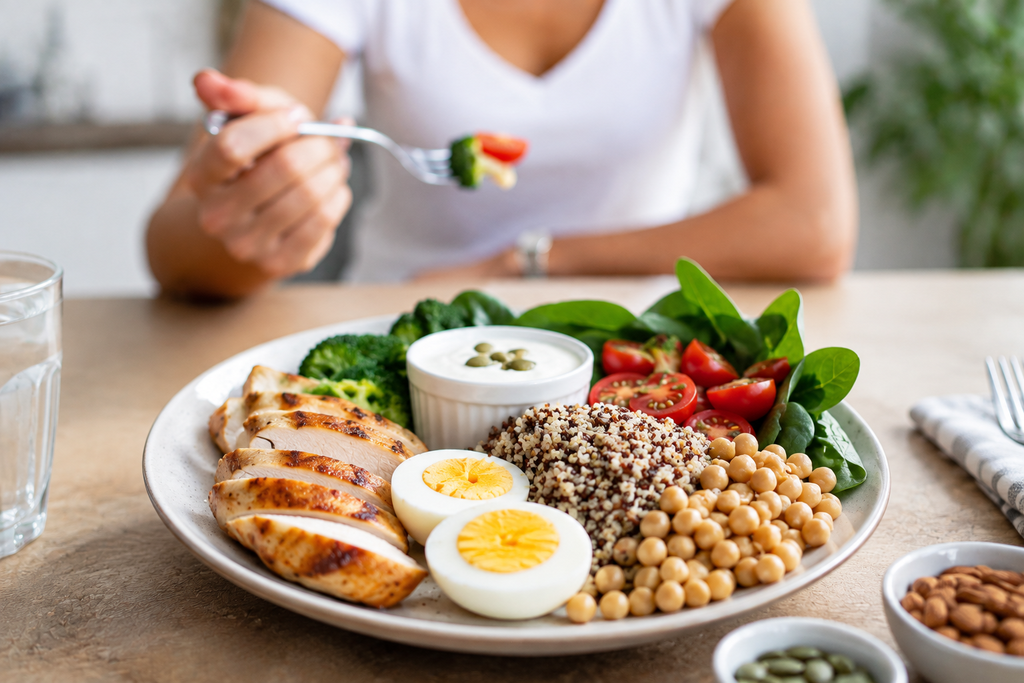
- Front-load protein at breakfast, which is where most people’s intake is lowest and where the appetite benefit is most useful.
- Aim for roughly 30-35g per main meal rather than one large evening dose, to hit the hormonal threshold more than once daily.
- Pair protein with fiber — they work through separate satiety pathways and combine well.
- Track protein for a week to establish your actual baseline; most people overestimate their intake considerably.
- Treat the early weeks as a window to build habits, not as a permanent effect you can rely on indefinitely.
If you’re building out a broader plan, it’s worth pairing this with our guides on how much protein you need per day and calorie deficit explained, since protein works within a deficit rather than instead of one.
When Should You See a Doctor?
Talk to a doctor or registered dietitian before significantly increasing protein intake if you have kidney disease or reduced kidney function, since protein needs are managed differently in that context. Also worth professional guidance if you have a history of disordered eating, or if you’re unsure how to increase protein without unintentionally raising total calorie intake.
Frequently Asked Questions
Does protein really reduce hunger, or does it just feel that way? Both. Research shows measurable hormonal changes — lower ghrelin, higher GLP-1 and CCK — alongside subjective reports of increased fullness, though hormonal shifts appear to require larger doses than subjective effects.
How much protein do I need per meal for the appetite effect? Subjective fullness responds to doses under 35 grams, but the hormonal appetite-regulating changes were observed at doses of 35 grams or more in meta-analysis data.
Does the appetite-suppressing effect of protein last long-term? Research suggests it diminishes. Acute effects are well documented, but long-term protein intake didn’t sustain the same appetite hormone changes — GLP-1 actually decreased over time in pooled data.
Is plant protein as filling as animal protein? Research comparing matched 30-gram doses has found somewhat varied satiety hormone responses between plant and animal sources. It’s an active research area, and total intake likely matters more than source for most people.
The Bottom Line
Protein’s appetite effect is real and mechanistically well-documented — it acts on the same GLP-1 pathway as modern weight loss drugs, at a much smaller magnitude. But the research also suggests the effect is strongest acutely and appears to adapt over months. The most durable case for protein during weight loss isn’t appetite at all; it’s preserving lean mass while you lose fat, which the evidence supports far more consistently.
This article is for general informational purposes and is not a substitute for personalized medical or nutritional advice. Consult a healthcare provider before significantly changing your protein intake, particularly if you have kidney disease.
References
- American Journal of Clinical Nutrition — The Role of Protein in Weight Loss and Maintenance
- Journal of Obesity & Metabolic Syndrome — Clinical Evidence and Mechanisms of High-Protein Diet-Induced Weight Loss
- European Journal of Nutrition — Dietary Protein and Appetite Sensations: A Systematic Review