Journaling for mental health has been studied seriously since the 1980s, when psychologist James Pennebaker ran some of the first controlled experiments on what he called “expressive writing.”.” The core finding held up well over decades of follow-up research: putting difficult experiences into words on paper measurably changes how people process them — not just anecdotally, but in ways researchers can track in mood, stress hormones, and even brain activity.
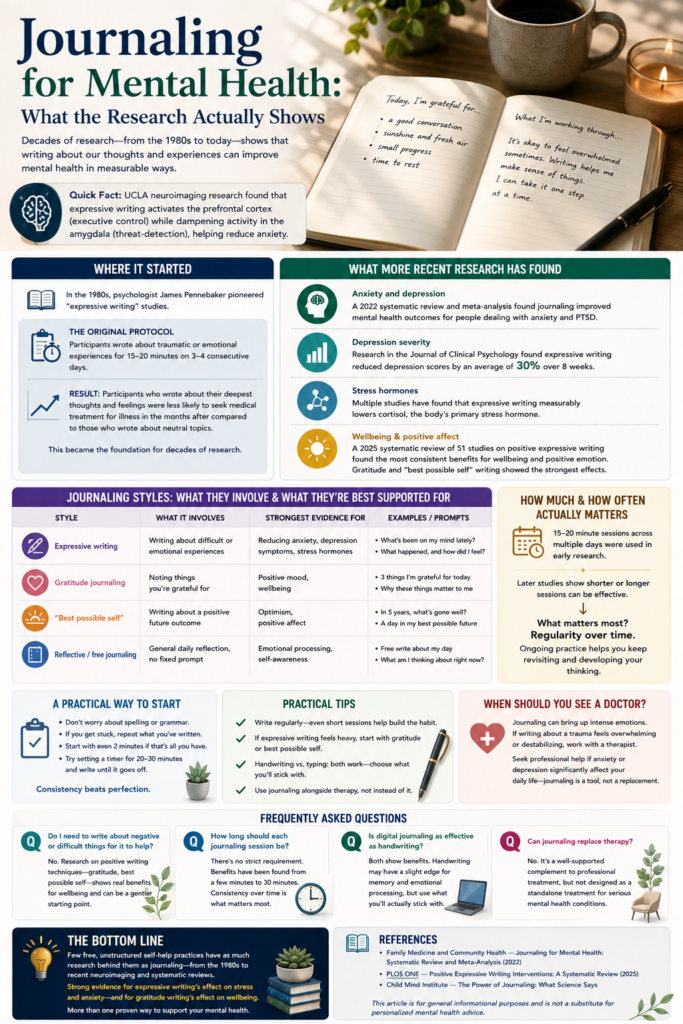
Quick Fact: UCLA neuroimaging research found that expressive writing activates the prefrontal cortex — the brain’s executive control center — while dampening activity in the amygdala, the brain’s threat-detection region. That shift is thought to be part of the biological mechanism behind journaling’s anxiety-reducing effect.
Where the Research Started
Pennebaker’s original studies had participants write about traumatic or emotional experiences for 15-20 minutes across several consecutive days. People who did this were less likely to seek medical treatment for illness in the months afterward compared to those who wrote about neutral topics — an early signal that processing emotion on paper had effects reaching beyond mood alone. That basic protocol became the foundation for decades of research that followed.
What More Recent Research Has Found
Anxiety and depression. A 2022 systematic review and meta-analysis published in Family Medicine and Community Health found journaling improved mental health outcomes for people dealing with anxiety and PTSD specifically, while noting more high-quality research is still needed — a fair, honest caveat rather than an overstated claim.
Depression severity. Research published in the Journal of Clinical Psychology found expressive writing reduced depression scores by an average of 30% over eight weeks in the studied group — a substantial effect for a practice that costs nothing and requires no special training.
Stress hormones. Multiple studies have found that expressive writing measurably lowers cortisol, the body’s primary stress hormone, even after relatively brief writing sessions.
Wellbeing and positive affect. A 2025 systematic review of 51 studies on positive expressive writing techniques — gratitude, “best possible self,” and similar approaches — found the most consistent benefits were for wellbeing and positive emotion specifically, with gratitude and “best possible self” writing showing the strongest, most reliable effects among the techniques studied.
Quick Reference: Journaling Styles and What They’re Best Supported For
| Style | What It Involves | Strongest Evidence For |
|---|---|---|
| Expressive writing | Writing about difficult or emotional experiences | Reducing anxiety, depression symptoms, stress hormones |
| Gratitude journaling | Noting things you’re grateful for | Positive mood, wellbeing |
| “Best possible self” | Writing about a positive future outcome | Optimism, positive affect |
| Reflective/free journaling | General daily reflection, no fixed prompt | Emotional processing, self-awareness |
How Much and How Often Actually Matters
The original research protocol used 15-20 minute sessions across multiple days, but later studies found shorter and longer sessions can be similarly effective — there’s no strict minimum that research insists on. What does matter more consistently is regularity: journaling appears to work better as an ongoing practice than a one-off exercise, likely because it allows you to keep revisiting and developing your thinking over time rather than processing something once and moving on.
A Practical Way to Start (If You’ve Never Done It)
Don’t worry about spelling, grammar, or writing “well” — the mental health research isn’t measuring writing quality. If you get stuck, simply repeating what you’ve already written is a legitimate way to keep going. Some people find even two minutes is enough to start; others prefer setting a timer for 20-30 minutes and writing until it goes off.
Practical Tips
- Don’t wait for a “big” emotional event to journal — regular, smaller reflection sessions appear to build the same skill over time.
- If pure expressive writing about difficult experiences feels too heavy to start with, gratitude or “best possible self” writing are gentler entry points with their own solid evidence base.
- Handwriting versus typing both show benefits in the research; consistency matters more than the specific method.
- Treat it as a complement to therapy, not a replacement — journaling is a legitimate self-help tool, but it isn’t designed to substitute for professional treatment of significant mental health conditions.
If you’re building a broader mental wellness routine, it’s worth pairing this with our guides on stress management techniques and loneliness and social connection, since journaling, stress regulation, and social connection all reinforce each other in the research.
When Should You See a Doctor?
Journaling about difficult experiences can occasionally bring up intense emotions, especially early on — this is a normal part of the process for many people, but if writing about a specific trauma feels overwhelming or destabilizing rather than clarifying, it’s worth processing that material with a therapist rather than alone. Also seek professional support if symptoms of depression or anxiety are significantly affecting daily functioning, regardless of whether you’re journaling.
Frequently Asked Questions
Do I need to write about negative or difficult things for journaling to help? No. Research on positive writing techniques — gratitude, best possible self — shows real benefits for wellbeing specifically, and can be a gentler starting point than diving into difficult material.
How long should each journaling session be? There’s no strict requirement; research has found benefit from sessions as short as a few minutes and as long as 30 minutes. Consistency over time appears to matter more than session length.
Is digital journaling as effective as handwriting? Both show benefits in the research. Handwriting may offer a slight edge for memory and emotional processing due to its slower pace, but the more important factor is choosing a method you’ll actually stick with.
Can journaling replace therapy? No. It’s a well-supported complement to professional treatment, particularly for everyday stress and emotional processing, but it isn’t designed or studied as a standalone treatment for serious mental health conditions.
If digital habits are part of your stress picture, it’s worth reading how screen time and mental health are connected, according to recent research.
The Bottom Line
Few free, unstructured self-help practices have as much research behind them as journaling — from Pennebaker’s original 1980s studies through recent systematic reviews and neuroimaging work. The evidence is strongest for expressive writing’s effect on stress and anxiety, and separately strong for gratitude-style writing’s effect on wellbeing, giving you more than one legitimate entry point depending on what you’re looking for.
This article is for general informational purposes and is not a substitute for personalized mental health advice. If you’re experiencing significant anxiety, depression, or processing trauma, consider speaking with a therapist or mental health professional.
References
- Family Medicine and Community Health — Journaling for Mental Health: Systematic Review and Meta-Analysis (2022)
- PLOS ONE — Positive Expressive Writing Interventions: A Systematic Review (2025)
- Child Mind Institute — The Power of Journaling: What Science Says