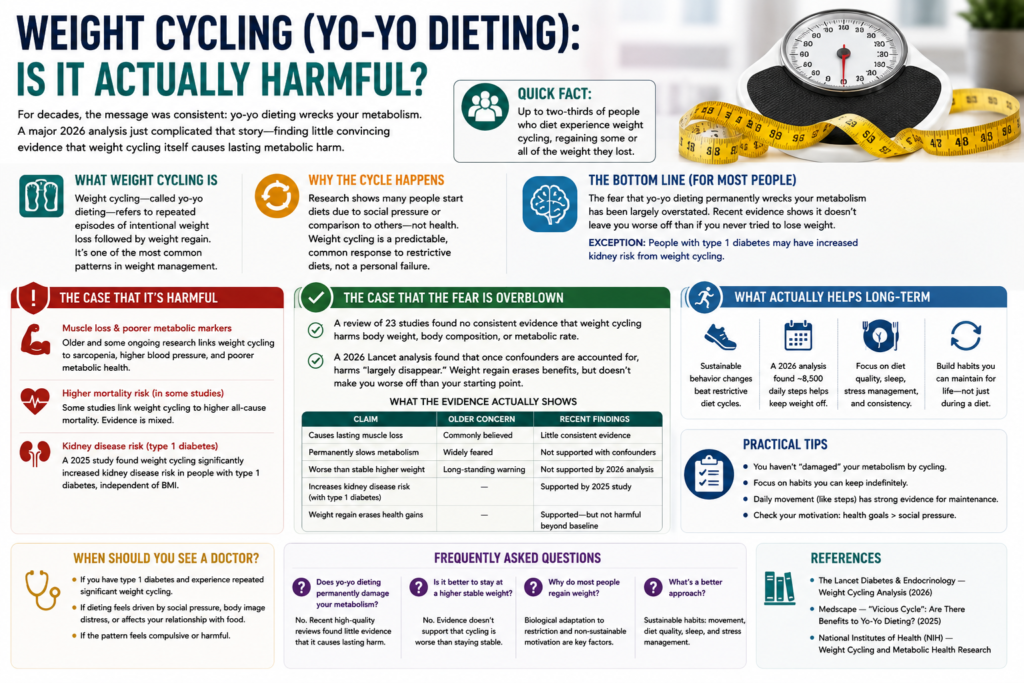
For decades, the message was consistent: yo-yo dieting wrecks your metabolism, and repeated weight loss and regain might leave you worse off than never dieting at all. A major 2026 analysis published in The Lancet Diabetes & Endocrinology just complicated that story considerably — after reviewing decades of human and animal research, the authors found little convincing evidence that weight cycling itself causes lasting metabolic harm.
Quick Fact: Up to two-thirds of people who diet experience weight cycling, regaining some or all of the weight they lost — making it one of the most common patterns in weight management, not a rare failure.
What Weight Cycling Actually Is
Weight cycling — commonly called yo-yo dieting — refers to repeated episodes of intentional weight loss followed by weight regain. It’s not a fringe pattern: research has long suggested most people who lose weight through dieting regain a meaningful portion of it within several years, which is part of why the topic has generated so much research and public concern.
The Case That It’s Harmful
Older and some ongoing research links repeated weight cycling to sarcopenia (muscle loss), increased hypertension risk, poorer metabolic markers, and even higher all-cause mortality in certain studies. Separately, a 2025 study found weight cycling significantly increased kidney disease risk in people with type 1 diabetes, independent of BMI — a finding specific enough that it doesn’t get erased by the broader debate below.
The Case That the Fear Is Overblown
This is where the picture gets genuinely more complicated — and more reassuring. A systematic review of 23 studies comparing people with and without a history of weight cycling found the overwhelming majority of evidence did not show adverse effects on body weight, body composition, or metabolic rate. The 2026 Lancet analysis went further: after properly accounting for pre-existing health conditions, aging, and overall obesity exposure, the researchers found the supposed harmful effects of weight cycling “largely disappear.” Weight regain reverses the health benefits gained during weight loss, but the research doesn’t support the idea that cycling leaves someone worse off than if they’d never tried to lose weight at all.
Quick Reference: What the Evidence Actually Shows
| Claim | Older Concern | Recent Findings |
|---|---|---|
| Causes lasting muscle loss | Commonly believed | Little consistent evidence found in major reviews |
| Permanently slows metabolism | Widely feared | Not supported once confounders are accounted for |
| Worse than staying at a stable higher weight | Long-standing warning | Not supported by 2026 Lancet analysis |
| Increases kidney disease risk (with type 1 diabetes) | — | Supported by 2025 study, independent of BMI |
| Weight regain erases health gains from loss | — | Supported — but doesn’t make things worse than baseline |
Why This Debate Matters Beyond the Numbers
The fear of “ruining your metabolism” through yo-yo dieting has shaped real clinical advice for years, sometimes discouraging people from attempting weight loss at all. The Obesity Medicine Association’s own clinical guidance captures the more balanced current view well: while repeated dieting cycles may carry some adverse effects, attempts to reach a healthier weight shouldn’t be avoided purely out of fear of imperfect, non-permanent results.
Why the Cycle Happens in the First Place
Research interviewing people who’ve experienced weight cycling found something notable about motivation: participants overwhelmingly reported starting diets due to social pressure or comparison to peers and celebrities, not primarily for health reasons. Weight cycling isn’t best understood as a personal failure — it’s a predictable, common response to restrictive dieting patterns, particularly ones adopted for reasons other than sustainable health behavior change.
What Actually Seems to Help Long-Term
Rather than another aggressive diet cycle, the more consistently supported path involves sustainable behavior changes: dietary quality, regular movement, sleep, and stress management, maintained as ongoing habits rather than temporary restriction. One 2026 international analysis specifically found that people who increased their daily steps to around 8,500 were more likely to keep weight off after dieting — a modest, sustainable behavior rather than another restrictive cycle.
Practical Tips
- If you’ve weight-cycled before, the research doesn’t support treating yourself as having “damaged” your metabolism — that framing isn’t well supported by current evidence.
- Focus on habits you could maintain indefinitely (not just during a diet phase) rather than approaches you know you’ll abandon once weight is lost.
- Consistent movement, like a daily step target, has more supporting evidence for weight maintenance than most short-term diet plans.
- If your motivation for dieting is primarily social comparison rather than a health goal you’ve defined for yourself, it’s worth examining that before starting another restrictive cycle.
If you’re building a sustainable approach, it’s worth pairing this with our guides on calorie deficit explained and breaking a weight loss plateau, since both focus on moderate, sustainable approaches rather than aggressive short-term cycles.
When Should You See a Doctor?
Talk to a doctor if you have diabetes and have experienced repeated significant weight cycling, given the specific kidney disease risk found in recent research for people with type 1 diabetes. It’s also worth professional support if dieting and weight cycling feel driven by social pressure or body image distress rather than a health goal, or if the pattern feels compulsive or is affecting your relationship with food.
Frequently Asked Questions
Does yo-yo dieting permanently damage your metabolism? Recent major reviews, including a 2026 Lancet Diabetes & Endocrinology analysis, found little convincing evidence for this — once other health factors are accounted for, the feared long-term metabolic harm largely doesn’t hold up.
Is it better to stay at a stable higher weight than to yo-yo diet? Current evidence doesn’t support that weight cycling is worse than maintaining a stable higher weight. Weight regain does reverse the health benefits gained during loss, but it doesn’t appear to leave people worse off than their starting point.
Why do most people regain weight after dieting? Research points to a mix of biological adaptation to restriction and, notably, that many people start diets for social or appearance-based reasons rather than sustainable health behavior change, which affects long-term adherence.
What’s a better approach than repeated dieting cycles? Sustainable behavior changes — consistent movement (including simple step targets), dietary quality, sleep, and stress management — maintained as ongoing habits show more support for long-term weight maintenance than aggressive short-term restriction.
The Bottom Line
The fear that yo-yo dieting permanently wrecks your metabolism has driven a lot of anxiety and clinical caution for decades — and the most rigorous recent analysis suggests that fear was largely overstated, at least for the general population. The exception worth taking seriously is diabetes-specific kidney risk. For most people, the bigger issue isn’t that weight cycling itself causes lasting damage — it’s that repeated restrictive dieting rarely produces the lasting result people are looking for in the first place.
This article is for general informational purposes and is not a substitute for personalized medical or nutritional advice. Consult a healthcare provider before starting a new weight loss approach, especially if you have diabetes or a history of disordered eating.
References
- The Lancet Diabetes & Endocrinology — Weight Cycling Analysis (2026)
- Medscape — “Vicious Cycle”: Are There Benefits to Yo-Yo Dieting? (2025)
- National Institutes of Health (NIH) — Weight Cycling and Metabolic Health Research