The “eight glasses a day” rule traces back to a 1941 recommendation from the U.S. Food and Nutrition Board. The original text said adults need about 2.5 liters of water daily.
It also said, in the very same report, that most of that quantity is already contained in prepared foods.
That second sentence got dropped. What remained was a number, stripped of its context, that has shaped how billions of people think about drinking water for eight decades.
Quick Fact: A major study published in Science concluded that eight cups of water a day is unnecessary for most healthy adults — largely because the advice ignores water from every other source, including food, tea, coffee, and soup.
Where the Number Actually Came From
The 1941 report specified roughly 1 milliliter of water per calorie of food consumed. For someone eating 2,000 calories, that works out to 2,000 ml — about eight 8-ounce glasses.
The arithmetic was never wrong. The interpretation was.
The recommendation covered total fluid from all sources. Over decades, it transformed into an assumption that you must drink 2.5 liters of plain water on top of whatever you eat and drink otherwise.
A 2002 review published in the American Journal of Physiology went looking for the scientific evidence behind the 8×8 rule specifically. It found none.
Food Is a Larger Water Source Than People Realize
This is the piece the rule omits entirely.
Roughly 20-30% of daily water intake comes from food for most people — and considerably more for anyone eating a produce-heavy diet. Water content by weight:
- Cucumber, lettuce, celery: 95%+
- Watermelon, strawberries: 91-92%
- Yogurt, cottage cheese: ~85%
- Broccoli, oranges, apples: 84-89%
- Cooked rice, pasta: 65-70%
- Soup: 90%+
Someone eating several servings of vegetables and fruit daily is taking in a meaningful fraction of their fluid needs before drinking anything at all.
Quick Reference: What Actually Counts Toward Hydration
| Source | Counts? | Notes |
|---|---|---|
| Water | Yes | Obviously |
| Tea and coffee | Yes | Mild diuretic effect doesn’t offset the fluid |
| Milk | Yes | ~87% water plus electrolytes |
| Fruits and vegetables | Yes | Can supply 20-30%+ of daily intake |
| Soup and broth | Yes | Among the highest-water foods |
| Sports drinks | Yes | Only needed for prolonged intense exercise |
| Alcohol | Net negative | Diuretic effect exceeds fluid content |
The Coffee Myth
The belief that coffee dehydrates you is one of the most persistent hydration misconceptions.
Caffeine does have a mild diuretic effect. But the fluid volume in a cup of coffee substantially exceeds the additional fluid loss it causes. Net result: coffee contributes positively to hydration.
Regular coffee drinkers also develop partial tolerance to the diuretic effect, further reducing it. If your morning coffee is your first fluid of the day, it counts.
What Actually Determines Your Needs
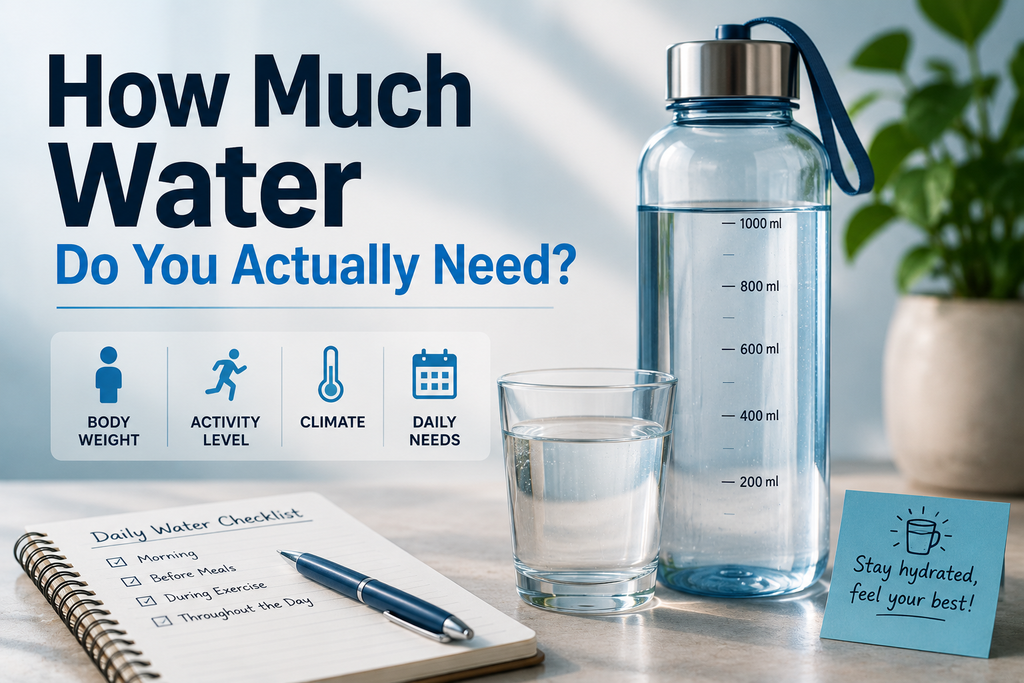
Hydration researchers consistently emphasize that fluid needs are highly individualized. The main variables:
Body size. Larger bodies require more fluid. A 6’2″ 220-pound person and a 5’2″ 120-pound person don’t have comparable needs.
Activity level and sweat rate. This varies enormously between individuals — some people sweat far more than others at identical exertion.
Climate and humidity. Heat and humidity both increase requirements substantially.
Diet composition. High produce intake supplies meaningful fluid; high sodium or protein intake increases requirements.
Age. The thirst reflex weakens with age, which is why older adults are more likely to become dehydrated without noticing.
Health status. Fever, vomiting, diarrhea, and certain medications all change the calculation.
The Simplest Real Indicator
Rather than counting glasses, most clinicians point to a straightforward marker: urine color.
Pale yellow, resembling light lemonade, generally indicates adequate hydration. Dark yellow or amber suggests you should drink more. Completely clear urine typically means you’re drinking more than necessary — the excess is simply being excreted.
Notably, clear urine has no additional health benefit over pale yellow. As one review put it, the only change from drinking beyond your needs is that your urine goes from yellow to clear, which carries no medical significance.
Quick Reference: Urine Color Guide
| Color | Likely Status |
|---|---|
| Clear | Overhydrated — you can ease off |
| Pale yellow | Well hydrated (target) |
| Medium yellow | Adequate, but drink soon |
| Dark yellow / amber | Drink now |
| Brown or unusual | See a doctor |
B vitamins and some medications can turn urine bright yellow independent of hydration status.
Thirst: Reliable, With Two Exceptions
For most healthy adults in ordinary conditions, thirst is a well-calibrated signal. Drink when thirsty, and you’ll generally be fine.
But there are two situations where thirst lags behind actual need:
During exercise or heat exposure. The thirst signal often arrives after early dehydration has already begun, and it’s frequently satisfied before you’ve fully replaced losses. In these conditions, drinking at regular intervals beats waiting for thirst.
In older adults. The thirst reflex genuinely weakens with age, making scheduled fluid intake more reliable than relying on the sensation.
Yes, You Can Drink Too Much
This deserves stating plainly because “drink more water” is treated as advice without a ceiling.
Drinking substantially more water than your body needs — particularly in a short window — dilutes blood sodium, a condition called hyponatremia. In severe cases it causes confusion, seizures, and can be fatal. In August 2023, a mother of two died after drinking too much water too quickly.
This is rare and generally requires drinking large volumes rapidly. But it means the answer to “how much water?” is a range, not an ever-upward target.
What People Actually Find
The most common realization is that the anxiety was the problem.
People carrying a marked bottle, tracking ounces, and feeling guilty for falling short frequently discover their intake was adequate all along once food, coffee, and tea are counted. Hydration researchers have specifically noted that fixating on a fixed number can promote either overhydration or unnecessary anxiety about fluid intake.
The second common pattern involves misreading a symptom. Fatigue, headache, and low mood are genuinely associated with mild dehydration (defined as losing 1-2% of body weight in fluid). But those symptoms have many causes, and drinking more water only helps if dehydration was actually the issue.
Third: people frequently underestimate how much their environment shifts their needs. The same person requires meaningfully different intake in an air-conditioned office in winter versus outdoors in August — and habits set in one context rarely adjust automatically to the other.
Common Mistakes
Counting only plain water. Tea, coffee, milk, soup, and produce all contribute. Excluding them makes intake look far lower than it is.
Treating a fixed number as a target regardless of context. Body size, climate, and activity change requirements substantially. One number can’t serve everyone.
Aiming for clear urine. Pale yellow is the target. Clear generally means you’re drinking beyond your needs.
Avoiding coffee for hydration reasons. The fluid in coffee outweighs its mild diuretic effect. It counts.
Relying on thirst during exercise or heat. These are the two conditions where the signal lags behind actual need.
Assuming more is always better. Hyponatremia is real, if uncommon, and there’s no documented benefit to drinking past adequate hydration.
Practical Tips
- Check urine color once mid-morning rather than counting ounces — it’s a faster and more individualized signal.
- During exercise or hot weather, drink at intervals rather than waiting for thirst.
- Count your coffee, tea, and produce toward intake; you may already be closer than you think.
- To estimate your sweat rate, weigh yourself before and after a workout — each pound lost is roughly 16 ounces of fluid to replace.
- If you’re over 65, build fluid into routines (with meals, on waking) rather than relying on thirst.
If you’re evaluating other common nutrition advice, it’s worth pairing this with our guides on how to read a nutrition label and ultra-processed foods, since both examine claims that turned out more nuanced than the headline version.
When Should You See a Doctor?
Talk to a doctor if you experience persistent excessive thirst or urination, which can signal diabetes or a kidney issue rather than a hydration problem. Also seek guidance if you have heart failure, kidney disease, or liver disease, since fluid intake in these conditions is often deliberately restricted and general advice doesn’t apply.
Seek urgent care for signs of significant dehydration — dizziness, confusion, rapid heartbeat, minimal urination — or for symptoms of hyponatremia after drinking large volumes rapidly, including nausea, headache, and confusion.
Frequently Asked Questions
Do I really need eight glasses of water a day? Not necessarily. The rule came from a 1941 recommendation covering total fluid from all sources, including food. There’s no scientific evidence supporting eight glasses of plain water specifically.
Does coffee count toward my daily water intake? Yes. Caffeine’s mild diuretic effect is outweighed by the fluid volume in the cup, so coffee contributes positively to hydration.
How do I know if I’m drinking enough? Urine color is the simplest indicator — pale yellow suggests adequate hydration. Clear generally means more than necessary; dark yellow means drink more.
Can drinking too much water be dangerous? Yes, though it’s uncommon. Consuming large volumes rapidly can dilute blood sodium and cause hyponatremia, which in severe cases is life-threatening.
Does food really count toward hydration? Substantially. Food supplies roughly 20-30% of daily fluid intake for many people, and considerably more for those eating plenty of fruits, vegetables, and soups.
The Bottom Line
The eight-glasses rule survived eighty years because it’s memorable, not because it’s accurate — it was a total-fluid recommendation that lost its own footnote. Real hydration needs depend on your body size, climate, activity, and diet, and food and coffee count toward them. Check your urine color, drink when thirsty except during exercise and heat, and stop treating a number from 1941 as a target you’re failing to hit.
This article is for general informational purposes and is not a substitute for personalized medical advice. Consult a healthcare provider about fluid intake if you have kidney, heart, or liver conditions.
References
- American Journal of Physiology — “Drink at Least Eight Glasses of Water a Day.” Really?
- Tufts Medicine — Medical Myths: Drink 8 Glasses of Water Each Day
- University of Rochester Medical Center — Hydration 101: Myths Debunked