
The previous version of this page disagreed with itself, and the disagreement is the most useful thing on it.
Its detailed section said that anyone training regularly for muscle needs 1.6 to 2.2 g/kg a day. Its bottom line, a few hundred words later, said most adults need 1.0 to 1.6 g/kg. Both cannot be the answer for the same reader, and the gap between them is not a typo. It is what happens when five ranges drawn from five different kinds of evidence are laid out as though they were one scale.
Because they are not one scale. Of the five numbers that page gave, exactly one comes from a dose-response analysis that measured where the benefit stops. Forty-nine randomised trials, 1,863 participants, and a breakpoint at about 1.62 g/kg a day beyond which more protein produced no further detectable gain. The other four ranges are expert consensus, extrapolation, and in one case a figure designed to answer a completely different question.
That last one is the 0.8 g/kg Recommended Dietary Allowance, and it is the most misread number in nutrition. It is a minimum set to prevent deficiency in nearly everyone, not an estimate of what is optimal for anything. An article that places it on the same axis as a training target invites the reader to think of 1.6 as “double what you need,” when the two figures are answering different questions entirely.
So this rebuild does something more boring and more usable than listing ranges. It runs the calculation. Each section takes the previous section’s output: your situation decides your multiplier, your multiplier and your weight give a number of grams, the grams become food, and then the last table takes most of it back by naming what you can stop counting.
That ending matters as much as the number. The honest finding across this literature is that one figure does almost all the work, and the rules stacked on top of it — the per-meal minimums, the timing windows, the daily tracking — are mostly noise.
Step 1: One Question Decides Almost Everything
Every protein recommendation in existence is an answer to a situation, not to a person. So before any arithmetic, establish which situation you are in. Most people are in exactly one of these.
| Your situation | What protein is doing there | Does it change your number? |
|---|---|---|
| Not training, not losing weight | Covering requirements, maintaining what you have | No. This is the baseline case, and the baseline is low |
| Resistance training to build muscle | Supplying the raw material for the gain the training signals | Yes — this is the one situation with a measured dose-response behind its number |
| Losing weight, in a calorie deficit | Protecting lean mass from being lost alongside fat | Yes — and this is protein’s clearest documented role, which is not the same as helping you lose |
| Over about 60 | Overcoming anabolic resistance — older muscle responds less to the same amount | Yes, upward, and the effect of age was measurable in the trials |
| Living with chronic kidney disease | — | Yes, and in the opposite direction. This page does not apply to you; your intake is set by your clinician |
| Pregnant, breastfeeding, recovering from surgery or illness | — | Yes, and not from an article. These have their own requirements |
Two of those rows deserve expanding before the arithmetic, because they are where the original page was least precise.
The deficit row is where protein’s evidence is strongest and most often overstated. Pooled across 24 randomised trials, higher-protein energy-restricted diets produced 0.79 kg more weight loss than standard-protein ones — with a confidence interval running from 1.50 kg down to 0.08 kg, which honestly reads as somewhere between a kilogram and a half and almost nothing. What the same analysis found clearly is that higher-protein dieters retained 0.43 kg more fat-free mass (95% CI 0.09 to 0.78). And in a separate trial, extra protein after a very-low-energy diet meant regaining 0.8 kg over six months against 3.0 kg in the comparison group.
So protein during weight loss is not a weight-loss tool that happens to protect muscle. It is a muscle-protection tool that produces a small weight bonus, and the 2026 American Diabetes Association standards now reflect exactly that framing, telling clinicians to counsel adequate protein alongside muscle-strengthening activity specifically to limit muscle loss.
The over-60 row is the one most people under-read. Age moderated the response in the dose-response analysis: older participants showed smaller gains from the same intake. That is an argument for a higher number, not a lower one — which is the reverse of how protein is usually discussed with older adults.

Step 2: Your Situation Gives You One Multiplier
Take the row you landed on and read across. The third column is the part other pages leave out, and it is why these numbers should not be treated as equally firm.
| Situation | Grams per kg of body weight, per day | How firm is that figure? |
|---|---|---|
| Preventing deficiency (the RDA) | 0.8 g/kg | Firm, and answering a different question — a minimum to avoid deficiency, not an optimum for anything |
| Baseline: not training, not dieting | 1.0 to 1.2 g/kg | Expert consensus, widely used. No dose-response breakpoint behind it |
| In a calorie deficit | 1.2 to 1.6 g/kg | Supported by what it is for — 24 trials showing lean-mass retention — rather than by a measured optimum dose |
| Resistance training for muscle | About 1.6 g/kg | The only measured breakpoint on this page. 49 trials, 1,863 participants. Beyond roughly 1.62 g/kg, no further detectable gain |
| The upper bound of that estimate | Up to about 2.2 g/kg | The upper edge of the confidence interval around 1.62 — not a target, just where the uncertainty ends |
| Over about 60 | 1.2 to 1.5 g/kg | Expert consensus, supported by the measured finding that age reduced the response to a given intake |
The fourth row is the anchor of this whole page, so it is worth saying exactly what it does and does not mean.
Across those 49 trials, adding protein to resistance training produced about 0.30 kg more fat-free mass than resistance training alone. Thirty grams of lean mass per hundred, over the trial periods studied. Effects were larger in people already resistance-trained than in beginners, and smaller in older participants. And the benefit stopped climbing at around 1.62 g/kg.
That 0.30 kg figure is the honest size of the thing. Protein is necessary and it is not the engine — the training is the engine, and protein is the supply line. Doubling the protein of someone who is not training produces nothing, because nothing is asking for it.
And the 2.2 figure, which circulates widely as a target, is the top of a confidence interval. It describes where the statistical uncertainty around 1.62 runs out. Eating 2.2 g/kg is not wrong and is not demonstrated to beat 1.6; it is inside the margin of error of the same estimate.
So the practical collapse is this: almost everybody’s number is between 1.2 and 1.6 g/kg, and the only people with a defensible reason to go higher are resistance-trained athletes already at the breakpoint.
Step 3: Multiplier × Body Weight = Your Number
Now the arithmetic, worked out so you can read your own row rather than doing it. Multiply your weight in kilograms by the multiplier from step 2.
| Multiplier | 60 kg (132 lb) | 75 kg (165 lb) | 90 kg (198 lb) |
|---|---|---|---|
| 0.8 g/kg — the RDA minimum | 48 g | 60 g | 72 g |
| 1.0 g/kg — low baseline | 60 g | 75 g | 90 g |
| 1.2 g/kg — baseline, or lower deficit figure | 72 g | 90 g | 108 g |
| 1.4 g/kg — mid deficit | 84 g | 105 g | 126 g |
| 1.6 g/kg — the measured breakpoint | 96 g | 120 g | 144 g |
| 2.2 g/kg — top of the confidence interval | 132 g | 165 g | 198 g |
Two cautions about using that table, both of which the original page got right and are worth keeping.
Use a sensible body weight, not necessarily your current one. These multipliers were derived in trial populations, and at very high body weights multiplying by 1.6 produces a number that reflects body size rather than lean tissue. If your weight is well above the range you are aiming for, the figures start to overstate. This is a point to raise with a dietitian rather than solve with an article.
And notice how narrow the useful band actually is. For a 75 kg adult, the entire span from “baseline” to “the measured breakpoint” runs from 90 g to 120 g. That is a difference of about 30 grams a day — roughly one extra serving of fish, or a cup of Greek yogurt plus a handful of nuts. The distance between the number people worry about hitting and the number they are probably already near is usually one food item.
The gap that is genuinely wide is the one at the bottom: from the RDA’s 60 g to a deficit target of 105 g is a 45-gram jump, and that is the gap most people are actually in when they first look this up. The RDA is not where you should be aiming, and it is where a lot of people quietly sit.
Step 4: Your Number, in Food
Grams of protein per day is an abstraction until it is on a plate. Here is roughly what common foods contribute, so you can assemble your figure from step 3 rather than track it.
| Food | Typical portion | Roughly |
|---|---|---|
| Chicken breast, cooked | 100 g | 30 g protein |
| Oily fish (salmon, mackerel), cooked | 100 g | 22–25 g |
| Greek yogurt, plain | 170 g pot | 15–17 g |
| Eggs | 2 large | 12 g |
| Lentils, cooked | 1 cup / 200 g | 18 g |
| Chickpeas, cooked | 1 cup / 200 g | 15 g |
| Cottage cheese | 100 g | 11 g |
| Milk | 250 ml | 8 g |
| Tofu, firm | 100 g | 8–16 g, varying widely by product |
| Almonds | 30 g handful | 6 g |
| Bread, wholemeal | 2 slices | 6–8 g |
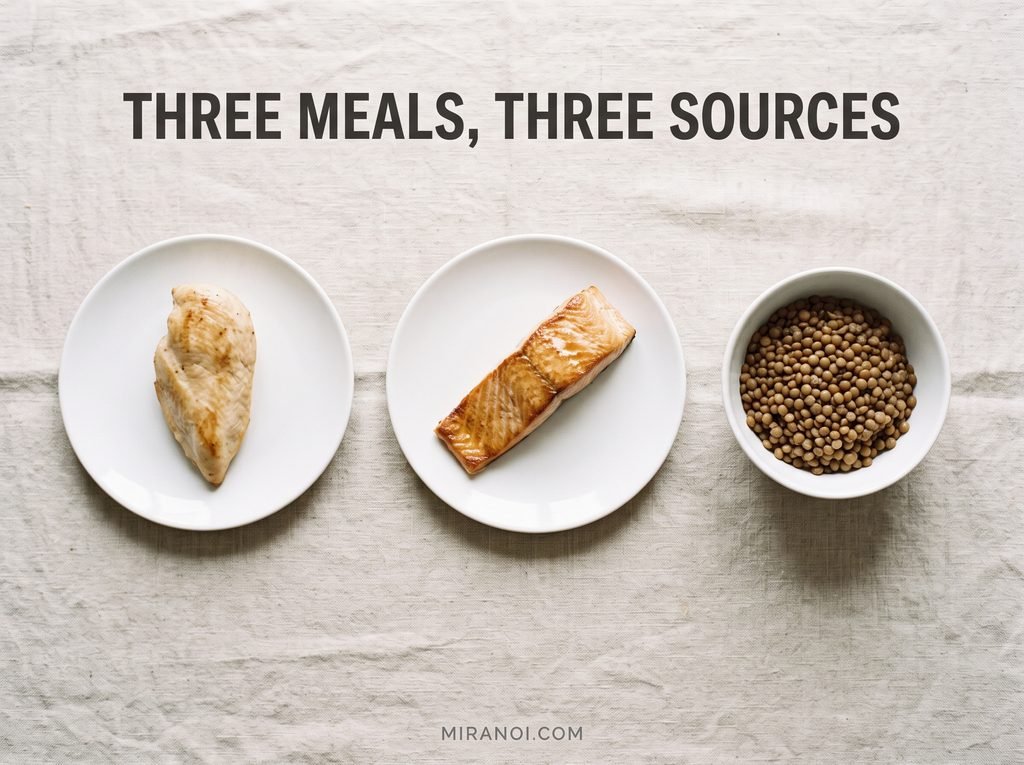
The useful thing about that table is not the individual figures, it is the arithmetic it makes obvious. Three ordinary meals containing one substantial protein source each will land most people between 90 and 120 grams without any counting at all. Chicken at lunch, fish at dinner, yogurt and eggs at breakfast is already about 85 grams before anything else on the plate contributes.
Which means the realistic problem is almost never “how do I reach 120 grams.” It is that one or two meals a day contain no protein source, and the fix is adding one, not tracking all three.
The tofu row is there as a deliberate warning: the protein content of tofu varies more than any other item in that table, from about 8 to 16 grams per 100 g depending on how firm it is and how it was made. If you rely on it, read the actual package, because a general figure for tofu is close to meaningless.
And a note on the plant-food rows. Lentils and chickpeas at 15 to 18 grams a cup are perfectly respectable protein sources, and the common claim that plant protein does not count is wrong at the level of a daily total. Where it matters is at the level of individual amino acids, and the practical answer there is variety across the day rather than any single food — which is the same answer as for almost every other nutrition question on this site.
Step 5: The Adjustments That Are Real
Three things genuinely shift your answer, and several widely repeated rules do not. This table separates them, and the right-hand column is the one to act on.
| The factor | Does it change your number? | What to actually do |
|---|---|---|
| Being in a calorie deficit | Yes | Move toward the top of your range. The lean mass you keep is the whole point, and this is where the 24-trial evidence sits |
| Resistance training | Yes | Up to about 1.6 g/kg. Beyond that, no further detectable gain in the pooled data — and the effect was larger in people already trained |
| Being over about 60 | Yes | 1.2 to 1.5 g/kg, and keep resistance training in the picture. Age measurably reduced the response to a given intake, which argues for more, not less |
| Doing both — losing weight while training | Yes, and this is the strongest case for the top of the range | 1.6 g/kg, plus resistance work. This is the combination the 2026 diabetes standards single out for protecting muscle |
| Spreading protein evenly across meals | Probably a minor effect at most | Reasonable to do and not worth tracking. Evenly spread meals are the natural consequence of having a protein source at each one |
| The “30 grams per meal” ceiling | No | Nothing caps absorption at 30 g. Your original page was right to call this a myth, and it stays called a myth here |
| Protein immediately after training | No meaningful effect on its own | Eat when it suits you. Total daily intake is what the evidence tracks; the narrow post-workout window has not held up |
| Protein powder specifically | No | A convenience, not a category. The trials used supplements because supplements are easy to standardise, not because powder beats food |
The last three rows are where most of the effort in this subject is spent, and they are the three with the least behind them.
On the per-meal question, this page is deliberately giving you no number. Figures like “0.4 g/kg per meal” circulate widely and I could not verify a reliable primary source for any specific per-meal threshold while writing this. So rather than repeat one, here is the honest version: hitting your daily total matters, the distribution probably matters a little, and nobody writing a web page can tell you the threshold. If you have a protein source at each meal, you have done the part that is established.
On timing, the evidence moved and most content did not. The idea that protein must arrive within a narrow window after training has not survived scrutiny, and total daily intake is what the dose-response work is built on. The practical consequence is a relief rather than a loss: you can stop planning your day around a shaker.
And on powder: the trials that produced the 1.6 g/kg breakpoint used protein supplements, which is worth knowing precisely because it does not mean what people assume. Trials use supplements to control the dose, not because the form is superior. Reaching the same total from food is the same intervention.
The Kidney Question, Answered Properly
This is the concern that stops people eating enough protein, and it deserves a straight answer with its limits visible.
| The question | What the evidence says |
|---|---|
| Does high protein harm healthy kidneys? | A meta-analysis of randomised trials comparing higher- with lower-protein intakes concluded that a high-protein diet likely does not adversely affect kidney function or GFR in healthy adults |
| What was different about that analysis? | It examined the change in kidney function after the intervention, rather than only the post-intervention GFR — the authors argued that absolute GFR varies too much between people to show what happened within each one |
| What about the standard worry? | That worry is the Brenner hypothesis: that excess protein raises glomerular pressure and causes hyperfiltration. The authors stated their findings contradict it in healthy people |
| Where did the concern come from, then? | From people with kidney disease, where protein restriction is part of management. The leap from that population to healthy people was made without evidence for it |
| If you have chronic kidney disease | This page does not apply to you. Protein intake in CKD is set by your clinician, and the direction is usually downward. Nothing here overrides that |
| A disclosure worth knowing | A co-author of that analysis reports funding from dairy, beef and PepsiCo interests. The finding is consistent with other work and the methodological argument stands on its own — and you should know the funding anyway |
That last row is included for the same reason the cocoa industry-funding note appears on the blood-pressure page: a finding that happens to favour an industry that funded it is not thereby wrong, and a reader is entitled to weigh it. In this case the conclusion is also the one most nephrologists now state, and the methodological point about measuring change rather than endpoint is a good one independent of who paid.
The practical summary is narrow and firm. If your kidneys are healthy, the protein intakes on this page — up to and including 1.6 g/kg — have no demonstrated kidney cost. If they are not, your number comes from your renal team and not from any article.
Two other safety notes that belong with it. Protein needs are different in pregnancy, breastfeeding, and recovery from surgery or serious illness, and all of those are clinical conversations. And if you have had a kidney stone, some types are affected by dietary factors including protein, which is another reason to ask rather than assume.
One more honest caveat about everything above: the researcher quoted in that work also noted that reduced protein intake can lead to muscle loss, which is a reminder that the risk runs in both directions. The question is not only whether more protein is safe. It is also what eating too little costs — and for older adults in particular, that cost is measurable.
Frequently Asked Questions
What is the single number I should use? Multiply your body weight in kilograms by 1.2 if you are not training or dieting, and by 1.6 if you are doing either. That covers most people, and the gap between those two figures for a 75 kg adult is 90 g against 120 g — about one extra protein serving a day.
Is the RDA of 0.8 g/kg wrong? No, it is answering a different question. It is the minimum that prevents deficiency in nearly everyone, not an estimate of what is optimal for muscle, ageing or weight loss. Treating it as a target is the most common error in this subject, and placing it on the same scale as a training figure is what causes it.
Does more than 1.6 g/kg help? In the pooled data from 49 trials, no further detectable gain appeared beyond about 1.62 g/kg. The widely quoted 2.2 figure is the upper edge of the confidence interval around that breakpoint, not a separate target. Eating 2.2 is not harmful in healthy people and is not demonstrated to beat 1.6.
Will protein make me lose weight? Barely, on its own. Across 24 trials, higher-protein energy-restricted diets produced 0.79 kg more loss than standard-protein ones, with a confidence interval reaching down to 0.08 kg. What protein reliably does in a deficit is protect lean mass — 0.43 kg more fat-free mass retained — and reduce what comes back: 0.8 kg regained over six months against 3.0 kg.
Does high protein damage your kidneys? Not in healthy adults, on the available randomised evidence. The concern originated in people with kidney disease, where protein restriction is part of treatment, and was extended to healthy people without evidence. If you have chronic kidney disease, your intake is set by your clinician.
Do I need protein within 30 minutes of training? No. The narrow post-workout window has not held up, and the dose-response evidence is built on total daily intake. Eat when it suits your day.
Is there a 30 grams per meal limit? No. Nothing caps absorption at 30 g, and the original version of this page was right to list that as a myth.
How much protein per meal, then? This page does not give a figure, deliberately. Specific per-meal thresholds circulate widely and no reliable primary source for one could be verified here. Having a protein source at each meal is the part that is established; the exact per-meal number is not something a web page should be asserting.
Do I need protein powder? No. The trials behind the 1.6 g/kg figure used supplements because supplements standardise the dose, not because the form is better. The same total from food is the same intervention. These high-protein recipes get there in 30 minutes.
Does plant protein count? Yes, at the level of a daily total — lentils and chickpeas give 15 to 18 g a cup. The real consideration is amino acid variety across the day rather than any single food, and tofu in particular varies so much by product that you should read the package rather than a general figure.

The Bottom Line: What You Can Stop Counting
The five steps above produced one number. This last table takes almost everything else away, which is the part that makes the number usable.
| Stop doing this | Why | What replaces it |
|---|---|---|
| Tracking protein daily | A protein source at each of three meals lands most people between 90 and 120 g. The arithmetic only needs doing once | Check once, then stop |
| Hitting a per-meal minimum | No reliable threshold could be verified, and the daily total is what the evidence is built on | Have a protein source at each meal |
| Eating within a window after training | The narrow post-workout window has not held up | Eat when it suits your day |
| Worrying about a 30 g absorption ceiling | It does not exist | Nothing |
| Buying protein powder to hit the number | Supplements standardise a dose in trials; they are not a superior form | Food, unless powder is simply convenient |
| Treating 2.2 g/kg as the target | It is the upper edge of the confidence interval around 1.62, not a separate finding | 1.6 g/kg, if you are training |
| Aiming at 0.8 g/kg | It is a deficiency minimum answering a different question | 1.2, or 1.6 if training or dieting |
| Worrying about your kidneys | No demonstrated effect on kidney function in healthy adults at these intakes | If you have CKD, your clinician’s number |
What survives all that subtraction is one line of arithmetic: your weight in kilograms times 1.2, or times 1.6 if you are training or in a deficit. For most readers that is a one-off calculation producing a figure between 90 and 120 grams, reached by having a protein source at each of three meals.
The reason to strip the rest away is not that detail is bad. It is that the measured effect being chased is modest and specific — about 0.30 kg more lean mass than resistance training alone produced, and 0.43 kg of fat-free mass protected during a deficit — and effort spent on timing windows and per-meal minimums is effort spent outside where that effect was demonstrated.
And one thing to add rather than remove, because the same analysis found it twice: the response was larger in people already resistance-trained, and smaller in older participants. Protein supplies what training demands. Without the training there is less to supply, and with age the same supply does less. If you are going to add one thing to the number from this page, add resistance work rather than more grams — that is where the 2026 diabetes standards point too, and a beginner’s guide to strength training needs no equipment to start.
This article is for general informational purposes and is not a substitute for individual medical or dietetic advice. If you have chronic kidney disease, your protein intake should be set by your clinician and nothing here applies. Protein requirements differ in pregnancy, breastfeeding and recovery from illness or surgery. If you are unsure what figure fits you, a registered dietitian is the right person to ask — which is also a grade-A recommendation in the 2026 diabetes standards for anyone managing weight.
References
- Morton RW, et al. A systematic review, meta-analysis and meta-regression of the effect of protein supplementation on resistance training-induced gains in muscle mass and strength in healthy adults. British Journal of Sports Medicine, 2018 — 49 trials, 1,863 participants, breakpoint about 1.62 g/kg/day
- Nunes EA, et al. Systematic review and meta-analysis of protein intake to support muscle mass and function in healthy adults. Journal of Cachexia, Sarcopenia and Muscle, 2022
- Comment on “Systematic Review and Meta-Analysis of Protein Intake to Support Muscle Mass and Function in Healthy Adults” by Nunes et al — published critique
- Tagawa R, et al. Dose-response relationship between protein intake and muscle mass increase: a systematic review and meta-analysis of randomized controlled trials
- Devries MC, et al. Changes in Kidney Function Do Not Differ between Healthy Adults Consuming Higher- Compared with Lower- or Normal-Protein Diets: A Systematic Review and Meta-Analysis. The Journal of Nutrition, 2018 — reported in Healio Nephrology
- Does a High-Protein Diet Affect Kidney Function? — Consultant360 summary of the same analysis
- Wycherley TP, et al. Effects of energy-restricted high-protein, low-fat compared with standard-protein, low-fat diets: a meta-analysis of 24 randomized controlled trials. AJCN, 2012 — figures via review in Journal of Obesity & Metabolic Syndrome
- Standards of Care in Diabetes — 2026, American Diabetes Association: protein and muscle-strengthening activity to limit muscle loss during weight loss
- Current Perspectives on Protein Supplementation in Athletes: General Guidance and Special Considerations — narrative review
Pingback: How To Read A Nutrition Label In 30 Seconds