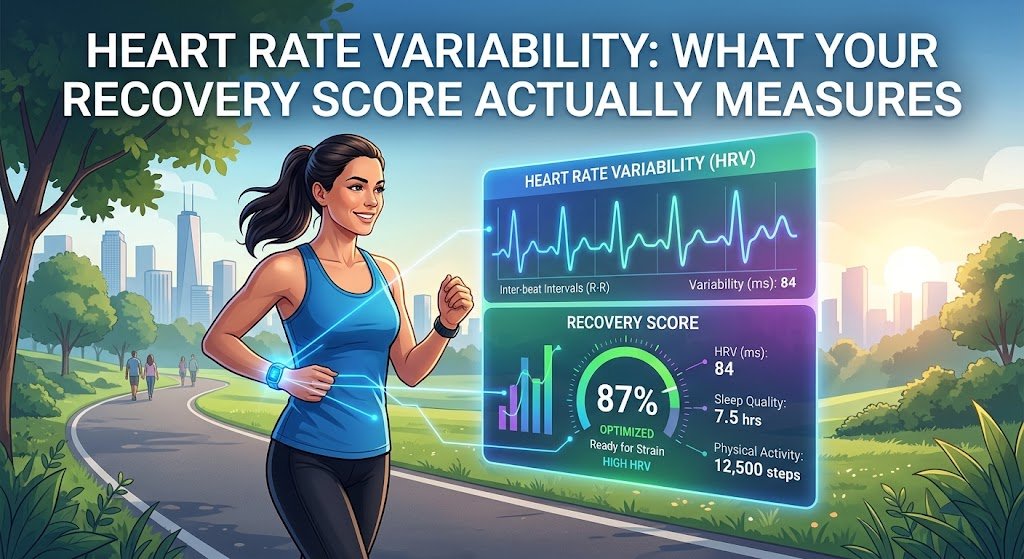
Underneath every “readiness score,” “recovery rating,” and “body battery” on a modern wearable sits a single physiological signal.
Not sleep stages. Not steps. Heart rate variability — the millisecond-level variation in time between consecutive heartbeats.
Everything else the app tells you is downstream of how accurately that one number was measured. Get it wrong by 10%, and the device tells you to push when you should rest, or rest when you should push.
Quick Fact: A healthy heart doesn’t beat like a metronome. Higher variability between beats generally indicates better autonomic function — which is the opposite of what most people assume about a “steady” heartbeat.
Last reviewed: September 2026
What HRV Actually Measures
Your heart rate might be 60 beats per minute, but those beats aren’t evenly spaced. One gap might be 1.02 seconds, the next 0.98, the next 1.05.
That variation reflects the tug-of-war between the two branches of your autonomic nervous system:
- Sympathetic (“fight or flight”) — speeds the heart, reduces variability
- Parasympathetic (“rest and digest”) — slows the heart, increases variability
When parasympathetic activity dominates, variability rises. When you’re stressed, under-recovered, ill, or fighting something off, sympathetic activity increases and variability falls.
This is why HRV works as a recovery proxy: it’s a non-invasive window into whether your body is in a state to absorb more stress, or already managing more than it can handle.
The Metric That Matters: RMSSD
Wearables report HRV differently, but one metric dominates the research: RMSSD — root mean square of successive differences.
It’s favored because it correlates strongly with parasympathetic activity specifically, it’s reliable in short recordings, and it’s straightforward to calculate. Most consumer devices report RMSSD or something derived from it, typically measured overnight.
The other common metric, SDNN, reflects overall variability including both nervous system branches. It appears more often in clinical research than consumer apps.
Quick Reference: HRV Terms
| Term | What It Means |
|---|---|
| RMSSD | Beat-to-beat variation; reflects parasympathetic activity |
| SDNN | Overall variability across a recording period |
| Parasympathetic | “Rest and digest” — raises HRV |
| Sympathetic | “Fight or flight” — lowers HRV |
| Readiness/Recovery score | Proprietary composite — not raw HRV |
Your Number Is Meaningless in Isolation
This is the single most important thing to understand about HRV, and the thing most people get wrong.
HRV varies enormously between individuals. Age, genetics, fitness, and sex all influence baseline values. Two healthy people can have HRV readings that differ by a factor of three, and both can be entirely normal.
There is no “good” HRV number to aim for.
What matters is your own trend against your own baseline. A reading of 45ms means nothing on its own. A reading of 45ms when your rolling average is 70ms is meaningful information — something is taxing your system.
Comparing your number to a friend’s, or to a range you found online, is the most common misuse of this metric.
What the Research Actually Supports
Training and recovery. A narrative review on HRV in strength and conditioning found it useful for assessing training status, adaptability, and recovery. Importantly, it also noted that reduced HRV may signal overreaching or overtraining — but may not be a sensitive marker in aerobically trained athletes. Utility differs by population.
General health associations. A 2025 study examining consumer wearable HRV across five longitudinal studies found resting HRV measured on waking or during sleep had small-to-moderate associations with clinically oriented measures like average blood glucose, depressive symptoms, and sleep difficulty.
Day-to-day stress. Here the findings were weaker. In one study, higher HRV was associated with more recovery time from work, less mental exhaustion, and less alcohol the previous day. But across studies, within-person correlations with prior-day stress and mood were non-significant.
That’s a meaningful caveat: HRV appears more useful as a slow-moving general health signal than as a reliable daily read on how stressed you were yesterday.
Clinical applications. In cardiovascular medicine, HRV can reveal autonomic dysfunction early and help predict outcomes. But reviews also flag persistent challenges — measurement variability, lack of standardization, and limited incremental prognostic value over established risk factors.
How Accurate Are Consumer Wearables?
A validation study published in Physiological Reports in August 2025 collected 536 nights of simultaneous medical-grade ECG and consumer wearable data. The finding: devices vary in accuracy for nocturnal resting heart rate and HRV compared to a gold-standard ECG chest strap.
Several practical points follow from this:
Accuracy is device-generation specific. A ring tested in 2020 isn’t the same sensor stack as the 2025 model. Validation results don’t transfer across generations.
Algorithms differ substantially. Devices vary in how frequently they sample, how long they collect, and whether they weight data from early or late sleep. Two devices on the same wrist can report different numbers legitimately.
Recovery scores are opaque. Reviewers have specifically noted there is little transparency into what actually feeds each device’s “Readiness” or “Recovery” score — which is what users actually see. Algorithms also change with updates, altering how the number is calculated without notice.
The practical conclusion: use one device consistently and track its trend. Don’t compare across devices, and don’t treat the composite score as a measurement.
Quick Reference: What Lowers and Raises HRV
| Lowers HRV | Raises HRV |
|---|---|
| Alcohol (often the largest single effect) | Consistent sleep schedule |
| Poor or short sleep | Aerobic fitness over time |
| Intense training without recovery | Slow, exhale-focused breathing |
| Illness or infection | Adequate recovery between sessions |
| Psychological stress | Hydration and regular meals |
| Late large meals | Time away from acute stressors |
What People Actually Run Into
The most common experience is frustration at unexplained variation. You sleep well, eat normally, don’t drink, and your HRV drops 15 points. There’s often no identifiable cause, because HRV responds to inputs you can’t see — early immune activity, cumulative load, ambient stress.
The practical response is to weight the 7-day trend over any single morning. Single readings are noisy; trends carry signal.
The second pattern is alcohol’s effect being far larger than expected. People consistently report it as the most visible input on their HRV — often more pronounced than a hard training session. This is one of the few places where wearable data delivers unusually clear personal feedback.
Third: many people become anxious about the number itself, checking it first thing and letting a low reading set the tone for the day. This is genuinely counterproductive, since stress lowers HRV — creating a loop where worrying about the number moves the number. Several researchers have raised this as a real concern with consumer HRV tracking.
Common Mistakes
Comparing your HRV to other people’s. Baseline values differ enormously between individuals. Only your own trend is interpretable.
Reacting to a single day’s reading. Daily variation is substantial and often unexplained. The 7-day trend is the usable signal.
Treating the recovery score as raw HRV. These are proprietary composites incorporating undisclosed inputs, and the formulas change with software updates.
Comparing numbers across devices. Different sampling rates, collection windows, and algorithms produce legitimately different values.
Assuming HRV reliably tracks daily stress. Research found within-person correlations with prior-day stress and mood were non-significant across studies.
Letting the number drive anxiety. Stress lowers HRV, so worrying about a low reading can perpetuate it.
Practical Tips
- Measure at the same time daily — overnight or immediately on waking is standard and least affected by daytime variables.
- Establish a baseline over at least two to four weeks before drawing conclusions about anything.
- Track the 7-day rolling average rather than daily values.
- Note context alongside readings: alcohol, training load, illness, and sleep. Patterns emerge from context, not numbers alone.
- Use one device consistently and don’t cross-compare.
- If a low reading arrives, treat it as one input among several — how you feel, sleep quality, and training history all matter alongside it.
If you’re building a broader recovery routine, it’s worth pairing this with our guides on breathing exercises and resting heart rate, since exhale-focused breathing directly raises HRV and resting heart rate is its closest companion metric.
When Should You See a Doctor?
Talk to a doctor about a sustained, unexplained decline in HRV over weeks — particularly alongside fatigue, reduced exercise tolerance, or feeling unwell — since persistently reduced HRV can reflect autonomic dysfunction or underlying illness.
Also seek evaluation if your device flags an irregular rhythm, or if you notice palpitations, dizziness, or chest discomfort. HRV tracking is not a diagnostic tool, and these symptoms warrant clinical assessment rather than interpretation from an app.
Frequently Asked Questions
What is a good HRV number? There isn’t one. HRV varies enormously by age, genetics, fitness, and sex — a healthy range for one person may be well outside another’s. Only your own baseline and trend are meaningful.
Are wearable HRV measurements accurate? Accuracy varies by device and generation. A 2025 validation study using 536 nights of simultaneous ECG data found consumer devices differ in accuracy against a gold-standard chest strap.
Why does my HRV drop for no reason? HRV responds to inputs you can’t directly observe, including early immune activity and cumulative stress load. Single-day variation is normal, which is why the multi-day trend matters more.
Does HRV reliably show how stressed I was yesterday? Less reliably than assumed. Research across five studies found within-person correlations between HRV and prior-day stress and mood were non-significant, suggesting it works better as a slow-moving health signal.
What raises HRV most reliably? Consistent sleep, reduced alcohol, adequate recovery between hard training sessions, aerobic fitness built over time, and slow exhale-focused breathing.
The Bottom Line
HRV is a genuine physiological signal with real research behind it — and it’s routinely misused. It’s a personal baseline, not a score to compare; a weekly trend, not a daily verdict; and a general health signal more than a daily stress readout. If it’s making you anxious rather than informing decisions, that’s a reason to check it less often, not more.
This article is for general informational purposes and is not a substitute for personalized medical advice. HRV tracking is not a diagnostic tool — consult a healthcare provider about persistent symptoms or irregular heart rhythms.
References
- Physiological Reports — Validation of Nocturnal Resting Heart Rate and Heart Rate Variability in Consumer Wearables (2025)
- Sensors — Resting Heart Rate Variability Measured by Consumer Wearables Across Five Longitudinal Studies (2025)
- NIH (PubMed Central) — Heart Rate Variability Applications in Strength and Conditioning: A Narrative Review