Breathwork has become a wellness category unto itself — apps, courses, influencers, entire retreats. Most of it is presented as interchangeable: breathe deliberately, feel calmer.
A Stanford randomized controlled trial put that assumption to the test, comparing three different breathing techniques head to head against mindfulness meditation over a full month. The techniques were not interchangeable. One clearly outperformed the others, and the reason comes down to a single mechanical detail most breathing advice never mentions.
Quick Fact: In the Stanford trial, participants practicing exhale-focused breathing showed a daily increase in positive mood of 1.91 points versus 1.22 points for mindfulness meditation — from just five minutes a day.
The Study That Separated Them
Published in Cell Reports Medicine, the trial enrolled 111 participants and randomly assigned each to one of four practices for five minutes daily over one month:
- Cyclic sighing — emphasizing prolonged exhalations
- Box breathing — equal inhale, hold, exhale, hold
- Cyclic hyperventilation with retention — longer inhales, shorter exhales
- Mindfulness meditation — the comparison condition
All four groups improved. But cyclic sighing produced the greatest improvement in mood and the largest reduction in respiratory rate, both significantly better than mindfulness meditation.
The pattern that predicted success was simple: the longer the exhale relative to the inhale, the better the outcome.
Why Longer Exhales Specifically
This isn’t mysticism — it’s cardiovascular mechanics.
When you inhale, blood return to the heart decreases, so the heart speeds up in response. When you exhale, blood return increases, the vagus nerve is stimulated, and parasympathetic activity slows the heart rate down.
The vagus nerve is the main component of the parasympathetic nervous system — the “rest and digest” state that opposes the “fight or flight” sympathetic response. Extending the exhale simply gives that slowing phase more time.
There’s a second mechanism worth understanding. Under stress, breathing becomes fast and shallow, which disrupts the balance of oxygen and carbon dioxide in the blood. Deliberately lengthening the exhale overrides that automatic pattern rather than waiting for it to pass.
As one of the study’s lead researchers put it, breathing is unusual because it sits right on the edge of conscious control — automatic most of the time, but available to take over deliberately in a way heartbeat and digestion are not.
Quick Reference: Techniques Compared
| Technique | Pattern | Best Evidence For |
|---|---|---|
| Cyclic sighing | Double inhale, long slow exhale (~1:2) | Mood improvement, lowering respiratory rate |
| Box breathing | Equal inhale/hold/exhale/hold (4-4-4-4) | Acute anxiety reduction, focus |
| Resonance breathing | ~5-6 breaths/min, equal in/out | Heart rate variability, baroreflex sensitivity |
| 4-7-8 breathing | Inhale 4, hold 7, exhale 8 | Pre-sleep wind-down, extended exhale |
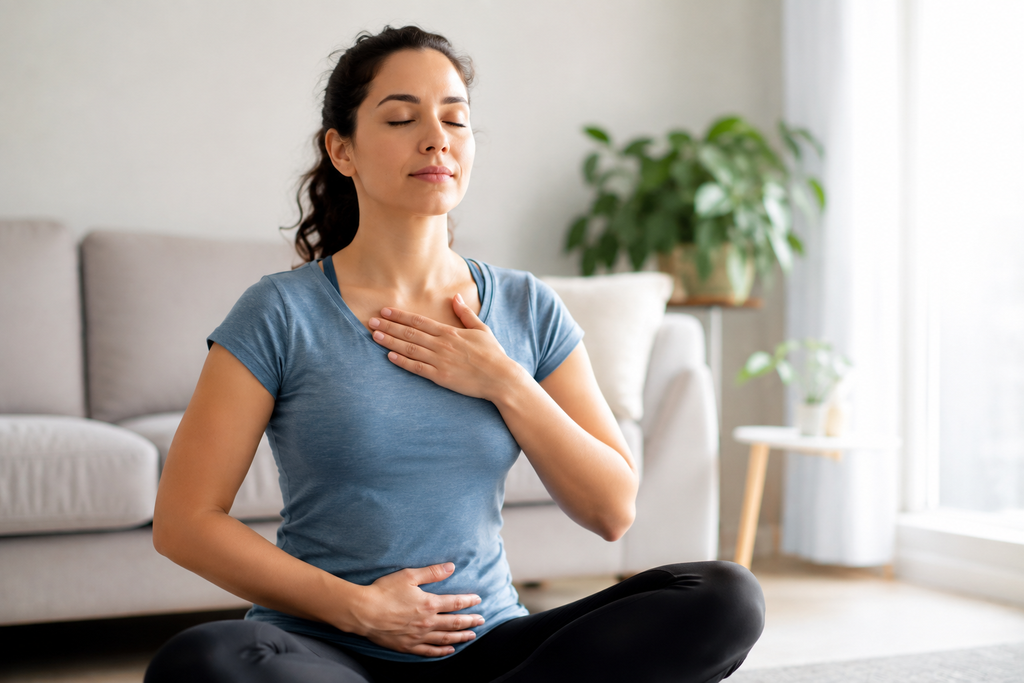
| Diaphragmatic breathing | Slow belly breathing | Lowering cortisol, vagal tone |
How to Do Cyclic Sighing
The technique itself takes about ten seconds to learn:
- Inhale through your nose until your lungs are comfortably, partially full
- Take a second, smaller sip of air through the nose — without exhaling — to fully expand the lungs
- Exhale slowly and completely through your mouth, making the exhale longer than both inhales combined
- Repeat continuously for five minutes
The target ratio is roughly 1:2 — exhale about twice as long as the inhale.
The double inhale isn’t decorative. It reinflates collapsed air sacs in the lungs, which is exactly what a spontaneous sigh does naturally when you’re stressed. The technique deliberately repeats a reflex your body already performs.
The Other Techniques Still Work
Cyclic sighing came out on top, but the study’s more important finding was that all breathwork groups outperformed mindfulness meditation on mood and physiological arousal.
Box breathing — equal counts of inhale, hold, exhale, hold — has separate supporting evidence. A 2026 pilot study testing one-minute interventions during real-life acute stress found both box breathing and cyclic sighing produced greater reductions in state anxiety than a control condition.
Resonance frequency breathing — roughly 5-6 breaths per minute — targets a different outcome. At that rate, breathing approximates the resonance frequency of the cardiovascular system, maximizing baroreflex gain and heart rate variability. The evidence base for it is well established, though it’s aimed at building autonomic resilience rather than acute calming.
Diaphragmatic breathing is the foundational skill underneath all of these. Research has found that interventions using it lower cortisol and increase HRV.
What People Actually Find Hardest
The most common report isn’t that breathwork doesn’t work — it’s that people expect it to feel dramatic and conclude it isn’t working when it feels subtle.
The effect measured in the Stanford study was roughly a two-point improvement on a five-point mood scale, accumulated daily over a month. That’s meaningful, but it isn’t a switch flipping.
The second common obstacle: people try breathwork only during acute panic, when it’s hardest to execute and least likely to feel effective. The research protocol was daily practice during ordinary moments — which is what builds the response you can then draw on under stress.
One practical note from the study design worth borrowing: participants practiced for a fixed five minutes daily, not “whenever they remembered.” The consistency was part of the intervention.
Common Mistakes
Emphasizing the inhale. The instinct under stress is to take a big breath in. But the trial’s inhale-emphasized condition (cyclic hyperventilation) performed worst of the three breathwork groups for mood. The exhale is the calming half.
Only using it during panic. Breathwork practiced daily builds the physiological response. Attempting it cold during peak anxiety, with no prior practice, is the hardest possible starting point.
Expecting instant, dramatic results. The documented effect is a modest daily improvement that accumulates. Judging it after one session sets an unrealistic bar.
Forcing an uncomfortably long exhale. The 1:2 ratio is a target, not a rule. Straining to hold an exhale creates tension, which defeats the purpose. Comfortable and consistent beats maximal.
Doing 4-7-8 standing up when new to it. Some people feel lightheaded when first practicing breath-hold techniques. Sitting down for the first several sessions is standard advice.
Assuming all breathwork is the same. Cyclic hyperventilation is stimulating, not calming — it’s sometimes used deliberately for alertness. Picking a technique that matches your goal matters.
Practical Tips
- Start with five minutes daily at a fixed time — after waking or before bed are the easiest anchors.
- Prioritize exhale length over total breath count; the ratio drives the effect more than the pace.
- Sit or lie down for the first sessions, particularly with breath-hold techniques.
- Use box breathing for acute moments (it’s easier to count under stress) and cyclic sighing for daily practice.
- If you use a wearable, respiratory rate is a more responsive marker than HRV for tracking whether the practice is landing.
If you’re building a broader stress routine, it’s worth pairing this with our guides on stress management techniques and journaling for mental health, since all three work through different pathways and combine well.
When Should You See a Doctor?
Talk to a doctor before starting breath-hold or hyperventilation-style techniques if you have a respiratory condition such as asthma or COPD, cardiovascular disease, or are pregnant. Also seek professional support if anxiety is persistent enough to interfere with daily functioning — breathwork is a useful tool, but it isn’t a treatment for an anxiety disorder on its own.
Frequently Asked Questions
Which breathing exercise is best for anxiety? Cyclic sighing showed the strongest results for mood in the Stanford trial, though box breathing has separate evidence for acute anxiety reduction and is often easier to execute in a stressful moment.
How long do I need to practice for it to work? The Stanford protocol used five minutes daily for one month. Effects on acute state anxiety have been observed from interventions as short as one minute.
Why does exhaling longer than inhaling calm you down? Exhaling increases blood return to the heart, which stimulates the vagus nerve and activates the parasympathetic nervous system — slowing heart rate. Inhaling has the opposite effect, so weighting the exhale tilts the balance toward calm.
Is breathwork better than meditation? For mood and physiological arousal specifically, the Stanford trial found breathwork outperformed mindfulness meditation. That doesn’t make meditation ineffective — both improved outcomes, and they target somewhat different things.
The Bottom Line
The useful finding from the breathwork research isn’t that breathing helps — it’s that the ratio matters more than the technique’s name. Exhale-weighted breathing consistently outperformed inhale-weighted and balanced approaches, and even beat mindfulness meditation on mood over a month. Five minutes daily, exhale roughly twice as long as you inhale, done consistently rather than only in crisis.
This article is for general informational purposes and is not a substitute for personalized medical or mental health advice. Consult a healthcare provider before starting breath-hold techniques if you have a respiratory or cardiovascular condition.
References
- Cell Reports Medicine — Brief Structured Respiration Practices Enhance Mood and Reduce Physiological Arousal
- Stanford Medicine — Cyclic Sighing Can Help Breathe Away Anxiety
- NIH (PubMed Central) — Take a Deep Breath: Breathing Techniques in Clinical Practice