
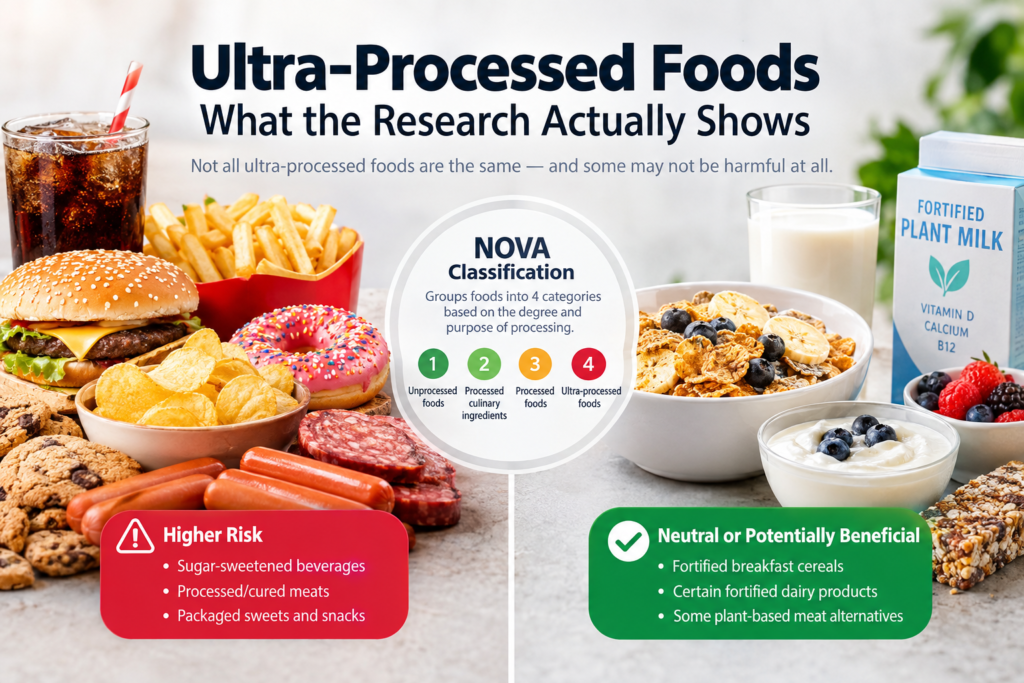
Ultra-processed foods have become nutrition science’s favorite villain — blamed for everything from obesity to cancer to cognitive decline. The headline evidence looks alarming: a 2025 meta-analysis pooling 18 studies and over a million participants found people eating the most ultra-processed food had a 15% higher risk of death from any cause. But a closer look at the same research reveals something the “just avoid UPFs” advice usually skips: not all ultra-processed foods behave the same way, and some may not be harmful at all.
Quick Fact: A 2025 review found substantial differences across ultra-processed food subtypes — sugar-sweetened beverages were consistently linked to harm, while fortified cereals and certain dairy products showed neutral or even protective effects, despite both technically falling under the same “ultra-processed” label.
What “Ultra-Processed” Actually Means
The most widely used definition comes from the NOVA classification system, which sorts foods into four categories based on the degree and purpose of processing — from unprocessed foods up to ultra-processed products containing ingredients rarely used in home cooking (like high-fructose corn syrup or modified starches) added mainly to improve flavor, texture, or shelf life. It’s a useful framework, but it groups an enormous range of products under one label — a sugary soda and a fortified whole-grain cereal can both technically qualify as “ultra-processed.”
What the Large Studies Actually Found
The mortality link is real, but the size varies by disease. A dose-response analysis found that for every 10% increase in ultra-processed food consumption, the risk of diabetes rose by about 11.5%, cardiovascular disease by 9.6%, obesity by 6.8%, and cancer by 2%. These are meaningful associations, not trivial ones.
Nearly all of this evidence is observational. Every major study on ultra-processed foods and health outcomes is observational — meaning it shows a correlation, not proof that processing itself is the cause. Confounding factors like socioeconomic status, overall diet quality, and lifestyle are difficult to fully separate from processing level, even with statistical adjustment.
Not all ultra-processed foods carry equal risk. This is the finding most “avoid UPFs entirely” advice glosses over. A 2025 critical review found substantial variation in health outcomes across UPF subtypes specifically, concluding that the binary “processed = bad” framing fails to account for nutritional composition and fortification benefits.
Quick Reference: UPF Subtypes and Evidence Strength
| Subtype | Evidence of Harm |
|---|---|
| Sugar-sweetened beverages | Strong and consistent |
| Processed/cured meats | Strong and consistent |
| Packaged sweets and snacks | Strong, generally consistent |
| Fortified breakfast cereals | Mixed — often neutral or beneficial |
| Certain fortified dairy products | Mixed — often neutral or beneficial |
| Some plant-based meat alternatives | Limited, inconsistent data |
Why Diet Quality Might Matter More Than the Label
A recurring theme in recent reviews is that a food’s nutrient profile and role in the overall diet may matter more than its NOVA classification alone. A low-quality food that isn’t classified as “ultra-processed” can still be high in sugar, refined starch, or saturated fat and displace more nutritious options — while some ultra-processed foods (fortified cereals, certain plant milks) can fill genuine nutritional gaps, particularly for people with limited access to fresh food. The 2025 Dietary Guidelines Advisory Committee’s own scientific report reflects this more nuanced framing rather than a blanket “eliminate UPFs” stance.
Where the Concern Is Genuinely Strongest
Despite the added nuance, some patterns hold up consistently across the research: diets high in sugar-sweetened beverages, processed meats, and packaged sweets are reliably linked to worse outcomes across multiple studies and disease categories. These specific categories deserve more caution than the “ultra-processed” umbrella term as a whole.
Practical Tips
- Focus on specific categories with the strongest evidence of harm — sugary drinks, processed meats, packaged sweets — rather than trying to eliminate anything with an “ultra-processed” label entirely.
- Check nutrition labels rather than relying on the processing category alone; a fortified, fiber-rich cereal and a candy bar can both be “ultra-processed” while being nutritionally very different.
- Build meals around whole and minimally processed foods as the base, without treating occasional convenient, packaged options as automatically harmful.
- If cost or access limits fresh food options, fortified processed foods (cereals, plant milks) can still provide real nutritional value — don’t let an all-or-nothing framing discourage practical choices.
If you’re evaluating your broader diet quality, it’s worth pairing this with our guides on 10 science-backed ways to lose weight naturally and how much protein you need per day, since overall dietary pattern matters more than any single classification.
Frequently Asked Questions
Should I avoid all ultra-processed foods? Not necessarily. The strongest evidence of harm concentrates in specific categories — sugary drinks, processed meats, packaged sweets — rather than the entire ultra-processed category, which includes some nutritionally beneficial fortified foods.
Is the NOVA classification system reliable? It’s the most widely used framework and has driven important research, but recent critical reviews argue it doesn’t account well for nutritional quality within the ultra-processed category, leading some researchers to call for refined alternatives.
Does ultra-processed food cause disease, or is it just associated with it? Current evidence is observational, meaning it shows a consistent association rather than definitive proof of direct causation, since confounding factors are difficult to fully rule out in this type of research.
Are fortified foods like cereal actually healthy despite being ultra-processed? Some can be, depending on their specific nutrient profile. Research has found certain fortified cereals and dairy products show neutral or even protective associations, unlike categories such as sugary drinks.
The Bottom Line
The research on ultra-processed foods is genuinely more nuanced than “avoid them all” — some categories, particularly sugary drinks and processed meats, show consistent, meaningful associations with health risks, while others, like certain fortified products, don’t fit the same pattern. Paying attention to actual nutritional content, not just the processing label, gives a more accurate picture than treating “ultra-processed” as a single, uniform category.
This article is for general informational purposes and is not a substitute for personalized medical or nutritional advice. Consult a healthcare provider or registered dietitian for guidance tailored to your individual health needs.
References
- American Council on Science and Health — Beyond Nova: How to Interpret the Evidence on Ultra-Processed Foods (2026)
- PubMed — Are All Ultra-Processed Foods Bad? A Critical Review of the NOVA Classification System (2025)
- National Institutes of Health (NIH) — Ultra-Processed Food and Health Research
Pingback: How To Read A Nutrition Label In 30 Seconds