The first few months of strength training feel almost too easy — weights go up nearly every session, muscles firm up, progress feels automatic. Then, without warning, it stalls. This isn’t bad luck or a sign you did something wrong; it’s your body adapting to a stimulus that hasn’t changed. The fix has a name: progressive overload.
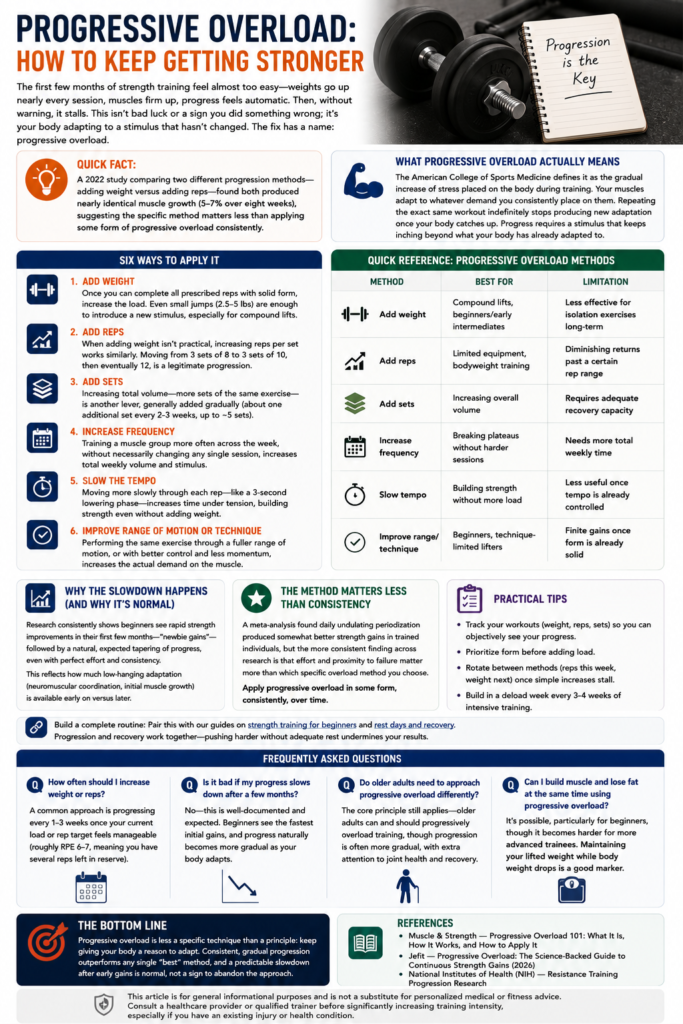
Quick Fact: A 2022 study comparing two different progression methods — adding weight versus adding reps — found both produced nearly identical muscle growth (5-7% over eight weeks), suggesting the specific method matters less than applying some form of progressive overload consistently.
What Progressive Overload Actually Means
The American College of Sports Medicine defines it as the gradual increase of stress placed on the body during training. In plain terms: your muscles adapt to whatever demand you consistently place on them, so repeating the exact same workout indefinitely stops producing new adaptation once your body catches up to that demand. Progress requires a training stimulus that keeps inching beyond what your body has already adapted to.
Six Ways to Apply It
1. Add weight. The most recognized method — once you can complete all prescribed reps with solid form, increase the load. Even small jumps (2.5-5 lbs) are enough to introduce a new stimulus, particularly for compound lifts like squats, bench press, and deadlifts.
2. Add reps. When adding weight isn’t practical (limited equipment, a plateau, or working with bodyweight), increasing reps per set works similarly. Moving from 3 sets of 8 to 3 sets of 10, then eventually 12, is a legitimate progression on its own.
3. Add sets. Increasing total volume — more sets of the same exercise — is another lever, generally added gradually (roughly one additional set every 2-3 weeks, up to about 5 sets for most exercises).
4. Increase frequency. Training a muscle group more often across the week, without necessarily changing any single session, increases total weekly volume and stimulus.
5. Slow the tempo. Moving more slowly through each rep — for example, a 3-second lowering phase — increases time under tension, building strength even without adding weight.
6. Improve range of motion or technique. Performing the same exercise through a fuller range of motion, or with better control and less momentum, increases the actual demand on the muscle even at the same weight and rep count.
Quick Reference: Progressive Overload Methods
| Method | Best For | Limitation |
|---|---|---|
| Add weight | Compound lifts, beginners/early intermediates | Less effective for isolation exercises long-term |
| Add reps | Limited equipment, bodyweight training | Diminishing returns past a certain rep range |
| Add sets | Increasing overall volume | Requires adequate recovery capacity |
| Increase frequency | Breaking plateaus without harder sessions | Needs more total weekly time |
| Slow tempo | Building strength without more load | Less useful once tempo is already controlled |
| Improve range/technique | Beginners, technique-limited lifters | Finite gains once form is already solid |
Why the Slowdown Happens (and Why It’s Normal)
Research consistently shows beginners see rapid strength improvements in their first few months of training — often described as “newbie gains” — followed by a natural, expected tapering of the rate of progress, even with perfect effort and consistency. This isn’t a sign that something has gone wrong; it reflects how much low-hanging adaptation (neuromuscular coordination, initial muscle growth) is available early on versus later, when further gains require more deliberate, incremental progression.
The Method Matters Less Than Consistency
A meta-analysis comparing linear periodization (steadily increasing difficulty over weeks) against daily undulating periodization (varying intensity within the same week) found the undulating approach produced somewhat better strength gains in trained individuals — but the more consistent finding across the broader research is that effort and proximity to failure matter more than which specific overload method you choose. In other words, arguing over the “best” method is less important than actually applying progressive overload in some form, consistently, over time.
Practical Tips
- Track your workouts (weight, reps, sets) so you can objectively see whether you’re actually progressing, rather than relying on memory or feel.
- Prioritize form before adding load — a heavier weight with breakdown in technique isn’t real progress and increases injury risk.
- Rotate between methods (reps this week, weight next) rather than relying on just one, especially once straightforward weight increases start to stall.
- Build in a deload week every 3-4 weeks of intensive training — reduced volume or intensity lets fatigue dissipate and supports a stronger return, rather than working against your progress.
If you’re building a complete training routine, it’s worth pairing this with our guides on strength training for beginners and rest days and recovery, since progression and recovery work together — pushing harder without adequate rest undermines the adaptation you’re trying to create.
Frequently Asked Questions
How often should I increase weight or reps? This varies by individual, but a common approach is progressing every 1-3 weeks once your current load or rep target feels manageable (roughly RPE 6-7, meaning you have several reps left in reserve).
Is it bad if my progress slows down after a few months? No — this is a well-documented, expected pattern. Beginners see the fastest initial gains, and progress naturally becomes more gradual as your body adapts, which is exactly why more deliberate progressive overload strategies become necessary over time.
Do older adults need to approach progressive overload differently? The core principle still applies — professional guidance confirms older adults can and should progressively overload training, though progression is often more gradual, with extra attention to joint health and recovery.
Can I build muscle and lose fat at the same time using progressive overload? It’s possible, particularly for beginners, though it becomes harder for more advanced trainees. A useful marker during a calorie deficit is maintaining your lifted weight even as body weight drops — that itself reflects a real strength gain relative to your size.
The Bottom Line
Progressive overload is less a specific technique than a principle: keep giving your body a reason to adapt. Whether that means more weight, more reps, more sets, better tempo, or more frequent training, the research points to the same conclusion — consistent, gradual progression outperforms any single “best” method, and a predictable slowdown after early gains is normal, not a sign to abandon the approach.
This article is for general informational purposes and is not a substitute for personalized medical or fitness advice. Consult a healthcare provider or qualified trainer before significantly increasing training intensity, especially if you have an existing injury or health condition.
References
- Muscle & Strength — Progressive Overload 101: What It Is, How It Works, and How to Apply It
- Jefit — Progressive Overload: The Science-Backed Guide to Continuous Strength Gains (2026)
- National Institutes of Health (NIH) — Resistance Training Progression Research