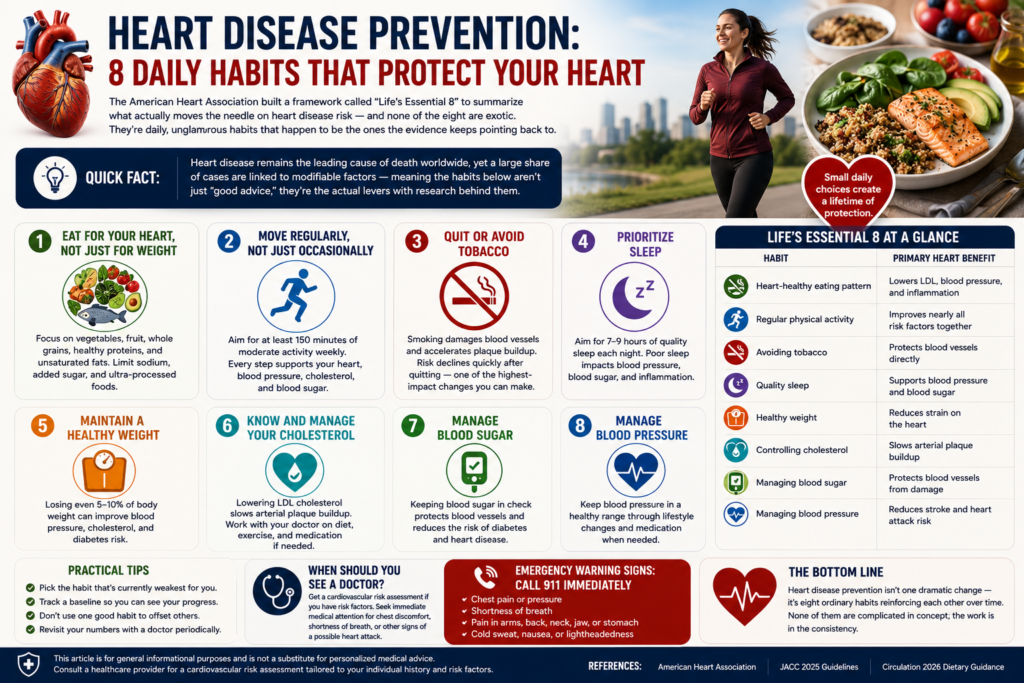
The American Heart Association built a framework called “Life’s Essential 8” to summarize what actually moves the needle on heart disease risk — and none of the eight are exotic. They’re daily, unglamorous habits that happen to be the ones the evidence keeps pointing back to.
Quick Fact: Heart disease remains the leading cause of death worldwide, yet a large share of cases are linked to modifiable factors — meaning the habits below aren’t just “good advice,” they’re the actual levers with research behind them.
1. Eat for Your Heart, Not Just for Weight
The AHA’s most recent dietary guidance centers on a pattern, not individual “good” or “bad” foods: plenty of vegetables and fruit, whole grains over refined ones, healthy protein sources, and unsaturated fats in place of saturated ones — while limiting sodium, added sugar, and ultra-processed foods. The emphasis on pattern matters; no single meal makes or breaks heart health, but the average of your choices over months does.
2. Move Regularly, Not Just Occasionally
Consistent physical activity supports nearly every heart disease risk factor at once — blood pressure, cholesterol, blood sugar, and weight. General guidance points to at least 150 minutes of moderate activity weekly, but the honest starting point for most people is simply moving more than they currently do, then building from there.
3. Quit or Avoid Tobacco
Smoking remains one of the most direct, well-established contributors to heart disease risk, damaging blood vessels and accelerating plaque buildup. The good news: cardiovascular risk begins declining fairly quickly after quitting, making it one of the highest-impact single changes available.
4. Prioritize Sleep
Sleep is formally included in the AHA’s framework for a reason — poor sleep is linked to higher blood pressure, worse blood sugar control, and increased inflammation, all of which feed into heart disease risk. Most adults need 7-9 hours consistently, not just on weekends.
Quick Reference: Life’s Essential 8 At a Glance
| Habit | Primary Heart Benefit |
|---|---|
| Heart-healthy eating pattern | Lowers LDL, blood pressure, inflammation |
| Regular physical activity | Improves nearly all risk factors together |
| Avoiding tobacco | Protects blood vessels directly |
| Quality sleep | Supports blood pressure and blood sugar |
| Healthy weight | Reduces strain on the heart |
| Controlling cholesterol | Slows arterial plaque buildup |
| Managing blood sugar | Protects blood vessels from damage |
| Managing blood pressure | Reduces stroke and heart attack risk |
5. Maintain a Healthy Weight
Excess weight, particularly around the abdomen, is linked to higher blood pressure, less favorable cholesterol levels, and increased diabetes risk — three separate heart disease risk factors compounding at once. Modest, sustainable weight loss (even 5-10% of body weight) has been shown to meaningfully improve several of these markers together.
6. Know and Manage Your Cholesterol
Updated cardiology guidance continues to emphasize LDL specifically as a driver of arterial plaque buildup over time. This is one of the areas where diet, exercise, and — when needed — medication work together rather than any single approach carrying the full load.
7. Manage Blood Sugar
Even outside a diabetes diagnosis, elevated blood sugar contributes to blood vessel damage over time. The updated 2025 hypertension guidelines specifically flag diabetes as a factor that lowers the threshold for more intensive blood pressure management, underlining how closely these systems are connected rather than separate problems.
8. Manage Blood Pressure
The newest clinical guidelines reinforce that lifestyle changes — a heart-healthy eating pattern, reduced sodium, regular activity, stress management, and limited alcohol — are strongly recommended for essentially all adults, with medication added when lifestyle alone isn’t enough to reach target levels.
These Habits Overlap More Than They Compete
None of the eight operate in isolation. Exercise improves blood sugar, cholesterol, weight, and blood pressure simultaneously. Sleep affects blood pressure and blood sugar. This is part of why starting with even one or two changes — rather than trying to overhaul everything at once — tends to produce benefits that ripple into the other seven.
Practical Tips
- Pick the habit that’s currently weakest for you rather than trying to fix all eight simultaneously.
- Track a baseline (blood pressure, weight, or sleep hours) before making changes, so you can actually see what’s moving.
- Don’t treat any single habit as a free pass for the others — a rigorous exercise routine doesn’t offset years of poor sleep or unmanaged blood pressure.
- Revisit your numbers with a doctor periodically rather than assuming lifestyle changes alone are sufficient without checking.
If you’re building out your own prevention plan, it’s worth pairing this with our guides on foods that naturally lower blood pressure and how to improve cholesterol naturally, which go deeper into two of these eight areas specifically.
When Should You See a Doctor?
Get a cardiovascular risk assessment if you have any combination of risk factors — high blood pressure, high cholesterol, diabetes, smoking history, or a family history of early heart disease. Seek immediate medical attention for symptoms like chest discomfort, shortness of breath, or other signs of a possible heart attack rather than waiting for a routine appointment.
Frequently Asked Questions
Can heart disease really be prevented, or just delayed? For many people, a substantial portion of heart disease risk is tied to modifiable factors, meaning genuine prevention — not just delay — is possible with sustained lifestyle changes, especially when started earlier in life.
Which of these eight habits matters most? There’s no single “most important” one — they interact heavily. That said, blood pressure and smoking tend to carry some of the most direct, well-established impact on risk.
Is medication a failure if I need it despite healthy habits? No. Genetics and other factors mean lifestyle changes alone aren’t always sufficient, and guidelines explicitly recommend combining both when needed rather than treating medication as a last resort after “failing” at lifestyle alone.
How quickly do these habits start affecting heart disease risk? Some effects, like blood pressure improvements from reduced sodium or increased activity, can show up within weeks. Others, like plaque reduction from long-term cholesterol management, build over months to years.
Knowing prevention habits matters, but so does recognizing an emergency — our guide on heart attack warning signs covers what to watch for, especially in women.
The Bottom Line
Heart disease prevention isn’t one dramatic change — it’s eight ordinary habits reinforcing each other over time: eating well, moving regularly, avoiding tobacco, sleeping enough, maintaining a healthy weight, and managing cholesterol, blood sugar, and blood pressure. None of them are complicated in concept; the work is in the consistency.
This article is for general informational purposes and is not a substitute for personalized medical advice. Consult a healthcare provider for a cardiovascular risk assessment tailored to your individual history and risk factors.
References
- American Heart Association — Life’s Essential 8
- Journal of the American College of Cardiology — 2025 Hypertension Guidelines
- Circulation (AHA Journal) — 2026 Dietary Guidance for Cardiovascular Health