Cardio vs strength training is one of the oldest debates in fitness, and the honest answer is that it depends entirely on what you’re optimizing for. Here’s how each actually compares across weight loss, muscle, heart health, and longevity — backed by the research, not gym folklore.
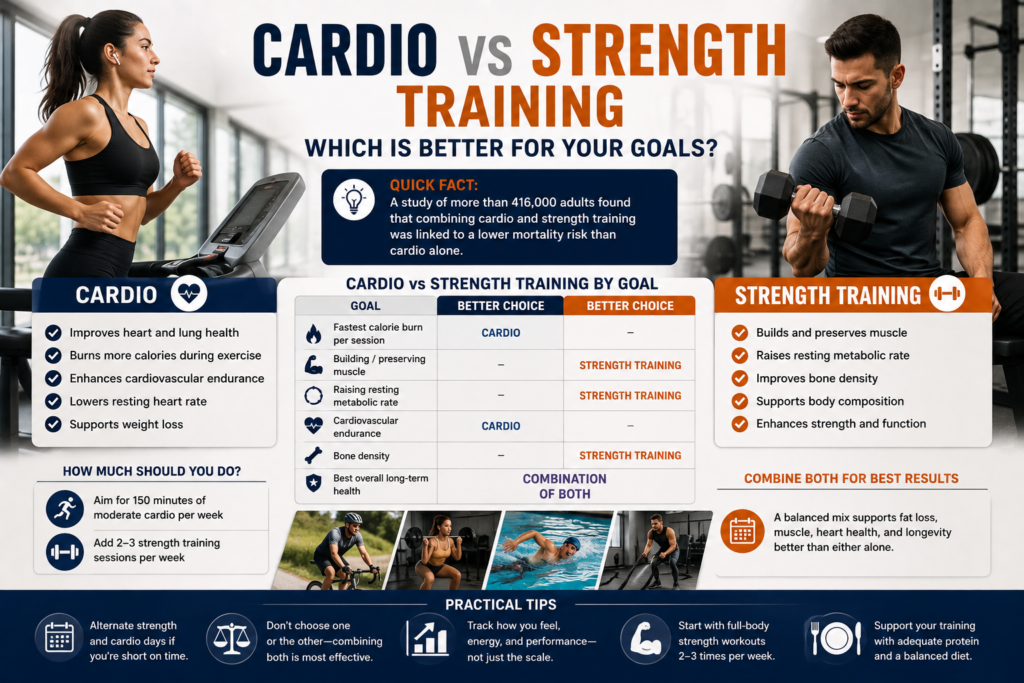
Quick Fact: A study following more than 416,000 adults found that people who combined cardio and strength training had a lower mortality risk than those who did cardio alone.
What Each Type of Exercise Actually Does
Cardio (running, cycling, swimming, brisk walking) primarily trains your heart and lungs, improving how efficiently your body delivers oxygen to working muscles. It burns a relatively high number of calories during the activity itself.
Strength training (weightlifting, resistance bands, bodyweight exercises) builds and preserves muscle mass. It burns fewer calories minute-to-minute than cardio, but muscle is more metabolically active than fat, meaning more muscle mass modestly raises the calories your body burns at rest.
Cardio vs Strength Training for Weight Loss
This is where the debate gets the most attention, and the research is nuanced. Cardio tends to burn more calories during the session itself, making it a straightforward way to create a calorie deficit. But strength training produces a stronger “afterburn” effect — elevated calorie burning for roughly 24-48 hours post-workout — and, more importantly, helps preserve muscle mass while losing fat. Some research has found that people relying on cardio alone for weight loss can lose muscle along with fat, while combining both approaches tends to produce better fat loss with muscle preservation than either alone.
The practical takeaway: if the scale number is your only goal, cardio is the most direct route. If you want to lose fat while keeping (or building) muscle — which most people actually want, even if they say “lose weight” — combining both is more effective than cardio alone.
Quick Reference: Cardio vs Strength Training by Goal
| Goal | Better Choice |
|---|---|
| Fastest calorie burn per session | Cardio |
| Building/preserving muscle | Strength training |
| Raising resting metabolic rate | Strength training |
| Cardiovascular endurance | Cardio |
| Bone density | Strength training |
| Best overall long-term health | Combination of both |
Cardio vs Strength Training for Heart Health
Cardio has the more direct, well-established relationship with cardiovascular health — it’s specifically designed to challenge and strengthen the heart and lungs, and is linked to lower resting heart rate and improved lung capacity. That said, strength training also contributes to heart health, partly by lowering blood pressure risk and supporting metabolic health, even though its primary mechanism is different from cardio’s.
Cardio vs Strength Training for Mental Health and Sleep
Both forms of exercise support mental health, though research suggests some differences: cardio may have a slight edge for reducing stress, while strength training tends to offer a bigger boost to self-esteem and body confidence. For sleep, some research gives resistance training a modest edge in sleep quality and duration, though both types of exercise generally support better sleep than a sedentary lifestyle.
So Which Should You Do?
For most people, the answer isn’t “either/or” — it’s both, in proportions that match your specific goals:
- Primary goal: weight loss. Lean slightly toward cardio for the calorie deficit, but include 2 strength sessions weekly to protect muscle mass during the deficit.
- Primary goal: building muscle or strength. Prioritize strength training 3-4 times weekly, with cardio as a supporting habit for heart health.
- Primary goal: general health and longevity. Aim for a genuine mix — general guidelines suggest roughly 150 minutes of moderate cardio plus 2 strength sessions per week.
Practical Tips
- If you’re short on time, alternating strength and cardio-focused days tends to be easier to sustain than trying to do both every session.
- Don’t abandon cardio entirely for strength training, or vice versa — the combined approach consistently outperforms either alone in the research.
- Track how you feel, not just the scale — strength and energy improvements often show up before visible body composition changes.
- Beginners to strength training benefit from starting with full-body sessions 2-3 times weekly before splitting into more specialized routines.
If you’re building out a complete routine, it’s worth pairing this with our guides on strength training for beginners and how much protein you need per day, since protein intake directly supports the muscle-preserving benefits of combining both training types.
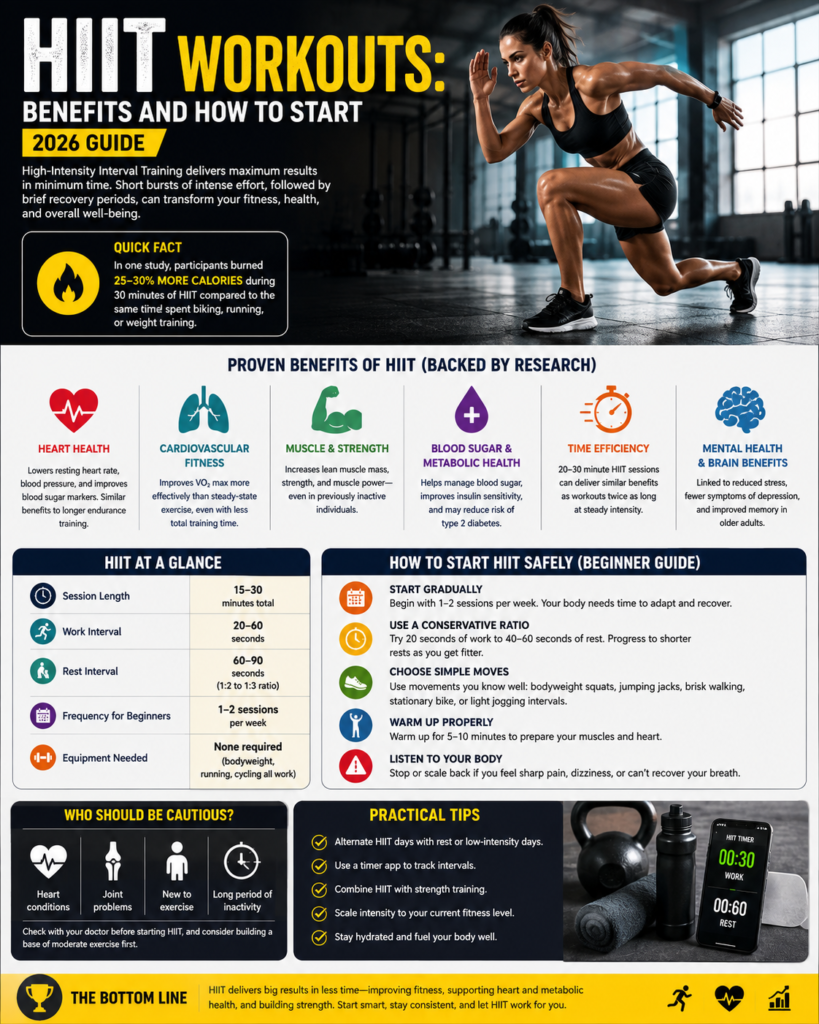
If you’re short on time, it’s worth learning about HIIT workouts and how they compare to steady-state cardio.
Frequently Asked Questions
Can I lose weight with strength training alone, no cardio? Yes, strength training alone can support weight loss, primarily through the calorie burn of the sessions themselves plus a modest boost to resting metabolism from added muscle. Adding cardio typically accelerates the process for most people.
How much cardio and strength training should I do each week? A common evidence-based target is roughly 150 minutes of moderate cardio plus 2-3 strength sessions weekly, adjusted based on your specific goals and current fitness level.
Is it bad to do cardio and strength training on the same day? No, it’s generally fine. If you want to prioritize strength gains, doing strength training first (before fatigue from cardio sets in) tends to preserve more of your lifting performance.
Does strength training count as cardio if my heart rate goes up? Not exactly. While intense strength training does elevate heart rate, it doesn’t provide the same sustained cardiovascular training stimulus as dedicated cardio, though circuit-style strength training can offer some overlapping benefits.
The Bottom Line
Cardio and strength training aren’t competitors — they’re complementary tools that serve different purposes. Cardio builds cardiovascular endurance and burns calories efficiently during the workout; strength training builds and preserves muscle, supports metabolism, and protects bone density. The research consistently favors combining both over choosing one, regardless of whether your primary goal is weight loss, muscle, or long-term health.
This article is for general informational purposes and is not a substitute for personalized medical or fitness advice. Consult a healthcare provider before starting a new exercise program, especially if you have an existing health condition.
References
- Cleveland Clinic — Cardio vs. Strength Training
- British Journal of Sports Medicine — Exercise and Mortality Risk
- National Institutes of Health (NIH) — Physical Activity Research