
The cost of not checking is measured in years.
Iron deficiency does not announce itself. It arrives as tiredness that you explain with work, or poor sleep, or age, or having young children. It becomes the reason you stopped running, the reason the stairs feel different, the reason you are cold when nobody else is. People live inside it for a decade and call it their personality.
And the test costs almost nothing. A single blood draw, a number back in a day.
Here is what makes the waiting worse than it needs to be: a great many people did get tested, were told their result was normal, and went home. In September 2026 the American Society of Hematology published new guidelines that change which of those results count as normal. Under the old standard a large share of deficient people were sent away reassured. Under the new one, they are not.
If you have been tired for a long time and were once told your iron was fine, that sentence is for you.
Last reviewed: November 2026
What changed in 2026
Every table on this page carries the same two columns, because the same number now means two different things depending on when it was read.
The headline change is one figure. The old common threshold for diagnosing iron deficiency was a ferritin of 15 ng/mL. The new guideline suggests 30.
| Population | Verdict before 2026 | Verdict under the 2026 guideline |
|---|---|---|
| Adults, not menstruating or pregnant | Deficient below 15 ng/mL | Deficient at 30 or below; 50 or below is appropriate if there are symptoms or ongoing risk factors |
| Menstruating people | Often 15, often a sex-specific lab range lower still | 30 or below, and the panel suggests against 15; 50 or below with heavy bleeding, symptoms, upcoming surgery, or pregnancy planning |
| Pregnancy | 15 | 30 or below, with a strong recommendation against using 15 |
| Children 9 months to 4 years | 12 | 20 or below |
| Anyone with inflammation | Ferritin alone | Ferritin and transferrin saturation; deficiency considered if saturation is under 20% or ferritin under 100 |
Note the one strong recommendation in that list. Nearly everything in these guidelines is graded conditional with low certainty, and the panel says so plainly. The single exception — the one place they are firm — is that 15 should not be used in pregnancy.
Two practical details from the same document that rarely make it into coverage. If you have any inflammatory condition, ferritin alone is unreliable, because ferritin rises with inflammation and can look reassuring while stores are empty — the guidance is to measure transferrin saturation alongside it. And if transferrin saturation is being measured, it should be drawn fasting, five to nine hours, including fasting from any multivitamin or iron supplement. A morning supplement before a morning blood test can distort the result that decides your treatment.
It is also worth knowing how much certainty sits underneath each line of that table, because it is not much. The children’s threshold rests on a single observational study of 87 children. And the reference standard the whole field is measured against — iron staining of bone marrow — has sampling bias and subjective grading, which the panel lists among its own limitations. These are the best available numbers, not settled ones, and the authors are the first to say so. Our page on vitamin D deficiency runs into a version of the same problem: a threshold everyone quotes, resting on less than you would hope.
Why 15 was the wrong number for iron deficiency
This is the part worth understanding, because it is the difference between a reassuring sentence and an accurate one.
The guideline panel pooled 17 studies covering 5,327 people and asked a simple question of each threshold: of everyone who genuinely has iron deficiency, how many does this cutoff actually catch?
| Threshold | Catches this share of true cases | Correctly clears this share of healthy people | Verdict before 2026 | Verdict under 2026 |
|---|---|---|---|---|
| Ferritin ≤15 ng/mL | 41% | 99% | the standard | suggested against |
| Ferritin ≤30 ng/mL | 67% | 96% | “low normal, nothing to do” | the recommended threshold |
| Ferritin ≤50 ng/mL | 89% | 86% | clearly normal | appropriate where symptoms or risk factors exist |
Read the first row again. A threshold of 15 missed close to six out of ten people who actually had the condition.
It was not a bad number because anyone was careless. It was built to be certain — 99% of the people it clears really are fine — and that certainty was bought by letting most genuine cases through. For a condition this common, in a test this cheap, that is the wrong trade, and it took a long time to say so.
Your lab’s “normal” may start lower than you think
The 15 was only half the problem. The other half is on the piece of paper you were handed.
Many laboratories do not use a clinical threshold at all. They print a reference range built from whatever the local healthy-ish population happened to measure — and because iron deficiency is so widespread, especially in women, that population is itself partly deficient. One US hospital system reported its own lower limits of normal as 7.3 ng/mL for adult women and 10.5 for adult men.
A ferritin of 9 on that report is not flagged. Nothing on the page tells you anything is wrong.
The guideline panel names this directly among its findings: lower reference limits in many laboratories are biased low, and that bias contributes to underdiagnosis. Their recommendation to laboratories is to stop printing population ranges and print clinical decision limits instead.
Until that happens, the practical consequence is this: “your ferritin was in the normal range” is not the same sentence as “your ferritin was above 30.” Ask for the number.
The same blood, two different answers
There is a second layer of uncertainty, and almost nobody mentions it.
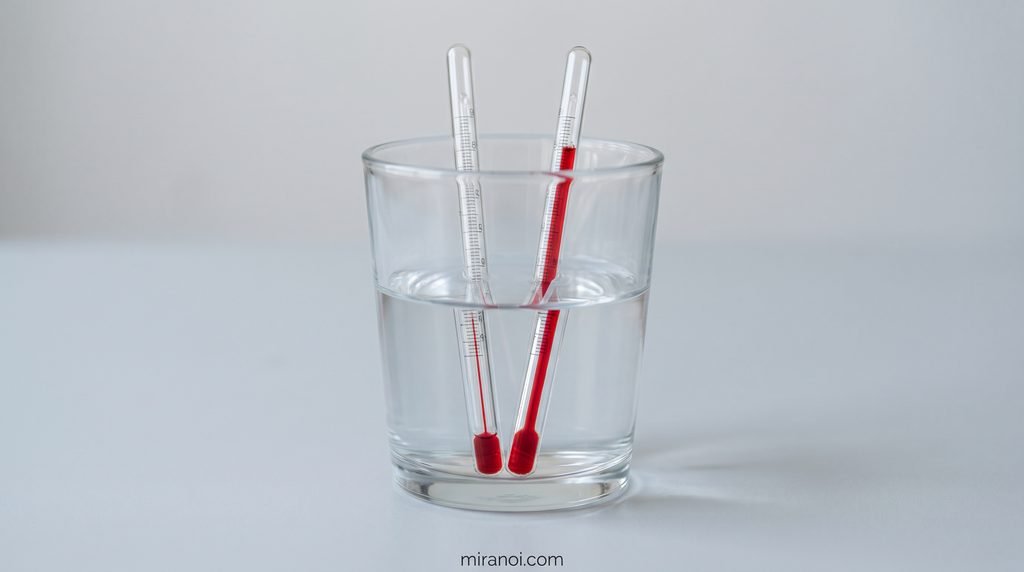
Ferritin assays do not agree with each other. At the low end — below 50 ng/mL, which is exactly the range that matters for this diagnosis — individual laboratory methods differ from the all-methods average by 30% to 40%.
| What you are told | What it could actually be | Verdict before 2026 | Verdict under 2026 |
|---|---|---|---|
| A true value of 10 ng/mL | reported anywhere from 7 to 14 | all three are “low”, so no practical difference | same: all three are deficient |
| A true value of 30 ng/mL | reported anywhere from 21 to 42 | 21 and 30 were both “normal” | 21 and 30 are deficient; 42 is not — the same blood lands on both sides |
| In chronic kidney disease | one assay ran 36% to 44% higher than another | — | can flip a treatment decision |
The middle row is the one to hold on to. A person whose true ferritin is 30 can be told 42 by one laboratory and 21 by another, and those two reports now lead to two different clinical conclusions about the same body on the same day.
This is not a reason to distrust the test. Ferritin remains the single best first measure of iron stores and the guidelines keep it as the primary one. It is a reason to treat a borderline result as borderline rather than final — and if your number sits just above the line and you feel unwell, that is a legitimate thing to say out loud.
What iron deficiency feels like
Fatigue is the symptom everyone knows, and it is also the least useful one, because almost everything causes fatigue. The symptoms worth knowing are the odd ones, because they are specific enough to be a clue.
| Symptom | Why it points at iron rather than something else | Verdict before 2026 | Verdict under 2026 |
|---|---|---|---|
| Tiredness that rest does not fix | Non-specific on its own | investigated only if anaemic | investigated at ferritin ≤30, or ≤50 with risk factors |
| Restless legs — an urge to move them at night | Strongly associated with low iron stores, and often present without anaemia | rarely connected to iron | an explicit testing trigger |
| Pica — craving ice, soil, chalk, paper | Close to a signature symptom; ice-chewing in particular | treated as a curiosity | an explicit testing trigger |
| Breathlessness on stairs that used to be easy | Reduced oxygen delivery | investigated when anaemic | worth testing earlier |
| Cold hands and feet, poor concentration, hair shedding | Common, non-specific, often dismissed | dismissed | still weak alone, meaningful alongside the above |
Restless legs and pica are the two to remember. If you chew ice compulsively, or your legs will not settle at night, those are not quirks — they are among the few things on this list that point at iron specifically rather than at life in general.
Worth saying plainly: none of these diagnoses anything. They are reasons to ask for the test.
Who gets iron deficiency, and why it happens
Iron leaves the body through blood. That single fact explains most of the risk list.
Menstruation is the largest cause worldwide, and heavy periods are routinely underestimated by the person having them — the 2026 guidance includes a good-practice statement that a detailed menstrual history is needed, precisely because “normal for me” is not a clinical measurement.
Pregnancy raises requirements sharply, which is why more than a third of pregnancies are affected.
Regular blood donation is the risk factor almost nobody is warned about. Among frequent donors in one US study, roughly 20% of men and 30% of women had essentially no iron stores — ferritin under 12. You can be doing something unambiguously good and be deficient because of it.
Gut conditions and gut surgery reduce absorption, which is why inflammatory bowel disease and coeliac disease sit high on the list, and why our page on gut health is relevant to a blood test.
Diet matters less than people assume but is not nothing: iron from meat is absorbed far more efficiently than iron from plants, so vegetarians and vegans need more of it, which touches the same ground as our guide to protein.
And then the one that changes the urgency: bleeding in the digestive tract. In an adult man or a postmenopausal woman, iron deficiency with no obvious explanation is treated as potential gut bleeding until proven otherwise, and it is sometimes the first sign of a colorectal cancer. That is the whole reason this is a doctor’s problem and not a supplement aisle problem.
How common iron deficiency actually is
Common enough that the numbers are hard to believe the first time you read them.
| Group | Share with iron deficiency | Evidence behind the figure |
|---|---|---|
| Children 9 months to 4 years | 30% | 56 studies, 121,394 children |
| Menstruating people | 27% | 79 studies, 264,178 people |
| Pregnant people | 37% | 31 studies, 93,782 people |
| Adults, not menstruating or pregnant | 16% | 52 studies, 154,819 adults |
More than a quarter of menstruating people. More than a third of pregnancies. Nearly a third of toddlers.
And most of those are not anaemic. Iron deficiency happens in stages: stores empty first, and haemoglobin only falls once they are gone. The stage in between — empty stores, normal blood count — is called iron deficiency without anaemia, and it is estimated to affect one to two billion people worldwide, at least twice as many as iron deficiency anaemia itself.
Which means a normal full blood count does not rule this out. If the only test you had was a CBC, you were not tested for this.

Does treating iron deficiency actually help?
Here the honest answer is smaller than the marketing, and worth knowing before you spend money.
The question that matters to most readers is narrow: if I am tired, not anaemic, and my ferritin is low, will iron tablets make me feel better?
| Evidence | What it found | Verdict before 2026 | Verdict under 2026 |
|---|---|---|---|
| Meta-analysis of 6 randomised trials | Pooled effect on fatigue 0.33 (0.17–0.48), I² = 0% | a small, consistent benefit | unchanged — still the best summary |
| Oral iron, 198 non-anaemic women, ferritin <50 | Fatigue fell 47.7% vs 28.8% on placebo over 12 weeks | the most-quoted trial | still quoted, still single |
| Intravenous iron, 294 women, ferritin <50 | 0.8 points on a 22-point scale; 33.3% vs 16.4% reported halving their fatigue; number needed to treat ≈ 6 | modest | modest |
| Intravenous iron, non-anaemic blood donors | Ferritin and haemoglobin rose; fatigue and wellbeing did not change at all | an inconvenient null | still an inconvenient null |
| Subgroup with ferritin ≤15 | Fatigue fell 1.8 vs 0.4 on placebo (p = .005) | — | the benefit concentrates at the bottom |
Put together: the effect is real, it is small to moderate, and it is strongest in the people who are most deficient. A number needed to treat of 6 means roughly one person in six feels meaningfully better who would not have otherwise. That is a decent return for a cheap tablet, and it is not the transformation some supplement pages promise.
One pattern across the trials deserves attention. Benefit appeared in women with ferritin at or below 50 and concentrated below 15. The blood donors, who had ferritin up to 50 but were otherwise well, got nothing. The lower you actually are, the more there is to gain.
Taking iron every other day
The most useful practical finding in this field is about timing, and it is the opposite of what most labels say.
Swallowing iron raises a hormone called hepcidin, which is the body’s switch for shutting iron absorption down. Hepcidin stays elevated for about 24 hours. So the second dose of the day, and to a degree the next morning’s dose, arrives while the door is still closing.
Stable-isotope trials in iron-depleted women found that alternate-day dosing absorbed a greater fraction per dose than consecutive daily dosing, and that splitting a daily dose into twice-daily raised hepcidin and reduced absorption compared with a single morning dose.
Now the honest qualification, because absorption is not the same thing as getting better. A randomised trial in adults with iron deficiency anaemia compared 120 mg on alternate days against 60 mg daily for eight weeks and found no significant difference in haemoglobin improvement. A trial in children did find better haemoglobin, lower hepcidin and fewer gastrointestinal side effects on alternate days.
So the fair summary is: alternate-day dosing is better absorbed, probably as effective, and usually easier on the stomach — which matters, because the stomach is why most people stop. It is a reasonable thing to raise with a prescriber, and not a reason to change a regimen that is already working.
What iron deficiency is not
Three things this page is careful not to claim.
It is not a diagnosis you should make for yourself. Low iron has causes, and some of them matter more than the iron — in adults, unexplained deficiency can be the first sign of bleeding somewhere in the digestive tract, which is why it is investigated rather than simply topped up.
It is not a reason to take iron without testing. Iron supplements in someone who is not deficient do nothing useful and can cause harm; this is not a vitamin you take speculatively.
And it is not the explanation for every tiredness. Our pages on sleep and stress cover the far more common causes, and a low ferritin found alongside them does not mean the others have been ruled out. The point of this page is that iron is cheap to check and frequently missed, not that it is usually the answer.
A note on the numbers in this article
| Claim | What was actually read | Status |
|---|---|---|
| All 2026 thresholds, the sensitivity and specificity figures, the four prevalence estimates, interlaboratory variation, the panel’s stated limitations | The ASH 2026 guidelines, read directly — though the fetch covered roughly the first half of a very long document | Firm for what was read; the pregnancy and children sections should be re-read in full before publishing |
| Laboratory lower limits of 7.3 and 10.5 ng/mL | A conference abstract from the hospital system that reported them | Firm as a single institution’s figures — not a general claim about all laboratories |
| 1–2 billion with deficiency without anaemia; twice as common as the anaemic form | A 2025 review and a 2025 threshold paper | Secondary — open both before publishing |
| Fatigue trials: the pooled 0.33, the 47.7% trial, the NNT of 6, the blood-donor null, the ≤15 subgroup | Abstracts and one clinical-education summary; the full texts were not opened | Verify each before publishing — these carry the article’s main practical claim |
| Alternate-day absorption and the contradicting haemoglobin trial | Abstracts and a review PDF | Firm in direction; confirm the Indian trial’s exact null result at source |
Deliberately not written: any specific dose, brand or product; any claim that iron improves energy in people who are not deficient; any figure for how long repletion takes, because it varies too much to state usefully.
When should you see a doctor?
See one before starting iron, not after. The reason is not caution for its own sake — it is that the cause matters.
Seek medical advice promptly for iron deficiency alongside any of: blood in the stool or black stools, unexplained weight loss, a change in bowel habit, vomiting blood, or iron deficiency appearing in a man or a postmenopausal woman, where it is investigated as potential bleeding until shown otherwise.
Also worth a same-week appointment: breathlessness on ordinary exertion, chest pain, a racing heart, or fainting.
And if you are pregnant, the 2026 guidance is unusually firm here — a ferritin of 15 is not an acceptable cutoff in pregnancy, and 30 or below should be treated as deficiency.
Frequently asked questions
My doctor said my iron was normal. Could I still be deficient? Yes, and this is the most common situation on this page. Ask for the actual ferritin number. If it is under 30 — or under 50 with symptoms — it meets the 2026 criteria even if the lab printed it as normal.
Isn’t a normal blood count enough? No. Stores empty before haemoglobin falls. A normal full blood count rules out anaemia, not iron deficiency, and the non-anaemic stage is roughly twice as common.
How low is low? Under 30 ng/mL in most adults. Under 50 if you have symptoms, heavy periods, surgery coming, or are planning a pregnancy. Under 20 in young children.
Will iron fix my tiredness? Sometimes. Across trials, about one person in six feels meaningfully better, with the benefit concentrated in those who were most deficient.
Should I take it every day? Every other day is better absorbed and gentler on the stomach, though one trial found no difference in haemoglobin after eight weeks. Raise it with whoever prescribed it.
Why do two labs give different numbers? Below 50 ng/mL, assays differ from each other by 30 to 40%. A true 30 can be reported as anywhere from 21 to 42.

What to say at the appointment
The hardest part of this is not the medicine. It is getting the right test ordered and the right number read out, in ten minutes, without sounding like you are arguing.
So here is the whole page compressed into something you can actually say:
“I’ve been tired for a while and I’d like to check my iron stores. Could we do a serum ferritin, not just a full blood count? And could you tell me the actual number rather than whether it’s in range — I understand the 2026 haematology guidance uses 30 as the cutoff, and 50 if there are symptoms. If it’s low, I’d want to talk about why, not just take a supplement.”
Four things are doing work in that paragraph: it asks for ferritin specifically, it asks for the figure instead of the verdict, it names the standard without lecturing, and it asks for the cause rather than the patch.
If the answer comes back above 50, iron is probably not your explanation, and that is genuinely useful to know — it sends you somewhere more likely. If it comes back at 24, you now know that a year ago that number would have been filed as normal, and this year it is not.
Either way you will have spent one blood test to close a question you may have been carrying for years.
This article is for general informational purposes and is not medical advice. Iron deficiency has causes that need identifying, and iron supplements are not harmless in people who do not need them. Testing and treatment decisions belong with a qualified clinician.
References
- American Society of Hematology. 2026 guidelines for diagnosis of iron deficiency. Blood Advances, 2026;10(21):7353 — the ferritin thresholds for adults, menstruating individuals, pregnancy, children and people with inflammation; the pooled sensitivity and specificity of 0.41/0.99 at ≤15, 0.67/0.96 at ≤30 and 0.89/0.86 at ≤50 across 17 studies and 5,327 individuals; the prevalence estimates of 30%, 27%, 37% and 16%; the interlaboratory variation of ±30–40% below 50 ng/mL; and the panel’s statement that laboratory lower reference limits are biased low
- Ferritin reference ranges and improving diagnosis of iron deficiency without anemia. Blood, 2025;146(Supplement 1):2609 — the reported institutional lower limits of normal of 7.3 ng/mL in adult women and 10.5 ng/mL in adult men
- Iron deficiency without anemia: an underrecognized and undertreated clinical condition. PMC, 2025 — the estimate of 1–2 billion people affected by the non-anaemic stage, and the ferritin and transferrin saturation patterns that distinguish it
- Vaucher P, et al. Effect of iron supplementation on fatigue in nonanemic menstruating women with low ferritin: a randomized controlled trial. CMAJ, 2012;184(11):1247–1254 — 198 non-anaemic women with ferritin below 50; a 47.7% reduction in fatigue score versus 28.8% on placebo, with haemoglobin up 0.3 g/dL and ferritin up 6.8 µg/L
- The effects of intravenous iron supplementation on fatigue and general health in non-anemic blood donors with iron deficiency. Scientific Reports, 2020 — ferritin and haemoglobin rose while fatigue and general wellbeing did not change
- Stoffel NU, et al. Iron absorption from oral iron supplements given on consecutive versus alternate days. The Lancet Haematology, 2017 — higher fractional absorption on alternate days, higher serum hepcidin in the consecutive-day group (p = 0.0031), and higher hepcidin with twice-daily split dosing than a single morning dose
- Alternate day versus daily oral iron for treatment of iron deficiency anemia: a randomized controlled trial. PMC, 2023 — 120 mg on alternate days versus 60 mg daily for eight weeks, finding no