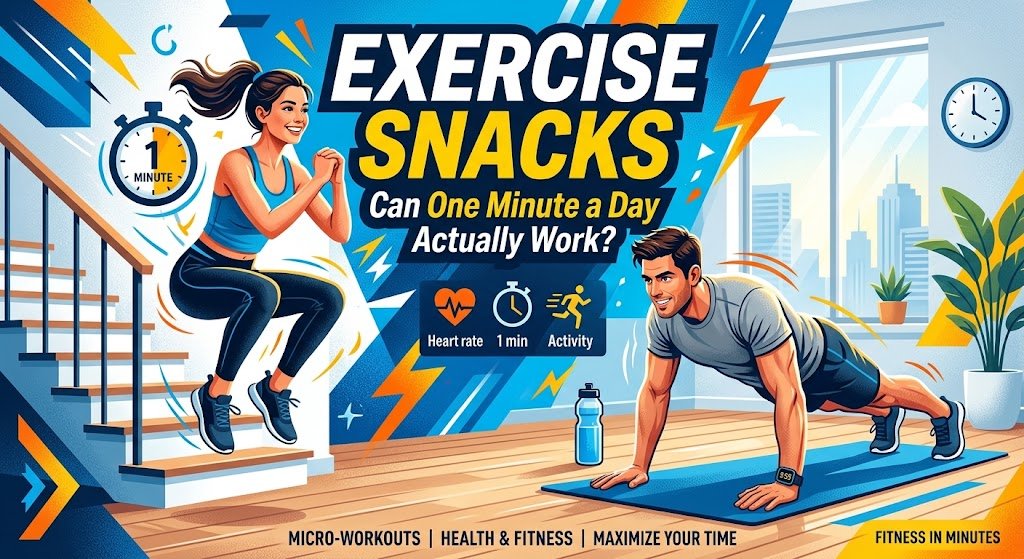
A 2025 study tracked people wearing wrist accelerometers through their ordinary days — no gym, no planned workouts, just whatever movement happened naturally.
The finding: just over five brief bouts of vigorous activity per day was associated with a 44% lower risk of death from any cause. The total time involved was about 1.1 minutes.
That number sounds too small to be real. It isn’t a typo, and the research behind it is more substantial than the headline suggests.
Quick Fact: A systematic review published in the British Journal of Sports Medicine in 2025 found that exercise snacks — bursts of 5 minutes or less — significantly improved cardiorespiratory fitness in physically inactive adults.
Last reviewed: September 2026
What Exercise Snacks Actually Are
An exercise snack is a short, deliberate burst of moderate-to-vigorous activity integrated into your normal day. The defining feature isn’t the exercise itself — it’s the distribution.
Instead of one 30-minute session, you take several bouts of 20 seconds to 5 minutes, spread across the day, with hours between them.
The research definition used in the BJSM review: bursts of moderate-to-vigorous intensity lasting 5 minutes or less, excluding warm-up and cool-down, performed at least twice daily, 3-7 days a week.
Stair climbing dominates the research. It requires no equipment, reaches vigorous intensity quickly, and exists in most buildings.
Exercise Snacks vs. VILPA vs. HIIT
These three terms get used interchangeably and shouldn’t be.
Exercise snacks are planned. You decide to climb four flights at 10am, 2pm, and 5pm. The intentionality allows tracking and habit formation.
VILPA (vigorous intermittent lifestyle physical activity) is unplanned. Running for a bus, carrying heavy groceries uphill, taking stairs because the elevator is slow. It happens inside daily life without being scheduled.
HIIT is a single session containing multiple hard intervals with short recovery between them. All the work happens in one block.
The distinction matters practically: exercise snacks are a habit you build, VILPA is an opportunity you take, and HIIT is a workout you schedule.
Quick Reference: The Three Approaches
| Approach | Planned? | Bout Length | Distribution |
|---|---|---|---|
| Exercise snacks | Yes | Seconds to 5 min | Spread across the day |
| VILPA | No — incidental | Usually under 1-2 min | Whenever it occurs |
| HIIT | Yes | 20 sec to 4 min | Within one session |
What the Research Actually Found
Cardiorespiratory fitness. The 2025 BJSM systematic review and meta-analysis found exercise snacks significantly improved CRF in physically inactive adults — the population where improvement matters most.
Mortality. The VILPA accelerometer research found roughly five bouts daily associated with a 44% lower all-cause mortality risk, with benefits tapering off around eight bouts per day.
Visceral fat. A 12-week randomized controlled trial using stair-climbing snacks — 4 days weekly, 6 bouts daily, four flights (60 steps) in 20-30 seconds, with at least an hour between bouts — found reductions in abdominal visceral fat and epicardial adipose tissue.
Energy expenditure. Research in the European Journal of Sport Science concluded exercise snacks effectively increase energy expenditure while requiring lower perceived effort than continuous sessions.
Brain health. A 2025 study in a long-term care medical journal found older adults engaging in moderate-to-vigorous activity had lower dementia risk — with benefits appearing at as little as 1 to 35 minutes per week.
Why Short Bouts Work At All
The intuition is that fitness requires sustained effort. The physiology is more forgiving than that.
Cardiorespiratory fitness improves through adaptations in cardiac output, oxygen delivery, and mitochondrial function. These respond to intensity reached, not only duration sustained. A 30-second stair climb that genuinely elevates heart rate triggers some of the same signaling as a longer session.
There’s also a separate mechanism: interrupting sedentary time. Prolonged sitting produces its own metabolic consequences, independent of whether you exercised that day. Multiple short bouts break the sitting pattern in a way one morning workout doesn’t.
Research also suggests distributed short bouts may be more effective for some cardiometabolic markers than a single prolonged session — not merely an acceptable substitute.
A Realistic Protocol
Based on the research structures that produced measurable results:
Frequency: 4-6 bouts per day, at least an hour apart.
Duration: 20 seconds to 2 minutes per bout. The stair-climbing trial used four flights in 20-30 seconds.
Intensity: Vigorous enough that you’re breathing hard and couldn’t comfortably hold a conversation.
Days: 4-7 per week.
Timeframe: Studies ran 4-12 weeks before measuring improvement.
Quick Reference: Exercise Snack Options
| Option | Duration | Intensity | Where |
|---|---|---|---|
| Stair climbing (4 flights) | 20-30 sec | Vigorous | Office, home, apartment |
| Bodyweight squats | 30-60 sec | Moderate-vigorous | Anywhere |
| Fast walking burst | 1-2 min | Moderate-vigorous | Commute, errands |
| Push-ups | 30-45 sec | Vigorous | Home, office |
| Carrying groceries uphill | 1-3 min | Moderate-vigorous | Incidental (VILPA) |
| Jumping jacks | 30-60 sec | Vigorous | Home |
Where This Fits — And Where It Doesn’t
Honest framing matters here.
Exercise snacks are strongest for the inactive. Every positive finding in the research concerns physically inactive populations. If you already train regularly, snacks add something, but the dramatic effect sizes don’t apply to you.
They don’t replace resistance training. Nothing in this research addresses building muscle mass or strength in a meaningful way. That requires progressive loading.
They may not fully substitute for structured cardio. The findings show real fitness improvement, but the comparison studies are limited and the long-term data is young.
The benefit tapers. The mortality research found advantages leveling off around eight bouts daily — more isn’t linearly better.
What they genuinely solve is the adherence problem. The most common barriers to exercise are time and motivation, and a 30-second stair climb defeats both.
What People Actually Experience
The most common obstacle is remembering. Without a trigger, the intention dissolves into an ordinary day. People who sustain this consistently attach bouts to existing routines — after the first coffee, before lunch, at the end of a meeting — rather than relying on memory.
The second pattern is underestimating the intensity needed. A casual walk up one flight isn’t an exercise snack. The research protocols reached genuinely vigorous intensity, and the whole mechanism depends on that. If you’re not breathing noticeably harder, the bout likely isn’t doing much.
Third, and the most encouraging: people frequently report that the low commitment is what makes it stick. Skipping a 45-minute session feels like failure and tends to end the habit. Skipping one 30-second stair climb barely registers, and the next bout is an hour away. The forgiving structure is arguably as valuable as the physiology.
Common Mistakes
Going too easy. The research used vigorous intensity. A stroll up the stairs isn’t an exercise snack — it’s a walk.
Clustering bouts together. Doing six flights back-to-back is a workout, not distributed activity. The protocols used at least an hour between bouts.
Treating it as a replacement for strength training. Exercise snacks address cardiorespiratory fitness and sedentary time, not muscle mass.
Relying on memory instead of triggers. Attach bouts to existing daily events; intention alone fails within days.
Expecting it to work the same if you’re already fit. The documented effect sizes come from inactive populations.
Chasing more and more bouts. The mortality data showed benefits tapering around eight per day.
Practical Tips
- Pick one staircase and one trigger — “every time I finish a coffee, four flights” — rather than planning six different activities.
- Aim for breathing hard within 20 seconds; if you’re not, climb faster or take two steps at a time.
- Space bouts at least an hour apart; back-to-back defeats the sedentary-interruption mechanism.
- Start with 3 bouts daily for a week before adding more, so the habit stabilizes before the volume rises.
- Count incidental VILPA — carrying groceries, hurrying to catch something — as part of your daily total.
- Give it 4-12 weeks before evaluating; that’s the window the research used.
If you’re building a complete routine, it’s worth pairing this with our guides on how much exercise you actually need and VO2 max, since exercise snacks are one route to the cardiorespiratory fitness those articles cover.
When Should You See a Doctor?
Check with a doctor before starting vigorous exercise snacks if you have known heart disease, uncontrolled high blood pressure, a history of chest pain or dizziness during exertion, joint problems affecting stair climbing, or have been sedentary for an extended period — brief bouts still reach vigorous intensity.
Stop and seek evaluation for chest discomfort, unusual breathlessness, or dizziness during or after a bout rather than continuing through it.
Frequently Asked Questions
How long does an exercise snack need to be? Research defines them as bouts of 5 minutes or less, with many protocols using 20-60 seconds. The stair-climbing trial used four flights completed in 20-30 seconds.
How many exercise snacks per day should I do? Research protocols commonly used 4-6 bouts daily, at least an hour apart. Mortality data found benefits around five bouts, tapering off near eight.
Can exercise snacks replace a regular workout? Partially. They improve cardiorespiratory fitness in inactive adults, but they don’t substitute for resistance training, and long-term comparison data against structured exercise remains limited.
What’s the difference between exercise snacks and VILPA? Exercise snacks are planned and scheduled; VILPA is incidental vigorous activity occurring naturally during daily life, like hurrying up stairs or carrying heavy bags.
Do exercise snacks help with belly fat? One 12-week stair-climbing trial found reductions in abdominal visceral fat and epicardial adipose tissue, though this is a single study rather than a broad body of evidence.
The Bottom Line
The appeal of exercise snacks isn’t that short bouts beat real training — it’s that they beat the alternative most inactive people actually choose, which is nothing. A 2025 meta-analysis confirms measurable fitness gains, and VILPA research links roughly a minute of daily vigorous movement to substantially lower mortality risk. The mechanism that makes it work is unglamorous: it’s small enough that skipping it doesn’t end the habit.
This article is for general informational purposes and is not a substitute for personalized medical or fitness advice. Consult a healthcare provider before beginning vigorous exercise, particularly with existing cardiovascular conditions.
References
- British Journal of Sports Medicine — Effect of Exercise Snacks on Fitness and Cardiometabolic Health in Physically Inactive Individuals: Systematic Review and Meta-Analysis (2025)
- Frontiers in Public Health — Advances in Exercise Snacks for Interrupting Sedentary Behavior and Promoting Physical Activity: A Narrative Review (2026)
- NIH (PubMed Central) — Vigorous Intermittent Lifestyle Physical Activity (VILPA) Scoping Review