The original article diagnosed the symptom correctly and named the wrong cause.
It observed that meal prep collapses by midweek, which is true, and attributed it to eating the same meal repeatedly. Its fix was to prep components instead of finished meals, so that the same ingredients can be recombined into different dishes. That is a good method and most of this rebuild keeps it.
But four components recombined four ways is four arrangements of the same mouthfeel. The protein was cooked and chilled. The grain was cooked and chilled. The vegetables were roasted and chilled. By Wednesday everything on the plate is soft, cool and slightly damp, and no amount of putting the chicken next to the quinoa instead of on top of it changes that.
Meal prep does not fail because people get bored of the combination. It fails because they get bored of the texture — and the component framework as written has no component that solves it.
This rebuild adds the one that does, corrects two numbers in the original’s own tables, fixes a timeline that ends with warm food in sealed containers, and removes a citation that should not be on the site.
Quick Fact: The FDA allows six hours to cool cooked food safely — two hours to get from 135°F to 70°F, then four more to reach 41°F. The original article’s 60-minute session allots fifteen minutes to cooling before packing. You do not need to cool food in fifteen minutes, and you cannot. The session can end before the food is cold.
Sunday: The Session, and Why It Ends Too Early
The original’s 60-minute plan is well built, and its last fifteen minutes are wrong.
| Stage | From | To | Time allowed |
|---|---|---|---|
| Stage one | 135°F (57°C) | 70°F (21°C) | 2 hours |
| Stage two | 70°F (21°C) | 41°F (5°C) | 4 more hours |
| Total | 135°F | 41°F | 6 hours |
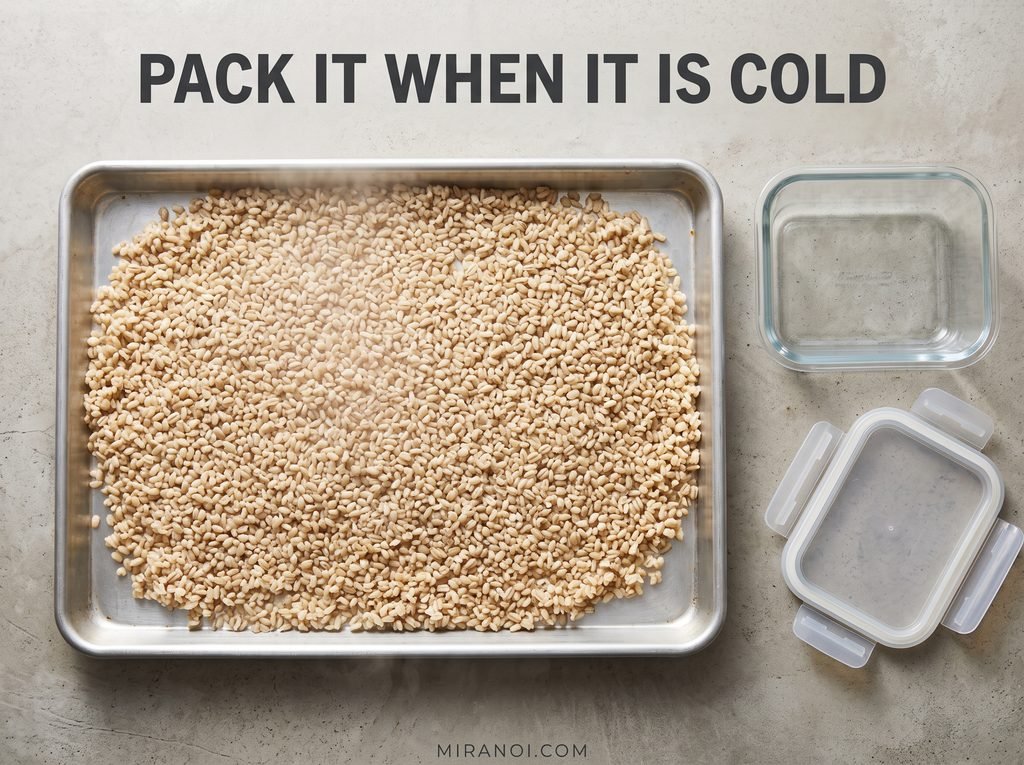
The original allots minutes 35–45 to spreading grains to cool, then minutes 45–60 to portioning and labelling “once cooled.” Food does not cool in fifteen minutes. What goes into those containers is warm.
And the FDA’s own guidance on cooling says to keep food loosely covered or uncovered while it cools, so heat can escape. Sealing warm food into a lidded container is the specific thing that prevents it.
The fix costs nothing and is not a safety panic. Spread the grains and vegetables thin, leave them uncovered on the counter, and walk away. Come back in ninety minutes and pack. Your session is still sixty minutes of work — it just does not end when the work ends. You have six hours and you are using two.
The original was right about the sheet pan. It was right about the danger zone. It just compressed a two-hour stage into a quarter of an hour and then put a lid on it.
Sunday, Continued: The Fifth Component
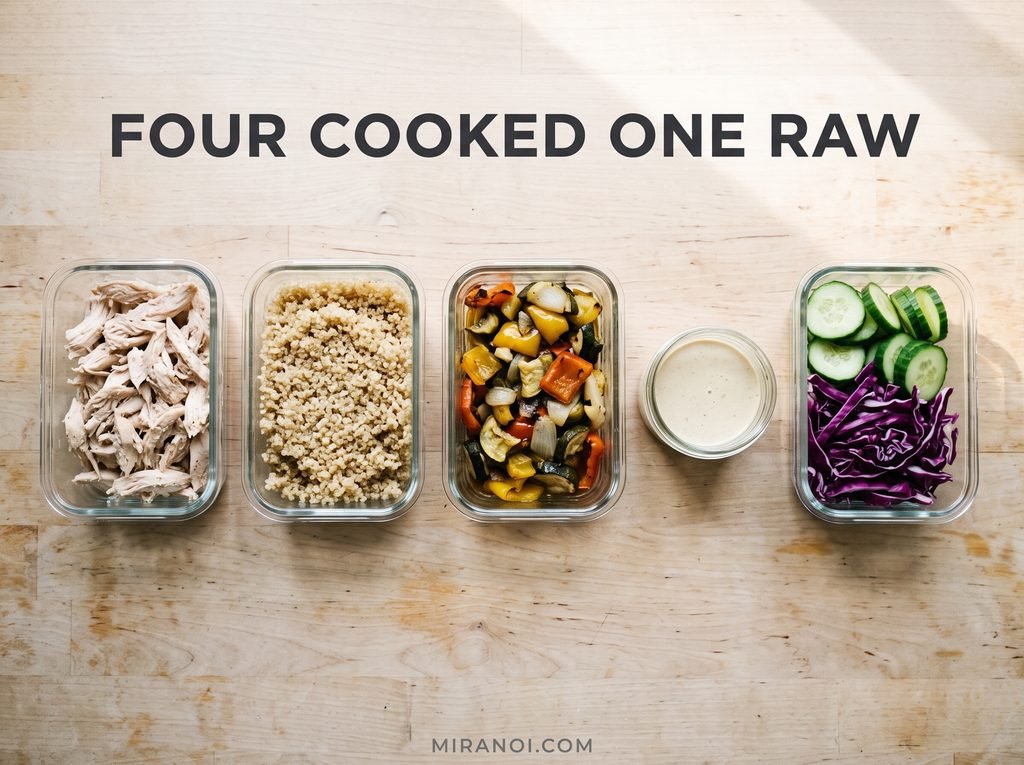
The original’s framework is four categories: a protein, a grain or starch, roasted vegetables, and a sauce. It is a good framework and it is missing one thing.
| Component | Examples | Prepped on Sunday? |
|---|---|---|
| Protein | Shredded chicken, hard-boiled eggs, lentils, baked tofu, ground turkey, beans | Yes |
| Grain or starch | Quinoa, brown rice, barley, roasted sweet potato, whole grain pasta | Yes |
| Roasted vegetables | Whatever holds up in a hot oven | Yes |
| Sauce or dressing | The one most people skip | Yes |
| Crunch | Cucumber, raw cabbage, radish, celery, toasted nuts and seeds, pickled onion, fresh herbs | No — added at assembly |
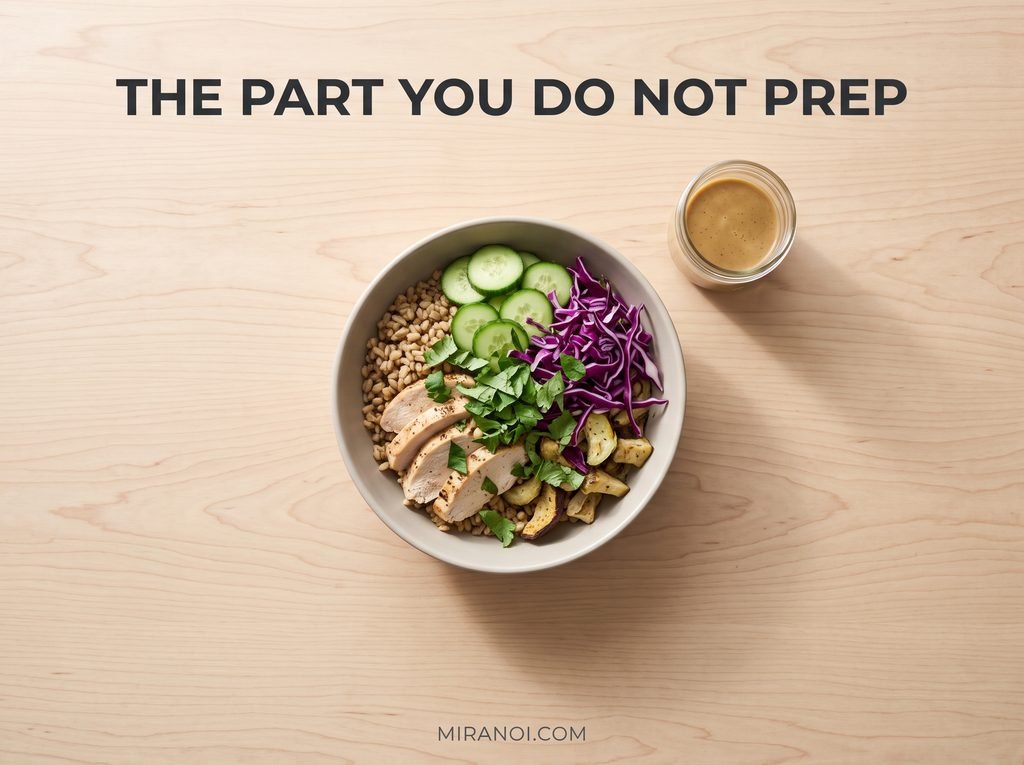
The fifth component is the only one that is deliberately not prepped, and that is the entire point of it. It takes sixty seconds at the moment of eating, it is the one thing on the plate that is cold, sharp and loud, and it is what makes Wednesday’s bowl taste like a different meal rather than a third serving of the same one.
Everything that goes into a container on Sunday arrives on Wednesday softer than it left. Fiber breaks down, moisture migrates, roasted edges go limp, grains absorb dressing. That process is not reversible by reheating and it is not solved by recombining.
A handful of sliced cucumber is. So are toasted seeds, shredded raw cabbage, a few torn herbs, or a spoonful of quick-pickled red onion — which takes five minutes on Sunday and lasts two weeks.
Monday: Five Clocks, Not One
The original’s storage table treats Sunday as a single starting gun. It does not have to be.
| Item | Refrigerator | One correction |
|---|---|---|
| Cooked chicken, turkey, beef | 3–4 days | — |
| Cooked grains (rice, quinoa, pasta) | 2 days | The original said 3–4. See below |
| Roasted vegetables | 3–4 days | — |
| Cooked legumes | 3–4 days | — |
| Hard-boiled eggs, in shell | 1 week | — |
| Homemade dressings | 4–7 days | Dairy-based: 3–4 days |
| Quick-pickled vegetables | 2 weeks | New |
Why the grains figure changes. The original’s own food safety section explains it: rice, quinoa and pasta can carry Bacillus cereus, whose spores survive cooking and whose toxin is heat-stable. The FDA’s general leftovers guidance gives 3–4 days because it does not carve grains out as a separate category. Several other national food safety authorities do, and advise eating cooked rice within two days.
The article had the reasoning and the table did not reflect it. Two days for grains.
And this is where the component method’s real advantage shows up, which the original never claims. Because the components are separate, their clocks can be separate.
| Cook on | Component | Covers |
|---|---|---|
| Sunday | Protein, roasted vegetables, sauces, pickles | Monday to Thursday |
| Sunday | Grains, batch one | Monday and Tuesday |
| Tuesday evening | Grains, batch two | Wednesday and Thursday |
| Daily, at assembly | Crunch | That meal |
Cooking grains takes fifteen minutes of standing around, most of which is unattended. Doing it twice turns a three-day system into a four- or five-day one, and it is the only component that needs it.
Tuesday: The Sauce Was the Best Point in the Original
The original called the sauce “the component most people skip, even though it does the most to change how the meal tastes.” That is correct and under-sold.
| Sauce | Built on | What it does to the same bowl |
|---|---|---|
| Tahini–lemon | Sesame, acid | Makes it Mediterranean; thick, coats grains |
| Peanut–lime | Legume, acid, heat | Makes it Southeast Asian; adds protein and fat |
| Yogurt–herb | Dairy, acid | Makes it cool and fresh; shortest fridge life |
| Vinaigrette | Oil, acid, mustard | Makes it a salad; thin, so dress at the table |
| Ginger–tamari | Aromatics, salt | Makes it a stir-fry; watch the sodium |
Make two, not one. Two sauces across four days is the cheapest variety available in the whole system, and unlike recombining the components it actually changes what the food tastes like.
One addition the original did not make: dress at the table, never in the container. Grains absorb dressing and go heavy and slick within a day. The sauce goes in a separate small jar.
Wednesday: The Day the Method Is Actually Tested
This is the day people stop, and now you know what to bring to it.
| The problem on Wednesday | What fixes it |
|---|---|
| Everything is soft | Raw crunch, added at the plate |
| Everything tastes the same | The second sauce |
| Everything is the same temperature | Heat one component properly, leave another cold |
| The grains are two days old | The Tuesday-evening second batch |
| Nothing is sharp | Acid at the table — lemon, vinegar, pickle |
| You are sick of looking at it | Eat it as a wrap instead of a bowl |
The last row is the original’s own insight and it still works. The rest of them are the things that were missing.
On temperature: a bowl where the protein is hot and the cabbage is cold reads as a cooked meal. A bowl where everything is the same lukewarm reads as leftovers, which is what most reheated prep actually is.
Reheat to 165°F throughout, and stir halfway through microwaving. The original was right about this and almost nobody does the stirring.
Thursday: Freeze It or Lose It
| Freezes well | Freezes badly |
|---|---|
| Cooked grains (1–2 months) | Raw salad vegetables — cucumber, lettuce |
| Cooked legumes (2–3 months) | Cooked potato — goes grainy |
| Cooked meat (2–6 months) | Dairy or yogurt-based sauces — they split |
| Roasted root vegetables (10–12 months) | Mayonnaise-based dressings |
| Soups and stews | Hard-boiled eggs — rubbery |
| Most oil-based sauces | Anything whose appeal is crispness |
The original’s rule was right: anything meant for day four or later should be frozen on day one, not on day three. Freezing something on Wednesday because it is about to go off freezes food that is already three days old.
Thaw in the refrigerator overnight, never on the counter.
The Citation to Remove
The original cites “Cornell research suggesting the average person makes over 200 food-related decisions daily.”
That figure comes from the lab of Brian Wansink, whose work should not be cited. In 2018 a Cornell faculty committee found that he “committed academic misconduct in his research and scholarship” — specifically misreporting research data, problematic statistical techniques, failure to properly document and preserve research results, and inappropriate authorship. The dean of the faculty upheld the findings. He announced his retirement effective June 2019. Thirteen of his papers have been retracted, one of them twice, and at least fifteen more corrected.
The specific 2007 paper that produced the 200-decisions figure does not appear among the retracted ones, so this is not a claim that the number is fabricated. It is a claim that a finding from a lab with that record should not be load-bearing in anything, and that a widely repeated round number from it is exactly the kind of statistic that gets repeated because it is memorable rather than because it is solid.
The argument it was supporting — that reducing daily decisions makes healthy eating easier — does not need it. That point stands on its own, and this article makes it without a number attached.
Worth checking the rest of the site for the same figure. It circulates widely in nutrition and habit-formation writing, and it is the sort of thing that appears in several articles once it appears in one.
What Actually Goes Wrong for Beginners
The original’s diagnosis here was good and this adds one line to each.
Prepping five days when three is the limit. Correct, and now with a reason: at 3–4 days refrigerated and two days for grains, a Sunday session genuinely cannot reach Friday without the freezer or a midweek top-up.
Sessions stretching to three or four hours. Correct. A four-hour session is not a bigger version of a one-hour session, it is a sign of prepping too far ahead, and the extra three hours produce food that will be thrown away.
Cooling large batches on the counter. Correct, and the fix is thinner, not faster. Shallow containers, spread grains, uncovered. The FDA’s methods list is shallow containers, smaller portions, ice-water baths and heat-conducting containers — all of them about surface area rather than speed.
And the one the original missed: buying containers before cooking anything. Equipment is the most popular way to start a habit without starting it. Use what you own for three weeks. If you are still doing it, then buy containers.
Common Mistakes
Prepping complete meals instead of components. The original’s core point and still the right one.
Treating Sunday as a single clock. Grains run out first. Cook them twice.
Giving cooked grains the same shelf life as cooked chicken. Two days, not four.
Sealing warm food into containers. Leave it uncovered until it is cold. You have six hours.
Skipping the sauce. It is the component that changes the most and costs the least.
Dressing the container instead of the plate. Grains absorb dressing and go heavy within a day.
Prepping nothing raw. The crunch is the fifth component and it is the one that makes Wednesday survivable.
Freezing on day three instead of day one. You freeze old food and thaw old food.
Buying equipment first. Use what you own.
Practical Tips
Prep four things, assemble five. The fifth is raw and takes a minute.
Make two sauces, never one. Put them in separate jars and dress at the table.
Quick-pickle a red onion on Sunday — thin slices, vinegar, a pinch of sugar, ten minutes. It keeps two weeks and it rescues more meals than anything else on the list.
Cook the grains twice: Sunday and Tuesday evening. It is fifteen mostly unattended minutes and it adds two days to the system.
Spread everything thin, leave it uncovered, and pack it when it is cold. Set a timer for ninety minutes and do something else.
Label with the day you cooked, not the day you packed.
Reheat one component properly and leave another cold. Temperature contrast does more than ingredient variety.
Start with three days and one meal a day. Expand only after three weeks of actually eating it.
Our six healthy lunch recipes for work cover what happens to this food after it leaves the house, our high-protein vegetarian meals are mostly component dishes already, and our high-protein recipes in 30 minutes give you proteins worth batching.
When Should You See a Doctor?
See a doctor for vomiting or diarrhoea that lasts more than two days, or for signs of dehydration — very little urine, dizziness on standing, a dry mouth that drinking does not fix.
Seek care promptly for a fever above 102°F (38.9°C) with vomiting or diarrhoea, blood in the stool, or diarrhoea lasting beyond three days.
Do not wait if you are pregnant, over 65, under 5, or immunocompromised. Foodborne illness is managed differently and more urgently in these groups.
Note the timing if you do get ill. Nausea and vomiting one to six hours after eating reheated rice or pasta points to Bacillus cereus specifically, and it is worth telling a doctor what you ate and when you cooked it.
Frequently Asked Questions
How long does meal prep food actually last? Three to four days for cooked meat, legumes and roasted vegetables. Two days for cooked grains. One week for hard-boiled eggs in the shell. Anything beyond that should have been frozen on the day you cooked it.
Why do I need to cool rice quickly? Bacillus cereus spores survive cooking and produce a heat-stable toxin as the grain cools slowly. Reheating kills the bacteria and does nothing to the toxin. Spread it thin, leave it uncovered, refrigerate when cold.
How long should a beginner session take? About sixty minutes of work, covering three days of one meal a day. But the session is not over when the work is — the food needs ninety minutes or so uncovered before it is packed, and you do not have to be in the room for that.
Do I need special containers? No. Use what you own for three weeks. If the habit survives, buy containers then.
Why does my prep taste boring by Wednesday even when I change the combination? Because the texture has not changed. Everything you prepped was cooked and chilled. Add something raw and sharp at the plate — cucumber, cabbage, toasted seeds, pickled onion — and a second sauce.
The Bottom Line: Count What You Threw Away
There is one honest measure of whether a meal prep system is working, and almost nobody uses it.
Not how long the session took. Not how many containers came out of it. Not whether you hit your macros on Monday. How much of it went in the bin.
A perfect two-hour session that produces six containers and sees four of them eaten has failed, and it has failed expensively — in money, in food, and in the specific discouragement of opening a fridge on Thursday and throwing out Sunday. A modest forty-minute session that produces three containers and sees three eaten has worked completely.
So for the first month, keep a tally on the fridge door. One mark for every container eaten, one for every one binned. It will tell you within three weeks whether you are prepping too much, prepping too far ahead, or prepping food you do not actually want to eat on day three — and those are three different problems with three different fixes, none of which you can diagnose from how the session felt.
Prep less than you think. Add something raw. Cook the grains twice. Count the bin.
This article is for general informational purposes and is not a substitute for professional medical advice. Food safety guidance here follows FDA and USDA recommendations; if you think you have food poisoning, speak to a healthcare provider.
References
- U.S. Food and Drug Administration. Cooling Cooked Time/Temperature Control for Safety Food. (Two-stage cooling requirements.)
- U.S. Food and Drug Administration. Refrigerator and Freezer Storage Chart.
- U.S. Department of Agriculture, Food Safety and Inspection Service. Safe Food Handling and Preparation.
- New Zealand Ministry for Primary Industries. Bacillus cereus bacteria in rice and other starchy food.
- Retraction Watch (2018). Cornell finds that food marketing researcher Brian Wansink committed misconduct, as he announces retirement.