Third-party tested supplements sound like a guarantee, and most people assume supplements in general are regulated like medications — tested for safety and effectiveness before reaching shelves.
They aren't. Under the 1994 Dietary Supplement Health and Education Act (DSHEA), manufacturers do not have to prove a supplement is safe or effective before selling it.
Which means the quality filter isn’t the government. It’s you — and there are specific, verifiable things to look for.
Quick Fact: The phrase “third-party tested” is completely unregulated. Any brand can print it on a label without ever submitting to a recognized program. The claim means nothing without a specific certification mark you can verify independently.
The Three Certifications That Actually Mean Something
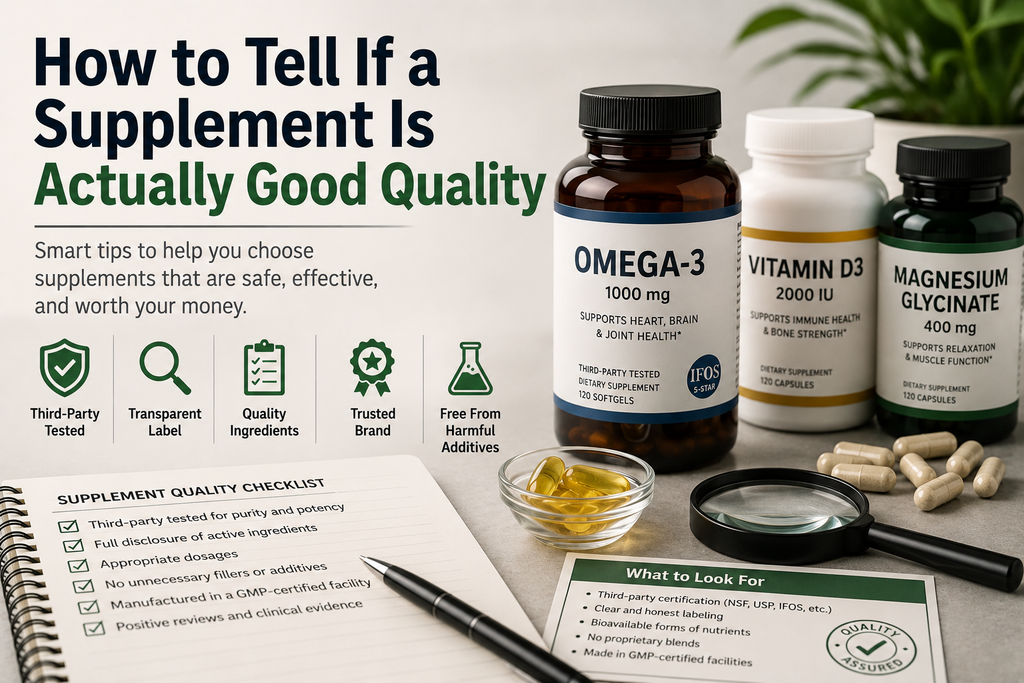
There’s only one published standard for third-party certification (NSF/ANSI 173), which means not every organization claiming to certify supplements meets a consistent bar. Three programs are consistently recognized as rigorous:
USP Verified. Run by the United States Pharmacopeia, a 200-year-old scientific nonprofit that also sets standards for pharmaceuticals. USP tests for identity, potency, purity, and dissolution — that last one meaning whether the pill actually breaks down in your digestive tract rather than passing through intact. This is the most relevant certification for general consumers.
NSF Certified for Sport. The most rigorous program available. Every batch is tested for 270+ banned substances, label accuracy is verified, and manufacturing facilities are audited annually. Required by the NFL, MLB, NHL, and PGA Tour. Essential for anyone in drug-tested competition, and a strong quality signal for everyone else.
Informed Sport / Informed Choice. Includes laboratory analysis and routine re-testing for contaminants and banned substances. Informed Sport tests every batch; Informed Choice tests on a monthly basis.
Quick Reference: What Each Certification Covers
| Certification | Tests For | Best For |
|---|---|---|
| USP Verified | Identity, potency, purity, dissolution | General consumers |
| NSF Certified for Sport | 270+ banned substances, label accuracy, facility audits | Athletes, highest assurance |
| Informed Sport | Banned substances, contaminants, every batch | Competitive athletes |
| Informed Choice | Banned substances, monthly testing | Recreational athletes |
| “Third-party tested” (no mark) | Unverifiable | Nothing — the term is unregulated |
The Critical Distinction Most People Miss
A certification seal verifies that what’s in the bottle matches the label and that it isn’t contaminated.
It does not verify that:
- The supplement works for your goal
- The dose is clinically effective
- The product is FDA approved
- The formula is well-designed
- You need it at all
This distinction matters most in categories where marketing is heaviest: weight loss, “metabolism” blends, sports performance, and sexual health. A product can be immaculately manufactured, accurately labeled, contaminant-free — and still contain an ingredient with no meaningful evidence behind it at a dose that does nothing.
The seal answers “is this what it says it is?” It doesn’t answer “should I take this?”
A Practical Three-Tier System
Certification coverage varies enormously by category. Basic vitamins and minerals have broad certified options; niche or newer supplements frequently have none. A tiered approach handles that reality:
Tier 1 — prioritize. Products carrying USP, NSF, or Informed Sport certification. Highest assurance of label accuracy and purity.
Tier 2 — acceptable with due diligence. Uncertified products from large, established manufacturers with a quality track record, made in cGMP-certified facilities (FDA registration 21 CFR Part 111), in countries with strong pharmaceutical manufacturing standards. Not verified, but produced to higher baseline standards than unknown internet products.
Tier 3 — heightened caution. No third-party testing, unknown manufacturer, high-risk category (weight loss, sexual performance, muscle building), or priced significantly below comparable certified products.
That last signal is worth weighing. Certification and quality raw materials cost money. A product dramatically cheaper than certified equivalents in the same category is worth questioning rather than treating as a bargain.
How to Verify a Seal Is Real
Printed logos can be copied. All three major programs maintain public, searchable databases of certified products on their own websites.
If a brand claims certification, the product should appear in the certifying organization’s database — not just on the label. Checking takes under a minute and is the single most useful verification step available to a consumer.
If it isn’t listed, the claim isn’t verified.
Reading a Supplement Label Critically
Beyond certification, several label features carry real information:
“Proprietary blend.” This is the most important red flag on any label. It allows a manufacturer to list ingredients without disclosing individual amounts. You know what’s in it, not how much — which means you can’t assess whether any ingredient is at an effective dose. Frequently, expensive ingredients appear in trace quantities behind this wording.
Ingredient form. Different forms of the same nutrient absorb differently — magnesium citrate versus oxide, folate versus folic acid, methylcobalamin versus cyanocobalamin. A label listing the specific form signals more care than one simply saying “magnesium.”
Absence of testing information. Quality manufacturers generally state their testing and manufacturing standards somewhere. Total silence on the topic is itself informative.
Expiration and lot number. Basic, but their absence indicates loose manufacturing control.
Quick Reference: Label Red Flags
| Red Flag | Why It Matters |
|---|---|
| “Proprietary blend” | Hides individual ingredient amounts |
| No certification mark | Can’t verify contents or purity |
| Disease treatment claims | Illegal under DSHEA — signals disregard for regulation |
| Price far below certified competitors | Certification and quality inputs cost money |
| No lot number or expiration date | Indicates weak manufacturing control |
| Vague sourcing (“herbal complex”) | Species and part of plant matter enormously |
What People Actually Run Into
The most common frustration is discovering that the supplement they specifically want has no certified option.
This is genuinely common. Vitamin D, magnesium, and fish oil have plenty of certified products. Newer or niche supplements often have none, because certification is voluntary and expensive, and smaller manufacturers frequently skip it. This is exactly the gap the Tier 2 approach fills — an established manufacturer in a cGMP facility isn’t verified, but it isn’t the same risk category as an unknown brand either.
The second pattern: people assume a high price signals quality. It sometimes correlates, but plenty of expensive supplements carry no certification while some modestly priced ones do. Price is a weaker signal than the seal.
Third, and most consequential: people put substantial effort into choosing a high-quality version of a supplement they don’t have a documented need for. Buying a USP-verified product is a good decision made after the more important one — whether the supplement is warranted at all. Certification improves the quality of the answer, not the question.
Common Mistakes
Trusting “third-party tested” without a specific mark. The phrase is unregulated. Look for USP, NSF, or Informed Sport specifically.
Assuming certification means it works. Seals verify contents and purity, not clinical effectiveness or appropriate dosing.
Ignoring proprietary blends. If amounts aren’t disclosed, you cannot evaluate whether the product does anything.
Not checking the certifier’s database. Logos can be printed by anyone. Verification takes a minute.
Buying based on price alone in either direction. Cheap doesn’t guarantee poor quality, and expensive doesn’t guarantee good.
Ignoring the form of the nutrient. Absorption differs meaningfully between forms of the same mineral or vitamin.
Optimizing quality before establishing need. The best-verified supplement is still unnecessary if you don’t have a gap it addresses.
Practical Tips
- Check the certifier’s online database before buying, not the label — it takes under a minute.
- Default to USP Verified for general supplements; NSF Certified for Sport if you compete in drug-tested sport.
- Treat “proprietary blend” as a reason to choose a different product, not a mystery to solve.
- If no certified option exists in your category, apply Tier 2 criteria: established manufacturer, cGMP facility, transparent labeling.
- Establish whether you need the supplement first — ideally through testing or a provider conversation — then optimize for quality.
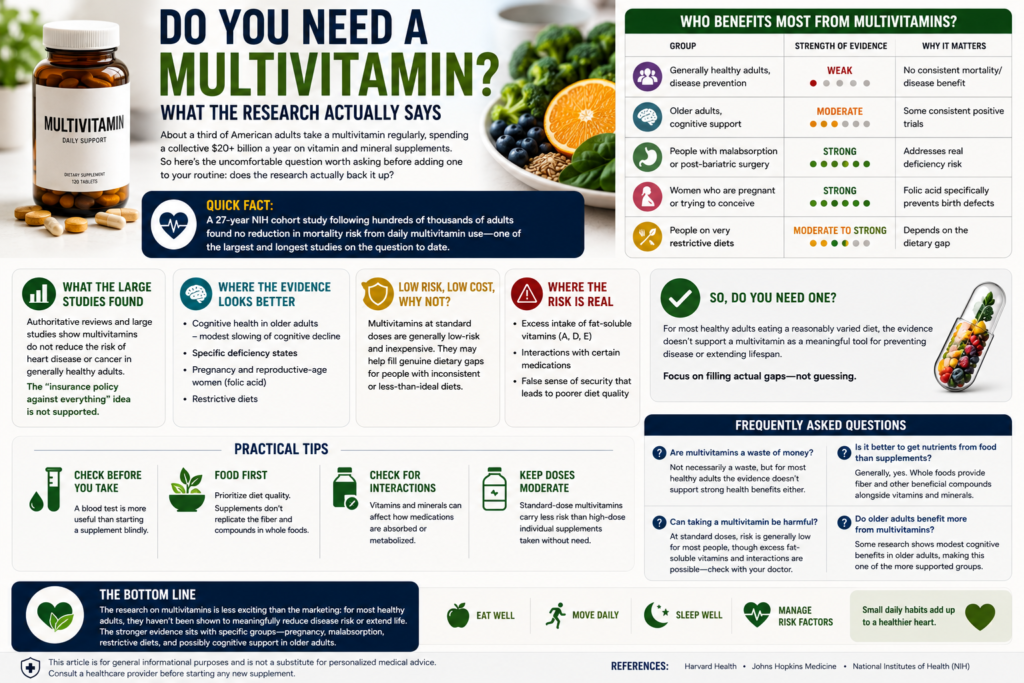
If you’re evaluating specific supplements, it’s worth pairing this with our guides on supplement interactions and do you need a multivitamin, since safety and necessity both matter alongside quality.
When Should You See a Doctor?
Talk to a doctor or pharmacist before starting any supplement if you take prescription medication, are pregnant or breastfeeding, or have a chronic condition. Bring the actual bottle or a photo of the label — the specific form and dose matter, and generic descriptions often omit both.
Seek prompt medical attention for unexpected symptoms after starting a new supplement, particularly unusual bruising or bleeding, rapid heartbeat, or signs of liver problems such as yellowing skin or dark urine. Report suspected adverse reactions to your provider, since supplement safety monitoring largely depends on post-market reporting.
Frequently Asked Questions
Are supplements regulated by the FDA? Not before sale. Under DSHEA, manufacturers don’t have to prove safety or effectiveness beforehand — the FDA can act only after a product is on the market and shown to be problematic.
What’s the difference between USP and NSF certification? USP focuses on pharmaceutical-grade quality — identity, potency, purity, and dissolution — making it well-suited to general consumers. NSF Certified for Sport additionally screens every batch for 270+ banned substances, which matters for competitive athletes.
Does “third-party tested” on a label mean anything? Not by itself. The term is unregulated and any brand can use it. Only a specific, verifiable certification mark carries weight.
Why should I avoid proprietary blends? Because they disclose ingredients without amounts, making it impossible to know whether any component is present at an effective dose — or merely a trace amount for label appeal.
Does third-party certification mean a supplement is safe for me personally? No. It confirms the contents match the label and aren’t contaminated. It doesn’t account for your medications, conditions, or whether you need the supplement at all.
The Bottom Line
The supplement aisle operates on an assumption of oversight that doesn’t exist. What replaces it is a verifiable seal — USP, NSF Certified for Sport, or Informed Sport — checked against the certifier’s own database rather than trusted from the label. But keep the boundary clear: certification tells you the bottle contains what it claims. Whether you should be taking it in the first place is a separate question, and a more important one.
This article is for general informational purposes and is not a substitute for personalized medical advice. Consult a healthcare provider or pharmacist before starting any supplement, particularly if you take medication or have a health condition.
References
- Operation Supplement Safety (Uniformed Services University) — Why Third-Party Certification Is Important
- U.S. Pharmacopeia (USP) — Dietary Supplement Verification Program
- NSF — Certified for Sport Program