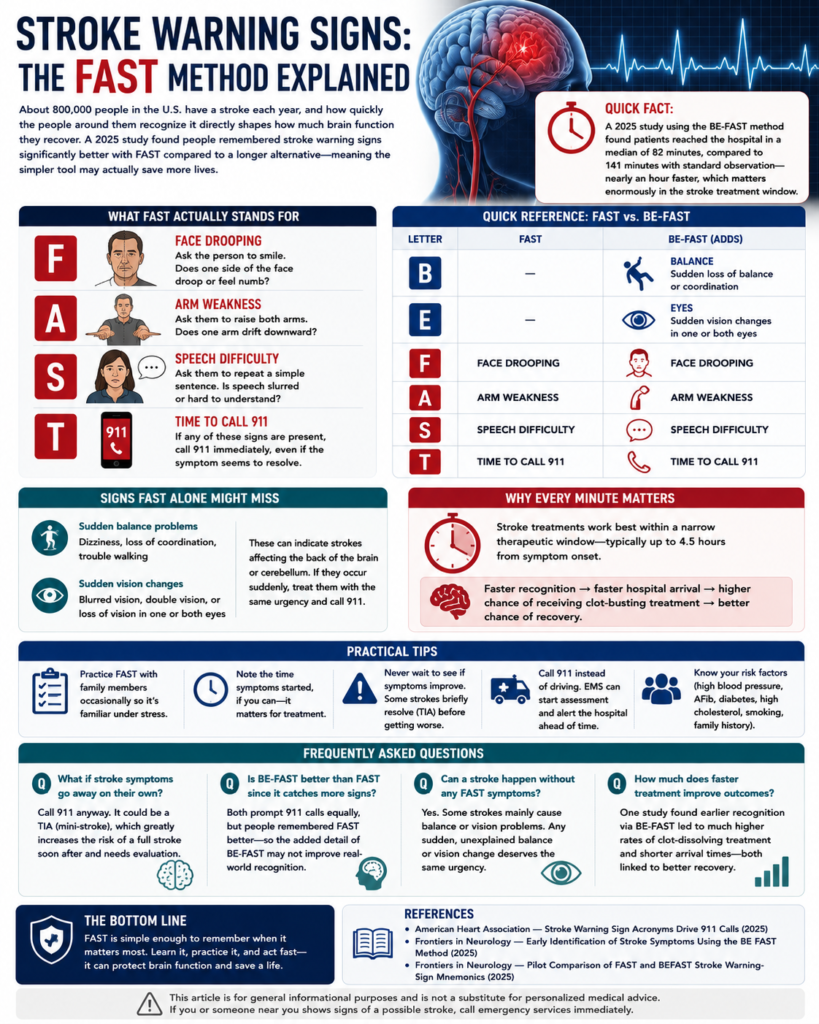
About 800,000 people in the U.S. have a stroke each year, and how quickly the people around them recognize it directly shapes how much brain function they recover. A 2025 study found something practically useful: people remembered stroke warning signs significantly better when taught the FAST acronym compared to a newer, more comprehensive alternative — meaning the simpler tool may actually save more lives specifically because it’s easier to recall in a crisis.
Quick Fact: A 2025 study using the BE-FAST method found patients assessed with it reached the hospital in a median of 82 minutes, compared to 141 minutes for those evaluated through standard observation — nearly an hour faster, which matters enormously given stroke treatment’s narrow window.
What FAST Actually Stands For
FAST has been the American Heart Association’s official public stroke education message since 2013, built on a validated clinical tool called the Cincinnati Prehospital Stroke Scale:
- F — Face drooping. Ask the person to smile. Does one side of the face droop or feel numb?
- A — Arm weakness. Ask them to raise both arms. Does one arm drift downward?
- S — Speech difficulty. Ask them to repeat a simple sentence. Is speech slurred or hard to understand?
- T — Time to call emergency services. If any of these signs are present, call 911 immediately, even if the symptom seems to resolve.
Why FAST Specifically (Not a Longer List)
Researchers have proposed more comprehensive alternatives — most notably BE-FAST, which adds Balance and Eyes to catch strokes affecting coordination or vision that FAST alone might miss. A 2025 randomized study compared how well people remembered each: both acronyms were equally effective at prompting people to call 911, but participants recalled the core signs significantly better with FAST than with BE-FAST. In an emergency, a shorter list you can actually remember may outperform a more complete one you can’t.
Quick Reference: FAST vs. BE-FAST
| Letter | FAST | BE-FAST (adds) |
|---|---|---|
| B | — | Balance — sudden loss of balance or coordination |
| E | — | Eyes — sudden vision changes in one or both eyes |
| F | Face drooping | Face drooping |
| A | Arm weakness | Arm weakness |
| S | Speech difficulty | Speech difficulty |
| T | Time to call 911 | Time to call 911 |
Signs FAST Alone Might Miss
This is genuinely worth knowing even if FAST remains easier to remember: BE-FAST’s added signs — sudden balance problems and sudden vision changes — can indicate strokes affecting the back of the brain or cerebellum, which don’t always produce the classic face, arm, or speech symptoms. If you notice sudden dizziness, loss of coordination, or vision changes without any of the FAST signs, treat it with the same urgency and call emergency services rather than waiting to see if a more “classic” symptom appears.
Why Every Minute Matters
Stroke treatment operates within a narrow therapeutic window — commonly cited as around 4.5 hours from symptom onset for certain treatments — after which the ability to reverse damage drops sharply. The research is direct on this point: faster recognition and hospital arrival is associated with higher rates of clot-dissolving treatment and better neurological outcomes. This is why “call emergency services immediately” isn’t cautious advice — it’s the single highest-impact action available once symptoms appear.
Practical Tips
- Practice the FAST test with family members occasionally so it’s familiar under stress, not something you’re learning for the first time during an emergency.
- Note the time symptoms started, if you can — this information directly affects which treatments are available once you reach the hospital.
- Never wait to see if symptoms improve before calling emergency services; some strokes have symptoms that briefly resolve (a warning sign called a TIA) before a more severe event.
- Call emergency services rather than driving the person yourself — paramedics can begin assessment and notify the hospital before arrival, saving additional time.
If you’re working on your broader cardiovascular risk, it’s worth pairing this with our guides on heart attack warning signs and heart disease prevention habits, since many of the same risk factors — high blood pressure, high cholesterol, diabetes — contribute to both stroke and heart attack risk.
When Should You See a Doctor?
This is a call-911 situation, not a see-your-doctor situation. If you or someone near you shows any FAST warning sign — face drooping, arm weakness, or speech difficulty — call emergency services immediately, even if symptoms seem to improve or resolve on their own. Outside of an acute event, talk to a doctor about your personal stroke risk if you have risk factors like high blood pressure, atrial fibrillation, diabetes, or a family history of stroke.
Frequently Asked Questions
What should I do if stroke symptoms go away on their own? Call emergency services anyway. Symptoms that resolve can indicate a transient ischemic attack (TIA), sometimes called a “mini-stroke,” which significantly raises the risk of a full stroke soon afterward and requires medical evaluation.
Is BE-FAST better than FAST since it catches more symptoms? Both were found equally effective at prompting people to call 911, but people remembered FAST’s core signs better in testing — meaning the added comprehensiveness of BE-FAST may not translate to better real-world recognition for most people.
Can a stroke happen without any FAST symptoms? Yes, some strokes primarily cause balance or vision problems that FAST doesn’t specifically capture, which is part of why sudden, unexplained balance or vision changes deserve the same urgency even without face, arm, or speech symptoms.
How much does faster treatment actually improve outcomes? Research shows meaningful differences — one study found earlier recognition using a comprehensive method was associated with significantly higher rates of clot-dissolving treatment and shorter time to hospital arrival, both linked to better neurological recovery.
The Bottom Line
FAST remains the go-to stroke recognition tool because it’s simple enough to remember under pressure, and remembering it correctly is directly linked to faster 911 calls and better outcomes. Learn it, practice it occasionally with people close to you, and treat any sudden balance or vision change with the same urgency even when it doesn’t fit the classic FAST pattern.
This article is for general informational purposes and is not a substitute for personalized medical advice. If you or someone near you shows signs of a possible stroke, call emergency services immediately.
References
- American Heart Association — Stroke Warning Sign Acronyms Drive 911 Calls (2025)
- Frontiers in Neurology — Early Identification of Stroke Symptoms Using the BE FAST Method (2025)
- Frontiers in Neurology — Pilot Comparison of FAST and BEFAST Stroke Warning-Sign Mnemonics (2025)