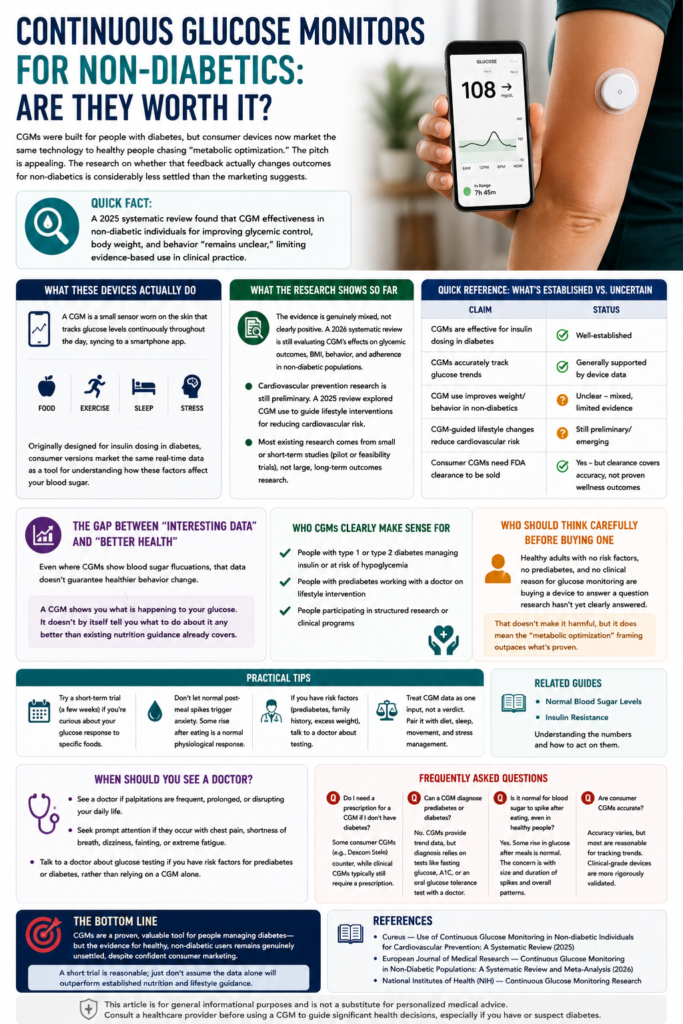
Continuous glucose monitors for non-diabetics are one of the hottest wellness trends right now. Originally built for people with diabetes, a wave of consumer devices — Dexcom Stelo, Abbott Lingo — now market the same technology to healthy people chasing “metabolic optimization.” chasing “metabolic optimization.” The pitch is appealing: real-time feedback on how your body responds to food. The research on whether that feedback actually changes outcomes for non-diabetics is considerably less settled than the marketing suggests.
Quick Fact: A 2025 systematic review found that CGM effectiveness in non-diabetic individuals for improving glycemic control, body weight, and behavior “remains unclear,” limiting evidence-based use in clinical practice — a notably cautious conclusion for a product now sold directly to consumers without a prescription.
What These Devices Actually Do
A CGM is a small sensor worn on the skin that tracks glucose levels continuously throughout the day, syncing to a smartphone app. Originally designed for insulin dosing decisions in diabetes, consumer versions market the same real-time data as a tool for understanding how specific foods, meals, exercise, sleep, and stress affect your blood sugar — with the implicit promise that this awareness translates into better health choices.
What the Research Actually Shows So Far
The evidence is genuinely mixed, not clearly positive. A systematic review and meta-analysis published in early 2026 set out specifically to evaluate CGM’s effects on glycemic outcomes, BMI, dietary behavior, and adherence in non-diabetic populations — the fact that this remains an open research question, rather than settled science, is itself informative.
Cardiovascular prevention research is still preliminary. A separate 2025 systematic review explored CGM use specifically for guiding lifestyle interventions aimed at cardiovascular risk reduction in non-diabetic adults. This is an active, emerging research area rather than one with established, proven outcomes.
Most existing research comes from small or short-term studies. A number of trials are described in the literature as pilot or feasibility studies — useful for understanding whether an approach is plausible, but not the kind of large, long-term evidence needed to confirm CGMs meaningfully improve health outcomes for people without diabetes.
Quick Reference: What’s Established vs. Uncertain
| Claim | Status |
|---|---|
| CGMs are effective for insulin dosing in diabetes | Well-established |
| CGMs accurately track glucose trends | Generally supported by device data |
| CGM use improves weight/behavior in non-diabetics | Unclear — mixed, limited evidence |
| CGM-guided lifestyle changes reduce cardiovascular risk | Still preliminary/emerging |
| Consumer CGMs need FDA clearance to be sold | Yes — but clearance covers accuracy, not proven wellness outcomes |
The Gap Between “Interesting Data” and “Better Health”
Even where CGMs reliably show blood sugar fluctuations, that data alone doesn’t guarantee healthier behavior change. Seeing a spike after a bowl of rice is only useful if it leads to a sustained shift — and most of the strongest weight and metabolic health research still centers on established levers like diet quality, movement, sleep, and stress, not glucose monitoring itself. A CGM shows you what is happening to your glucose; it doesn’t by itself tell you what to do about it in a way better than existing nutrition guidance already covers.
Who CGMs Clearly Make Sense For
- People with type 1 or type 2 diabetes managing insulin or at risk of hypoglycemia
- People with prediabetes working closely with a doctor on lifestyle intervention, where a clinician can help interpret the data meaningfully
- People participating in structured research or clinical programs designed to test whether the feedback changes outcomes
Who Should Think Carefully Before Buying One
Healthy adults with no risk factors, no prediabetes, and no clinical reason for glucose monitoring are essentially buying a device to answer a question research hasn’t yet clearly answered: whether the data changes anything meaningful for someone who wasn’t going to have a blood sugar problem in the first place. That doesn’t make it harmful, but it does mean the “metabolic optimization” framing outpaces what’s currently proven.
What Consumer CGMs Actually Cost
Price is the question most buyers research first, and the subscription structure catches people off guard.
Consumer CGMs are sold as ongoing subscriptions, not one-time purchases. Sensors typically last 14-15 days, meaning roughly two sensors per month, indefinitely, for as long as you wear one. Costs commonly land in the range of $89-$180 per month depending on the brand and whether you buy month-to-month or prepay.
Over a year, that puts continuous use in the same spending range as a gym membership or a monthly medication copay — for a device whose benefit in non-diabetic users the research describes as unclear.
This is worth weighing honestly. A short trial to learn how specific foods affect you is a different financial proposition than indefinite subscription monitoring.
Quick Reference: Consumer CGM Landscape
| Feature | Typical Range |
|---|---|
| Sensor lifespan | 14–15 days |
| Sensors needed per month | ~2 |
| Monthly cost | ~$89–$180 |
| Prescription required | Not for OTC consumer versions |
| Warm-up period | ~1 hour after application |
| Data delay vs. blood glucose | ~5–15 minutes |
What a Normal Glucose Curve Actually Looks Like
This is where most first-time users get unnecessarily alarmed.
Seeing your glucose rise after eating is not a problem. It is the expected physiological response to food. In people without diabetes, glucose typically rises after a meal, peaks somewhere in the following hour, and returns toward baseline within two to three hours.
What matters is the pattern over time, not any single reading — how high the peak goes, how long it stays elevated, and whether the overall trend is stable.
Two things reliably confuse new users:
Sensor lag. CGMs measure glucose in interstitial fluid, not blood, which trails blood glucose by roughly 5-15 minutes. A reading during a rapid change won’t match a fingerstick taken at the same moment. Neither device is broken.
Compression lows. Lying on the sensor — particularly overnight — can restrict local blood flow and produce falsely low readings. A sudden nighttime drop that resolves when you roll over is usually this, not hypoglycemia.
Common Mistakes
Treating every post-meal rise as a problem. Glucose rising after food is normal physiology. The concern is magnitude and duration, not the existence of a rise.
Comparing CGM readings to a fingerstick and assuming one is wrong. They measure different fluids with a built-in time lag. Disagreement during rapid change is expected.
Panicking over a nighttime low. Compression lows from sleeping on the sensor are common and don’t indicate hypoglycemia.
Eliminating foods based on a single reading. Individual responses vary day to day depending on sleep, stress, activity, and meal composition. One data point isn’t a pattern.
Buying an indefinite subscription for a short-term question. If the goal is learning how a handful of foods affect you, a few weeks answers that. Ongoing monitoring is a different commitment.
Using CGM data to self-diagnose. These devices provide trend information. Diagnosis requires standardized testing interpreted by a doctor.
Practical Tips
- If you’re curious about your glucose response to specific foods, a short-term trial (a few weeks) is lower-commitment than assuming you need one indefinitely.
- Don’t let normal, expected post-meal glucose fluctuations trigger anxiety about food — some rise after eating is completely normal physiology, not a warning sign, even in healthy people.
- If you have real risk factors (family history, prediabetes, overweight with metabolic concerns), a conversation with a doctor about testing is likely more useful than a consumer wellness device alone.
- Treat CGM data as one input, not a verdict — pairing it with established guidance on diet, sleep, and activity matters more than the device itself.
If you’re evaluating your blood sugar more broadly, it’s worth pairing this with our guides on normal blood sugar levels and insulin resistance, since both cover what the numbers actually mean and how to act on them.
When Should You See a Doctor?
Talk to a doctor about glucose testing if you have risk factors for prediabetes or diabetes — family history, excess weight, sedentary lifestyle, or related symptoms — rather than relying on a consumer CGM alone to self-diagnose. If you already use a CGM and see readings that concern you, bring the data to a doctor for interpretation rather than making significant dietary changes based on self-reading alone.
Frequently Asked Questions
Do I need a prescription for a CGM if I don’t have diabetes? Some consumer CGMs (like Dexcom Stelo) are sold over-the-counter specifically for non-diabetic wellness use, while clinical-grade CGMs typically still require a prescription.
Can a CGM diagnose prediabetes or diabetes? No. CGMs provide trend data, but diagnosis relies on standardized tests like fasting glucose, A1C, or an oral glucose tolerance test interpreted by a doctor.
Is it normal for blood sugar to spike after eating, even in healthy people? Yes. Some rise in glucose after meals is a normal physiological response; the concern is with the size and duration of spikes and overall patterns over time, not any single fluctuation.
Are consumer CGMs accurate? Accuracy varies by device and is generally considered reasonable for tracking trends, though clinical-grade devices used for insulin dosing decisions undergo more rigorous validation than some consumer wellness versions.
The Bottom Line
Continuous glucose monitors are a proven, valuable tool for people managing diabetes — but the evidence for healthy, non-diabetic users remains genuinely unsettled, despite confident consumer marketing. If you’re curious, a short trial is reasonable; just don’t assume the data alone will outperform established nutrition and lifestyle guidance you could follow without the device.
This article is for general informational purposes and is not a substitute for personalized medical advice. Consult a healthcare provider before using a CGM to guide significant health decisions, especially if you have or suspect diabetes.
References
- Cureus — Use of Continuous Glucose Monitoring in Non-diabetic Individuals for Cardiovascular Prevention: A Systematic Review (2025)
- European Journal of Medical Research — Continuous Glucose Monitoring in Non-Diabetic Populations: A Systematic Review and Meta-Analysis (2026)
- National Institutes of Health (NIH) — Continuous Glucose Monitoring Research