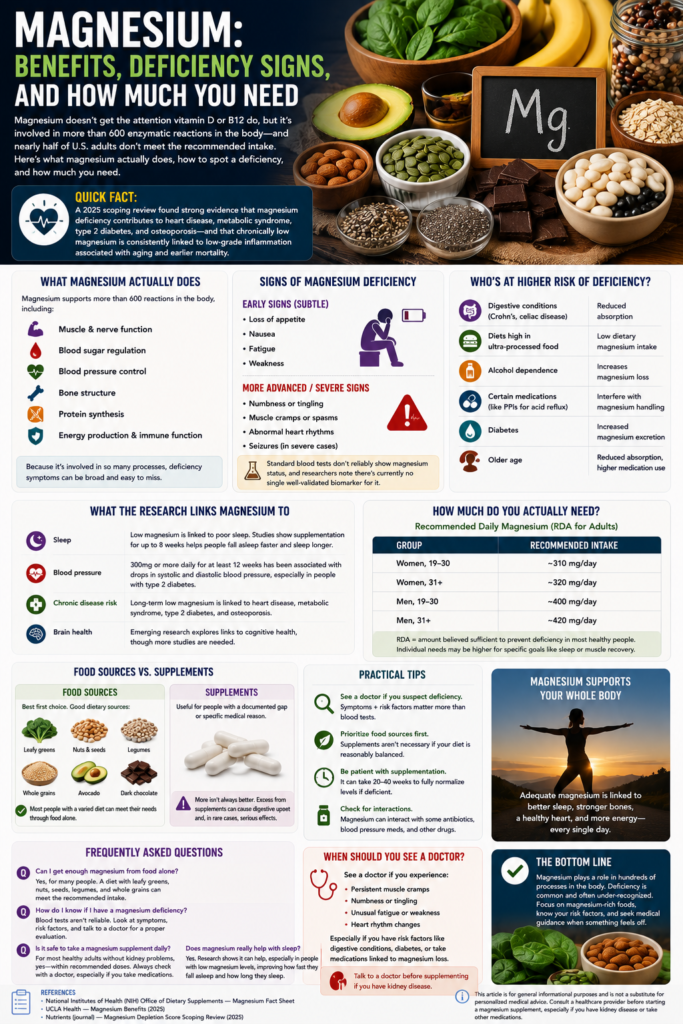
Magnesium benefits go far beyond what most people realize — it’s involved in more than 600 enzymatic reactions in the body, yet doesn’t get the attention vitamin D or B12 do. Nearly half of U.S. adults don’t meet the recommended intake, and a 2025 review even linked long-term magnesium depletion to increased risk of several chronic diseases and earlier mortality. — and nearly half of U.S. adults don’t meet the recommended intake. A 2025 review even linked long-term magnesium depletion to increased risk of several chronic diseases and earlier mortality. Here’s what magnesium actually does, how to spot a deficiency, and how much you need.
Quick Fact: A 2025 scoping review found strong evidence that magnesium deficiency contributes to heart disease, metabolic syndrome, type 2 diabetes, and osteoporosis — and that chronically low magnesium is consistently linked to low-grade inflammation associated with aging and earlier mortality.
What Magnesium Actually Does
Magnesium supports muscle and nerve function, blood sugar regulation, blood pressure control, bone structure, and protein synthesis. Because it’s involved in so many processes at once, deficiency symptoms can be broad and nonspecific — which is part of why low magnesium often goes unrecognized rather than being caught early.
Signs of Magnesium Deficiency
Early signs tend to be subtle and easy to attribute to something else: loss of appetite, nausea, fatigue, and general weakness. As deficiency progresses, more specific symptoms can appear — numbness or tingling, muscle cramps, and in more severe or prolonged cases, abnormal heart rhythms or seizures. Deficiency is genuinely difficult to detect through standard testing, since routine blood work doesn’t reliably capture magnesium status, and researchers note there’s currently no single well-validated biomarker for it.
Quick Reference: Who’s at Higher Risk of Deficiency
| Risk Factor | Why |
|---|---|
| Digestive conditions (Crohn’s, celiac disease) | Reduced absorption |
| Diets high in ultra-processed food | Low dietary magnesium intake |
| Alcohol dependence | Increases magnesium loss |
| Certain medications (like PPIs for acid reflux) | Interfere with magnesium handling |
| Diabetes | Increased magnesium excretion |
| Older age | Reduced absorption, higher medication use |
What the Research Links Magnesium To
Sleep. People with low magnesium levels are more likely to have trouble falling or staying asleep. In one review, older adults supplementing with magnesium for up to 8 weeks fell asleep faster and slept longer compared to a placebo group.
Blood pressure. A review of multiple studies found that supplementing 300mg or more of magnesium daily for at least 12 weeks was associated with measurable drops in both systolic and diastolic blood pressure in people with type 2 diabetes.
Chronic disease risk. Beyond individual symptoms, sustained low magnesium status has been linked to cardiovascular disease, metabolic syndrome, and osteoporosis in cohort research, though establishing a precise cause-and-effect relationship remains an active area of study.
Brain health. Emerging research is exploring connections between magnesium status and cognitive health, though this area is still developing compared to the more established links above.
How Much Do You Actually Need?
Quick Reference: Recommended Daily Magnesium (Adults)
| Group | Recommended Intake |
|---|---|
| Women, 19–30 | ~310 mg/day |
| Women, 31+ | ~320 mg/day |
| Men, 19–30 | ~400 mg/day |
| Men, 31+ | ~420 mg/day |
These figures represent the RDA — the amount believed sufficient to prevent deficiency in most healthy people. As one dietitian has noted, the RDA doesn’t necessarily reflect what might support more targeted goals like sleep quality or muscle recovery, which is part of why individual needs can reasonably vary above the baseline recommendation.
Food Sources vs. Supplements
Magnesium-rich foods include leafy greens, nuts and seeds, legumes, whole grains, and dairy. Most people who eat a varied diet with these foods regularly can meet their needs through food alone. If you’re not experiencing symptoms of deficiency and eat a reasonably balanced diet, a supplement generally isn’t necessary — magnesium is one of the nutrients where “more” isn’t automatically better, since excess intake from supplements (not food) can cause digestive upset and, in rare cases, more serious effects.
Practical Tips
- If you suspect a deficiency based on symptoms, see a doctor rather than self-diagnosing — standard blood tests don’t reliably capture magnesium status, so a clinical evaluation matters more than guessing.
- Prioritize food sources first; supplements are more useful for people with a documented gap or a specific medical reason.
- If you do supplement, expect it to take weeks (commonly cited as 20-40 weeks for a true deficiency) to fully normalize levels — this isn’t a same-day fix.
- Check with a doctor or pharmacist before supplementing if you take medications, since magnesium can interact with certain drugs, including some antibiotics and blood pressure medications.
If you’re evaluating your overall nutrient intake, it’s worth pairing this with our guides on the signs of vitamin D deficiency and do you need a multivitamin, since magnesium is one of several nutrients worth evaluating individually rather than assuming a general supplement covers it adequately.
When Should You See a Doctor?
See a doctor if you experience symptoms like persistent muscle cramps, numbness or tingling, unusual fatigue, or heart rhythm changes, especially if you have a risk factor like a digestive condition, diabetes, or regular use of medications linked to magnesium loss. Also check in before starting a magnesium supplement if you have kidney disease, since impaired kidney function affects how the body handles magnesium and increases the risk of it building up to unsafe levels.
For another nutrient worth evaluating, our guide on omega-3 fatty acids covers the research on fish oil supplements versus eating fish directly.
Frequently Asked Questions
Can I get enough magnesium from food alone? For many people, yes — a diet regularly including leafy greens, nuts, seeds, legumes, and whole grains can meet the recommended intake without supplementation.
How do I know if I have a magnesium deficiency? Standard blood tests don’t reliably detect magnesium status, so a combination of symptoms and risk factors, evaluated with a doctor, is more useful than trying to self-diagnose from a lab test alone.
Is it safe to take a magnesium supplement daily? For most healthy adults without kidney problems, magnesium supplements within recommended dosage ranges are generally considered safe, though it’s worth checking with a doctor first, especially if you take other medications.
Does magnesium really help with sleep? Research suggests it can help, particularly in people with low magnesium levels — several studies have found supplementation improved how quickly people fell asleep and how long they slept.
If you’re evaluating other nutrients too, our guide on vitamin B12 deficiency covers the signs, causes, and who’s most at risk.
The Bottom Line
Magnesium plays a role in hundreds of processes in the body, yet deficiency is common and frequently under-recognized because standard testing doesn’t reliably catch it. Prioritizing magnesium-rich foods, watching for risk factors and subtle symptoms, and talking to a doctor about testing or supplementation when something feels off remains the most reliable approach.
This article is for general informational purposes and is not a substitute for personalized medical advice. Consult a healthcare provider before starting a magnesium supplement, especially if you have kidney disease or take other medications.
References
- National Institutes of Health (NIH) Office of Dietary Supplements — Magnesium Fact Sheet
- UCLA Health — Magnesium Benefits (2025)
- Nutrients (journal) — Magnesium Depletion Score Scoping Review (2025)