Intermittent fasting weight loss claims have been some of the most talked-about in nutrition for years, and the research has genuinely shifted more than once., and the research on it has genuinely shifted more than once. A major 2025 Harvard-affiliated study found it can work as well as calorie counting. A 2026 Cochrane review — widely considered a gold standard for evidence synthesis — found it doesn’t clearly outperform standard dieting at all. Both are real, recent findings. Here’s how to make sense of that.
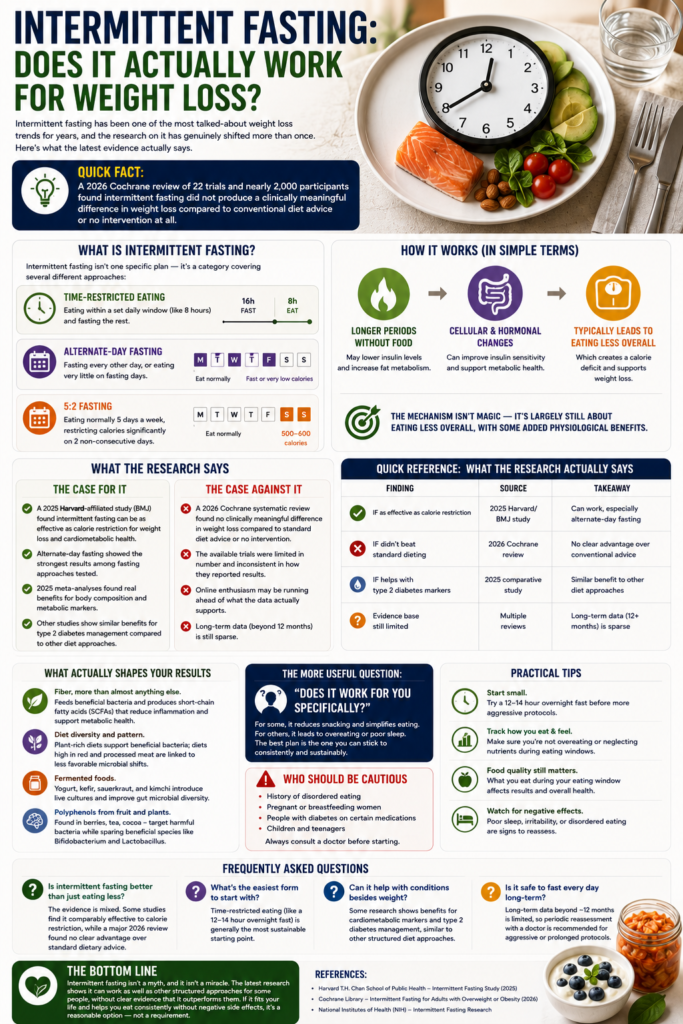
Quick Fact: A 2026 Cochrane review of 22 trials and nearly 2,000 participants found intermittent fasting did not produce a clinically meaningful difference in weight loss compared to conventional diet advice or no intervention at all.
What Intermittent Fasting Actually Is
Intermittent fasting isn’t one specific plan — it’s a category covering several different approaches:
- Time-restricted eating — eating within a set daily window (like 8 hours) and fasting the rest
- Alternate-day fasting — fasting every other day, or eating very little on fasting days
- 5:2 fasting — eating normally 5 days a week, restricting calories significantly on 2 non-consecutive days
The mechanism, when it works, isn’t magic — it’s largely still about eating less overall, alongside some effects on fat metabolism and insulin sensitivity from extended periods without food.
The Case For It
A 2025 study co-authored by Harvard T.H. Chan School of Public Health researchers, published in The BMJ, found intermittent fasting diets may be as effective as traditional calorie-restricted diets for weight loss and cardiometabolic health — with alternate-day fasting showing the strongest results among the fasting approaches tested. Other 2025 meta-analyses examining body composition in overweight and obese adults have found real, measurable benefits from various fasting protocols.
The Case Against It
A 2026 Cochrane systematic review — an organization known for particularly rigorous evidence standards — reached a more skeptical conclusion: when compared with conventional diet advice or no structured intervention, intermittent fasting didn’t produce a clinically meaningful difference in weight loss for overweight or obese adults specifically. The review’s lead author noted that online enthusiasm for fasting may be running ahead of what the data actually supports, and flagged that the available trials were limited in number and inconsistent in how they reported results.
Quick Reference: What the Research Actually Says
| Finding | Source | Takeaway |
|---|---|---|
| IF as effective as calorie restriction | 2025 Harvard/BMJ study | Can work, especially alternate-day fasting |
| IF didn’t beat standard dieting | 2026 Cochrane review | No clear advantage over conventional advice |
| IF helps with type 2 diabetes markers | 2025 comparative study | Similar benefit to other diet approaches |
| Evidence base still limited | Multiple reviews | Long-term data (12+ months) is sparse |
How Two “Correct” Studies Can Disagree
This isn’t really a contradiction so much as a reflection of how fasting studies are designed and measured. Some trials compare fasting against calorie counting (where both groups are actively trying to lose weight); others compare fasting against no specific intervention or general advice. The “does it work” answer shifts depending on what it’s being compared to — and individual studies vary widely in duration, population, and how strictly participants stuck to the plan.
The More Useful Question
Rather than “does intermittent fasting work,” the better question might be: does it work for you specifically, compared to what you’d otherwise do? For some people, a defined eating window removes decision fatigue and naturally reduces snacking — a real behavioral benefit that shows up as weight loss without feeling like active restriction. For others, it triggers overeating during eating windows, disrupted sleep, or an unsustainable relationship with food. Neither pattern is “wrong” — the research at the population level doesn’t predict what will happen for any one individual.
Who Should Be Cautious
Intermittent fasting isn’t appropriate for everyone. People with a history of disordered eating, pregnant or breastfeeding women, people with diabetes on certain medications (due to low blood sugar risk), and children and teenagers generally shouldn’t pursue fasting protocols without direct medical guidance.
Practical Tips
- If you try it, track how you actually feel and eat during your eating window — some people compensate for fasting by overeating later, which cancels out the calorie benefit.
- Start with a milder approach (like a 12-hour overnight fast) before considering more aggressive protocols like alternate-day fasting.
- Don’t treat intermittent fasting as a free pass on food quality — what you eat during eating windows still matters for overall health.
- If weight loss stalls or you notice negative effects (poor sleep, irritability, disordered eating patterns), it’s a signal to reassess, not push through.
If you’re evaluating your overall approach to weight loss, it’s worth pairing this with our guides on 10 science-backed ways to lose weight naturally and how much protein you need per day, since sustainable weight management usually depends more on overall pattern than any single method.
When Should You See a Doctor?
Talk to a doctor before starting intermittent fasting if you have diabetes, take medications affected by meal timing, have a history of disordered eating, or are pregnant or breastfeeding. Also check in if fasting is causing symptoms like dizziness, significant fatigue, or disrupted sleep rather than pushing through them.
Frequently Asked Questions
Is intermittent fasting better than just eating less? The evidence is mixed — some studies find it comparably effective to calorie restriction, while a major 2026 review found no clear advantage over standard dietary advice. For many people, it functions as one method of achieving a calorie deficit rather than a fundamentally different mechanism.
What’s the easiest form of intermittent fasting to start with? Time-restricted eating (like a 12-14 hour overnight fast) is generally considered the most sustainable starting point, since it requires the smallest change to normal eating patterns.
Can intermittent fasting help with conditions besides weight? Some research points to benefits for cardiometabolic markers and type 2 diabetes management specifically, though — like weight loss — the effect appears broadly comparable to other structured dietary approaches rather than uniquely superior.
Is it safe to fast every day long-term? Long-term data beyond about 12 months remains limited across the research, so caution and periodic reassessment with a doctor is reasonable for anyone considering sustained, aggressive fasting protocols.
The Bottom Line
Intermittent fasting isn’t a myth, and it isn’t a miracle — the honest picture from 2025-2026 research is that it can work as well as other structured approaches to weight loss for some people, without clear evidence that it outperforms them. If the structure helps you eat consistently and doesn’t create a negative relationship with food, it’s a reasonable option. If it doesn’t fit your life or triggers other issues, the research doesn’t suggest you’re missing out on something uniquely effective.
This article is for general informational purposes and is not a substitute for personalized medical or nutritional advice. Consult a healthcare provider before starting an intermittent fasting protocol, especially if you have diabetes, a history of disordered eating, or another health condition.
References
- Harvard T.H. Chan School of Public Health — Intermittent Fasting Study (2025)
- Cochrane Library — Intermittent Fasting for Adults with Overweight or Obesity (2026)
- National Institutes of Health (NIH) — Intermittent Fasting Research