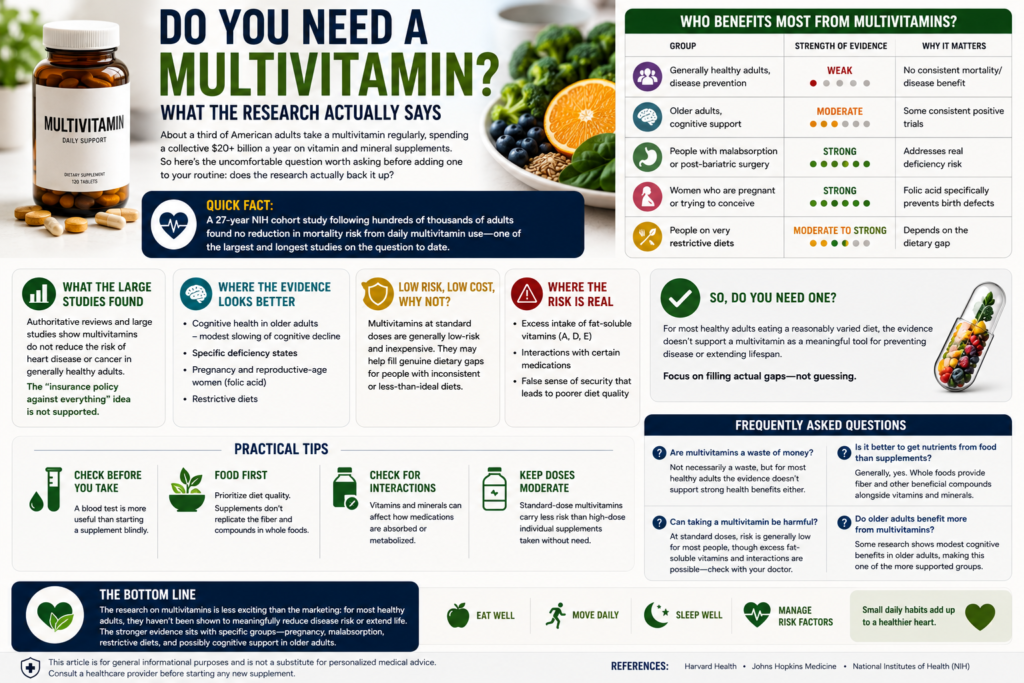
Do you need a multivitamin? About a third of American adults take one regularly, spending a collective $20+ billion a year on vitamin and mineral supplements — so it’s worth asking whether the habit actually holds up.. So here’s the uncomfortable question worth asking before adding one to your routine: does the research actually back it up?
The honest answer is more nuanced than a yes or no — and it depends heavily on who’s asking.
Quick Fact: A 27-year NIH cohort study following hundreds of thousands of adults found no reduction in mortality risk from daily multivitamin use — one of the largest and longest studies on the question to date.
What the Large Studies Actually Found
The U.S. Preventive Services Task Force — an independent panel that reviews preventive health evidence — has concluded there’s insufficient evidence to support multivitamin use for preventing cardiovascular disease or cancer in generally healthy adults. A separate analysis pooling data from roughly 450,000 people found multivitamins didn’t reduce heart disease or cancer risk. For a supplement taken by half of American adults, that’s a strikingly thin evidence base for its most commonly assumed benefits.
This doesn’t mean multivitamins are useless — it means the “insurance policy against everything” framing most marketing leans on isn’t well supported.
Where the Evidence Actually Looks Better
Cognitive health in older adults. Interestingly, this is one area with more consistent positive signal. Multiple studies within the COSMOS research program found multivitamin supplementation modestly slowed cognitive decline in older adults — an effect researchers compared to roughly two years of slower cognitive aging, with the benefit most pronounced in people with a history of cardiovascular disease.
Specific deficiency states. Multivitamins have clearer, well-established value for people with malabsorption conditions, those recovering from bariatric surgery, older adults with reduced nutrient absorption, and people with restrictive diets or chronic alcohol use — situations where an actual nutrient gap exists, rather than general “just in case” use.
Pregnancy and reproductive-age women. This is the clearest, most settled exception. Folic acid specifically has strong evidence for preventing neural tube defects when taken before and during early pregnancy, which is why prenatal vitamins are recommended regardless of diet quality.
Quick Reference: Who Multivitamins Are Better Evidenced For
| Group | Strength of Evidence |
|---|---|
| Generally healthy adults, disease prevention | Weak — no consistent mortality/disease benefit |
| Older adults, cognitive support | Moderate — some consistent positive trials |
| People with malabsorption or post-bariatric surgery | Strong — addresses real deficiency risk |
| Women who are pregnant or trying to conceive | Strong — folic acid specifically |
| People on very restrictive diets | Moderate to strong, depending on the gap |
The Case for “Low Risk, Low Cost, Why Not”
Some researchers land on a middle position: multivitamins at standard doses are generally low-risk and inexpensive, and even without strong mortality data, they may help fill genuine dietary gaps for people whose diets are inconsistent. This isn’t a strong endorsement, but it’s a reasonable argument for why “no clear benefit” hasn’t translated into “clearly avoid them” in most medical guidance.
Where the Risk Actually Shows Up
Multivitamins aren’t risk-free in every context. Potential downsides include excess intake of fat-soluble vitamins (A, D, E) which can accumulate to harmful levels, interactions with certain medications, and — perhaps most underrated — a false sense of nutritional security that leads people to deprioritize actual dietary quality. A pill is not a substitute for the fiber, phytonutrients, and food matrix effects of eating vegetables, whole grains, and fruit directly.
So, Do You Need One?
For most healthy adults eating a reasonably varied diet, the evidence doesn’t support a multivitamin as a meaningful tool for preventing disease or extending lifespan. For specific groups — pregnancy, malabsorption conditions, older age with cognitive concerns, or genuinely restrictive diets — the case is considerably stronger. The honest starting point isn’t “should I take a multivitamin,” but “do I actually have a gap a multivitamin would fill” — which a blood test or a conversation with a doctor can answer far better than guessing.
Practical Tips
- If you’re unsure whether you have a specific deficiency, a blood panel is more useful than starting a supplement blindly.
- Prioritize diet quality first — a multivitamin doesn’t replicate the fiber and compounds found in whole foods.
- Check for interactions if you’re on other medications, since some vitamins and minerals can affect how drugs are absorbed or metabolized.
- If you do take one, standard-dose multivitamins carry less risk than high-dose individual supplements taken without a documented need.
If you’re evaluating specific nutrient needs rather than a general multivitamin, it’s worth reading our guides on the signs of vitamin D deficiency and how much protein you need per day, since targeted gaps are usually more useful to address than a general “cover everything” approach.
Frequently Asked Questions
Are multivitamins a waste of money? Not necessarily a waste, but for most healthy adults the evidence doesn’t support strong health benefits either — the value is more about peace of mind or addressing a specific gap than disease prevention.
Is it better to get nutrients from food than supplements? Generally, yes. Whole foods provide fiber and other beneficial compounds alongside vitamins and minerals that supplements don’t replicate.
Can taking a multivitamin be harmful? At standard doses, risk is generally low for most people, though excess fat-soluble vitamins can accumulate, and interactions with certain medications are possible — worth checking with a doctor if you take other medications regularly.
Do older adults benefit more from multivitamins? Some research suggests modest cognitive benefits in older adults specifically, making this one of the more evidence-supported groups compared to general disease prevention in younger, healthy adults.
The Bottom Line
The research on multivitamins is less exciting than the marketing: for most healthy adults, they haven’t been shown to meaningfully reduce disease risk or extend life. The stronger evidence sits with specific groups — pregnancy, malabsorption, restrictive diets, and possibly cognitive support in older adults. If you’re taking one, know which category you fall into, rather than treating it as a blanket insurance policy.
This article is for general informational purposes and is not a substitute for personalized medical advice. Consult a healthcare provider before starting any new supplement, especially if you take other medications or have an existing health condition.
References
- Harvard Health — Do Multivitamins Make You Healthier?
- Johns Hopkins Medicine — Is There Really Any Benefit to Multivitamins?
- National Institutes of Health (NIH) — Multivitamin and Mortality Research